Andrew Beers had already led engineering teams when he joined Tableau in 2004. His next job was to write code. He was employee number seven, stepping into a company small enough that a technical problem could hardly be somebody else’s department. The move offers a useful introduction to his career: responsibility grew, titles followed, and the attraction kept coming back to the machinery.
Two decades later, after a long stretch at Tableau and a period he describes as semi-retirement, Beers is building again. He is now chief technology officer at Golden Analytics, working with former Tableau product leader François Ajenstat. The software has changed. So has the available computing power. The question underneath the work remains familiar: how much effort should a person have to spend before their data becomes useful?
There is a pleasing stubbornness to that question. A dashboard can look finished while the person using it is only getting started. A chart answers something, then immediately provokes another question. Beers has spent much of his working life on what happens after that first answer.
The attraction was under the hood
His route into Tableau ran through computer science. He earned a bachelor’s degree at the State University of New York at Buffalo and a master’s at Stanford, where he worked in Pat Hanrahan’s computer graphics research group. Hanrahan would become one of Tableau’s three founders, alongside Chris Stolte and Christian Chabot. Beers entered a company whose research roots were connected to his own education, although his role was to help make the resulting software work in practice.
What caught his attention was VizQL, the technology connecting a visual description with a query of the underlying data. An early look at Tableau Desktop appealed to someone who had used older analysis systems. Seeing the mechanism behind it sharpened that interest. His recollection ends with a short declaration: “VizQL was a technology that I had to get my hands on.”
That is an unusually tactile way to describe a query language. It also helps explain the move back into a developer’s job. An executive title provides distance and authority; writing software provides immediate contact with the thing being made. Beers’s Tableau work included rendering systems, styling languages and server products. These are the parts that users depend on without necessarily having any reason to name them.
at Tableau
as a developer
at Golden Analytics
A promotion measured in other people’s work
By 2010, he was Tableau’s vice president of product development. In 2016 he became chief development officer. The company’s filings give that progression a sober documentary outline: a succession of larger responsibilities within the same business, beginning in October 2004. In 2018 he took the CTO role, with a remit covering the longer view of technology and emerging areas such as machine learning.
Those titles chart a change in the unit of work. A developer can point to a piece of functioning code. A development leader has to help other people produce it, across products and priorities. A CTO also has to decide which ideas deserve attention before customers have started asking for them by name. The result is harder to display in a neat before-and-after screenshot.
At Tableau Conference in 2019, Beers welcomed the audience to Devs on Stage. The format put the people making the software in front of the people using it. Developers demonstrated such changes as animations and dynamic parameters. An enterprise software roadmap can be a solemn object. Here it became something an audience could watch, question and imagine putting to work.
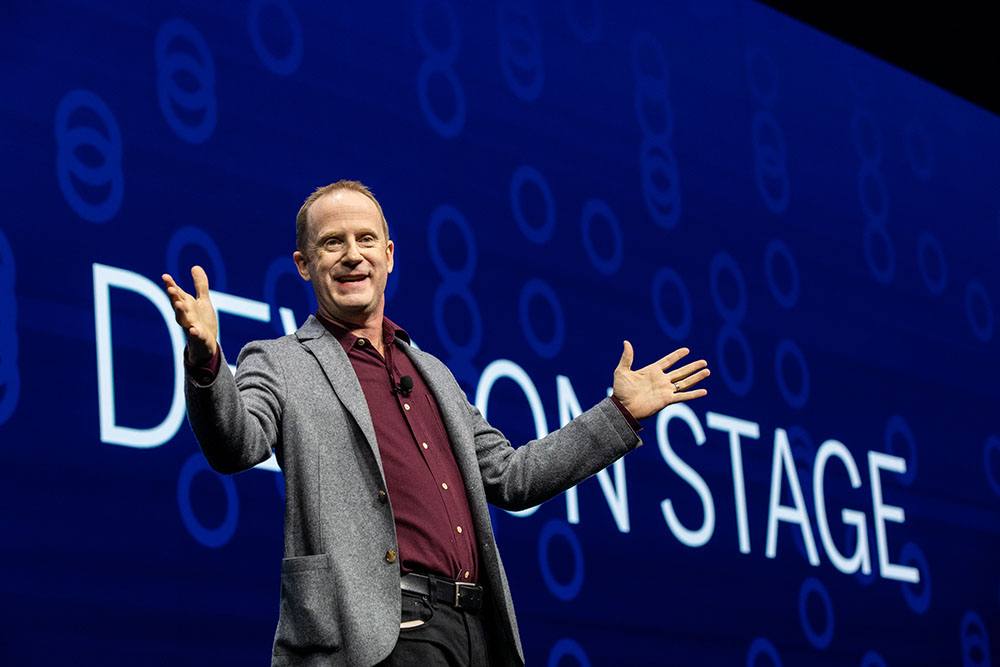
The photograph catches him with his arms spread, the event’s name filling the screen behind him. The setting suits a career spent between engineering and explanation. Someone has to make a feature reliable. Someone also has to show why a person with a perfectly adequate old routine might bother to use it.
The chart was allowed to have a joke
There is another, smaller glimpse of his relationship with that audience. In 2012, Tableau collected contributions to its #StuffDataGeeksSay campaign. Among the entries was a line from Beers’s @acbeers account: “A non-interactive chart. How... cute.”
The joke is a miniature product argument. A static picture allows its author to decide which question gets answered. An interactive view gives the reader a chance to interfere. For someone building analytical software, that interference is rather the point. The user can change the view, notice a pattern, decide the first question was poorly framed and try again.
“A non-interactive chart. How... cute.”
Andrew Beers · #StuffDataGeeksSay, 2012
It is also a useful antidote to the vocabulary that gathers around business intelligence. Governance, architecture and deployment all matter, but they do not explain why somebody enjoys finding something in a dataset. A small joke about a chart gets closer to the everyday pleasure of being able to poke at an answer.
Begin with the decision
When Beers discussed data culture in a 2021 interview, his starting point was the outcome an organisation wanted. Work backwards from that, he argued, to identify the information required. Having a great deal of data does little good if it cannot answer the question at hand. The advice is practical enough to sound obvious, which has never prevented organisations from doing the opposite.
He also placed responsibility with leadership. The CIO could establish standards, protect information and provide tools, while helping make analytical thinking part of decisions across departments. Usability belonged in that discussion too. Employees accustomed to straightforward consumer technology would reasonably find awkward workplace software frustrating.
Read together, these arguments describe a particular difficulty for the engineer: the work continues beyond a correct calculation. People need to know which data they are using, what question it can support and how to ask the next one. A beautifully maintained repository can still leave the meeting undecided. The practical test happens when someone has enough confidence to act.
- 01Choose the
outcome - 02Find the
right data - 03Explore and
ask again - 04Make the
decision
The person still gets a say
Beers was writing about responsible AI in 2018, well before the current wave of conversational tools. His concerns included transparency, biased inputs and the limits of what an algorithm can understand. Making an algorithm available for inspection would not, by itself, make its operation comprehensible to a customer. People needed an explanation they could actually use.
He also argued for diverse perspectives among the people building these systems and for human evaluation of whether a result solved the intended problem. That last requirement survives every improvement in the machinery. A system can complete the task it was given while leaving the important question untouched. Somebody has to notice.
By March 2021, he was explaining Tableau Business Science, which brought predictive techniques to business users. He described a balance between precision, speed and the knowledge people bring from their own work. Users could influence input data, variables and thresholds, or choose more automation. It was an attempt to make sophisticated methods accessible while preserving a place for judgment.
In his writing on consent that same month, Beers turned attention to an earlier decision: what information should an organisation collect in the first place? Securing data was one responsibility; considering its purpose and potential misuse was another. These are questions that have to be settled by people, even when collecting and processing the information becomes easier.
A coffee-shop demo, and another beginning
Beers left Tableau in 2022. His later explanation for returning to work was specific: the appeal of the team and the product, along with the chance to build with modern tools. Golden Analytics gave him that combination. Ajenstat, its founder and CEO, had spent more than thirteen years leading product work at Tableau. Their new company brought familiar colleagues back to a problem they knew from several directions.
One of those colleagues, Ron Theis, described receiving a Golden demonstration from Beers in a Green Lake coffee shop. Ten days later, Theis was working in Golden’s office. It is a small hiring story with a concrete sequence: see the software, find the prospect compelling, join the work. Even experienced people can still be recruited by a demonstration.
Golden emerged publicly in April 2026 with a $7 million seed round co-led by Madrona and NEA. Its proposed “slider of autonomy” lets users choose how much work to hand to AI. That makes control part of the product’s design. The ambition extends across finding, preparing, analysing and communicating data, the several jobs that can sit behind one apparently simple chart.
In July, Beers joined Ajenstat and former Tableau CEO Mark Nelson for an AI House discussion in Seattle. The advertised subject was the iceberg beneath an impressive prototype: security, performance, scalability and governance. Beers had taken on an early developer role more than twenty years before. Here he was discussing the less visible work of making another new product dependable.
The symmetry is appealing, but the outcome remains open. Golden still has to earn the everyday use its team wants. Beers’s return gives the story a fresh beginning rather than a victory lap. The interesting part is what he chose to return for: colleagues, a product and another chance to shorten the distance between a person’s question and an answer they can use.
Follow the next question
Writing, conversations and places to keep reading.