A restaurant can calculate a waiter’s tips to the penny and still leave the waiter waiting for payday. That gap, between knowing what somebody earned and putting it in their hands, is where a software problem becomes a banking problem. TipHaus had already built the calculation engine. To finish the job, it needed a bank, accounts, cards, and a dependable way to move money.
- Synctera connects financial products to bank partners and banking infrastructure.
- Its ledger and console keep money movement visible to operators and banks.
- Buying Cable added automated checks on whether compliance controls work.
A tip is a promise until it lands
Working with Synctera, TipHaus built two routes: hausmoney, an account and debit card for workers, and hausdirect, which sends earnings through a worker’s existing debit card. The distinction matters. One person wants a new account; another simply wants the tips to arrive. The same restaurant workflow can serve both.
TipHaus chief operating officer Kirk Grogan called Synctera “a Rosetta Stone for us.” His difficulty had included finding a bank that felt like a partner. The software supplied a way to build; the relationship supplied a way to operate. Embedded finance sounds rather less mysterious when somebody is waiting to buy groceries.
Synctera sells that combination to fintech founders, established businesses adding financial services, and sponsor banks. Its customers include financial guidance company Fruitful, student-focused Firstcard, and e-commerce banking business Ruby. Their audiences differ. Each needs financial machinery underneath a product customers recognize.
The bank gets a seat at the screen
Founded in 2020 by Peter Hazlehurst, Kris Hansen, and Dominik Weisserth, Synctera brought together experience on both sides of banking technology. Hazlehurst had led Uber Money and Google Wallet. Hansen had worked inside banks and at challenger bank KOHO. They understood why an attractive interface could conceal a difficult institutional relationship.
The platform supplies APIs for accounts, cards, onboarding, and payments. Its ledger records financial activity. Its console lets people investigate transactions, manage cases, and collaborate with the bank. Reconciliation compares the ledger with bank balances and payment records. If those records disagree, a polished home screen will be very little consolation.
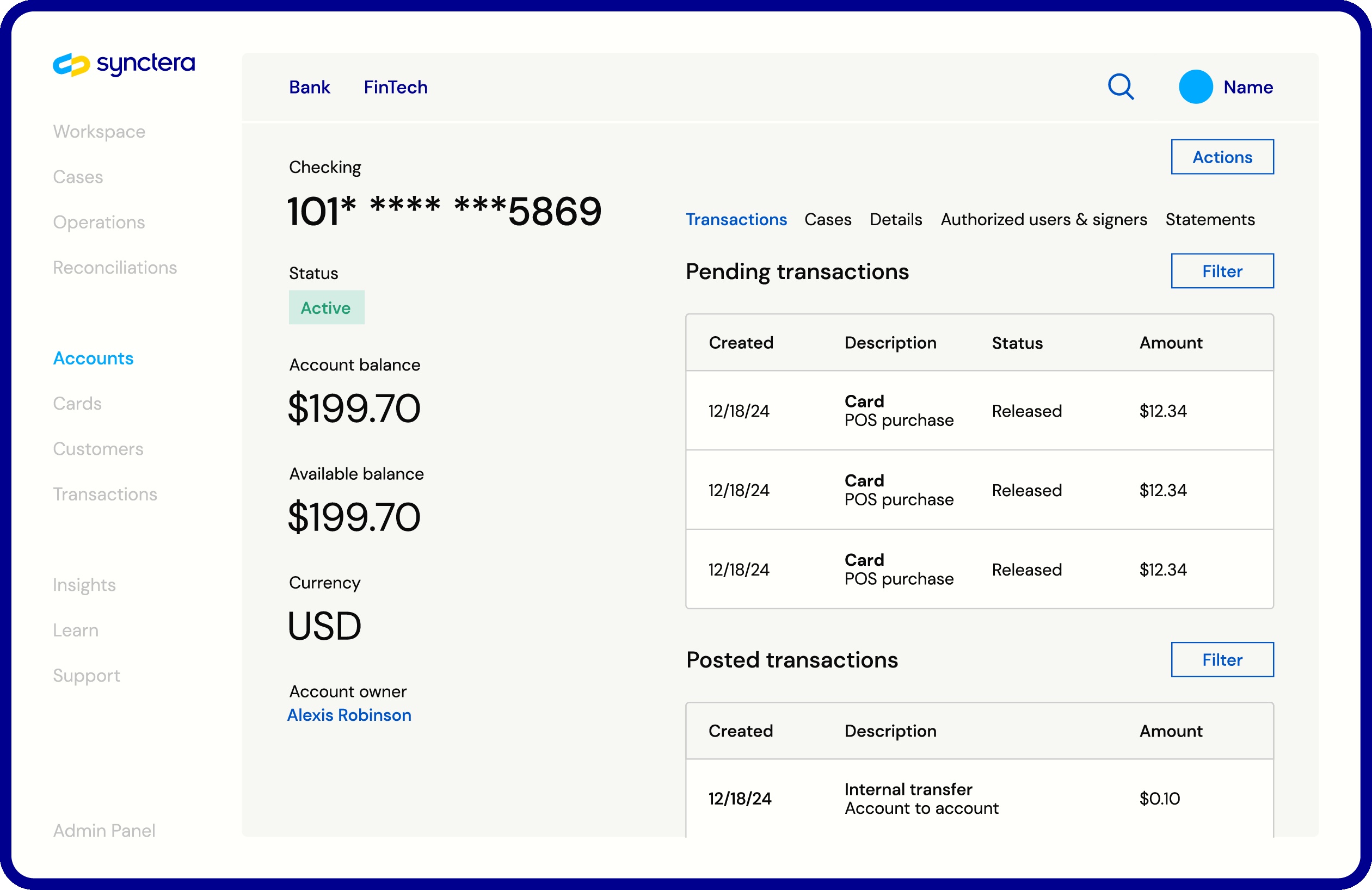
Banking services come from partner banks. Synctera supplies technology and operating infrastructure. That division makes bank selection consequential: the institution has to accept the proposed customers, activities, and risk. A developer can integrate an endpoint sooner than a bank can become comfortable with a business it does not understand.
Shared records. Ongoing collaboration.
Unit and Treasury Prime occupy overlapping territory. Synctera’s case rests on how its pieces work together: bank relationships, financial records, operational workflows, and compliance support. Buyers should compare that whole arrangement. Counting available APIs tells them less about who will resolve a disputed transaction on a difficult Tuesday.
Checking the checker
The founders initially considered a narrower risk and compliance product. In his six-year anniversary essay, Hazlehurst said that idea looked too small for venture-scale growth. They expanded the ambition into a banking platform. In April 2026, acquiring Cable brought a particular kind of scrutiny into that broader business.
Cable tests whether compliance controls actually function. A workflow can say it verifies customers; testing asks whether the expected checks happened. A monitoring rule can exist in a policy document; testing asks whether it produces the intended result. Synctera said Cable would remain available independently. The acquisition price was undisclosed.
Operating a control and proving it works are two different jobs.THE LOGIC OF THE CABLE ACQUISITION
There have been costs along the way. Synctera confirmed restructuring and staff cuts in March 2024. In March 2025, it announced $15 million in financing and named Bolt its largest signed customer to date. Those announcements describe investment and commercial progress; neither establishes profitability.
Another change arrived in September 2026. Synctera announced that its T-10 subsidiary had completed FinCEN money services business registration, adding direct compliance obligations for applicable activities. That registration does not make Synctera a bank. It does make the question of who takes responsibility more concrete.
The price of a smaller experiment
The proposed Synctera Labs program makes the entry costs unusually legible. Published terms list a $60,000 annual platform fee, prepaid, and a $10,000 fraud-loss reserve, plus usage charges. First programs are expected in February 2027. This is a planned route to testing with real customers and money, with a waitlist today.
Plus metered usage. Reserve is a funding requirement, not a platform fee. First launches expected February 2027.
The tradeoff is explicit: Labs customers keep about half of interchange, subject to terms, while regular programs start at 70%. Standard ACH origination is listed at $0.35 versus $0.20 for a regular program. Lower fixed commitments come with higher unit costs. Volume changes which deal looks attractive.
Labs also limits the experiment to a standard configuration for U.S. customers aged 18 and over, with caps of 100 business customers or 1,000 consumers. A founder needing a different geography, more customization, or greater scale has to consider another configuration. The package helps define an experiment; it cannot make every business fit.
Borrow the sequence, not the app
Ruby’s customer story offers a useful detail: live testing revealed edge cases its team said a sandbox would have missed. Real money introduces behavior that a demonstration cannot fully rehearse. Its team also met the sponsor bank weekly. The relationship continued after the integration.
That is the practical lesson to copy. Start with an existing customer’s money problem. Choose a bank relationship that can support the intended product. Test the movement of funds, including the awkward cases, and budget for operating it afterward. Synctera can supply infrastructure and expertise. The customer still needs a reason to use what gets built.
Follow the money
Explore the platform, meet the builders, and hear the acquisition conversation.