Insurance begins with a future tense. A policy says what will happen if. A claim arrives in the past tense, carrying documents, damage and two or more versions of events. Suzanne Robinson has spent much of her career at that grammatical border. She started as a litigator, moved into claims, passed through legal and compliance leadership, and eventually reached the chief executive's office. Along the way, she learned the peculiar discipline of promises examined after reality has had its say.
On January 6, 2025, Robinson became president and CEO of Minnesota Lawyers Mutual Insurance Company. The Minneapolis company is owned by its policyholders and specializes in professional liability insurance for attorneys. In other words, its customers are unusually qualified to read the fine print and professionally trained to argue about it. There are easier audiences before whom to sell certainty.
Robinson arrived with an apt résumé. She had worked in private legal practice, handled professional-liability claims, overseen legal and compliance functions for insurance companies, advised data and technology businesses, and led claims at an insurtech serving startups. Her route was not a sprint along a single corporate corridor. It was a tour of the rooms where risk changes its clothes.
The education of a careful reader
Before law school, Robinson studied comparative literature at Hamilton College. The pairing is almost too neat. Literature asks how narratives are built; litigation asks which narrative survives evidence. Insurance adds a third question: which version does the contract cover?
She earned her law degree from the University of Virginia School of Law, studying there from 1991 to 1994, and began her career that year in Chicago private practice. Her early work included a role as a litigation associate at DLA Piper. Four years later, she entered insurance. The move took her from arguing cases to understanding the machinery behind them - reserves, policy language, professional duties, negotiation and the expensive distance between what a client expected and what an insurer promised.
A career measured in versions of risk
At Travelers, from 1998 to 2011, Robinson managed financial-institution and professional-liability claims. Claims work is an education conducted by counterexample. Every file contains some assumption that failed: a deadline missed, advice misunderstood, controls circumvented, judgment challenged. The job rewards neither panic nor poetry. It asks for a record, a reading and a decision.
That experience gave Robinson a view of insurance from the moment the product becomes consequential. Sales can describe a promise. Underwriting can price it. Claims must decide how it behaves under pressure. It is quiet executive training because it forces a leader to reconcile empathy, contract language, money and precedent without pretending they always agree.
“I could not be happier to take on this new challenge. Let's go!!”Suzanne Robinson, on accepting the CEO role
A lawyer inside the operating machinery
In 2011, Robinson moved to Ameriprise Financial as vice president and group counsel. There she oversaw legal and compliance functions for life and health and property and casualty insurance companies. The role widened the aperture. A claims leader studies what has happened. A general counsel must also worry about what the company is doing now, what regulators may think later and how quickly today's sensible shortcut can become tomorrow's exhibit.
Her next chapter brought her closer to technology. Beginning in 2017, she worked as associate general counsel at Solera, supporting businesses in insurance technology and driver data, including Explore Information Services. Data promises clarity, while law specializes in conditions. Businesses collecting and interpreting sensitive information live between those impulses.
Robinson also founded the Women's Business and Development Group at Explore, focused on leadership, networking, diversity and inclusion. It is a revealing piece of institution-building in a career otherwise described through claims and counsel. Professional networks do not appear spontaneously. Someone books the room, invites the people and decides the conversation ought to exist.
When the new risks arrived
In June 2023, Robinson joined Vouch Insurance as head of claims. Vouch sells coverage to startups and emerging technology companies, businesses whose products can evolve faster than the vocabulary used to insure them. The setting changed from large financial institutions and data providers to founders thinking in product launches and funding rounds. The claims question remained stubbornly practical: when novelty causes an old-fashioned lawsuit, what happens next?
Robinson became one of four presenters in Vouch's public session on lawsuits affecting AI startups. The discussion addressed the AI risk landscape, coverage details and questions from the audience. Her fellow presenters came from company leadership, product insurance innovation and corporate law. The lineup itself told the story. Emerging risk is not a single department's puzzle. It requires the salesperson's ear, the product builder's imagination, the lawyer's caution and the claims leader's memory.
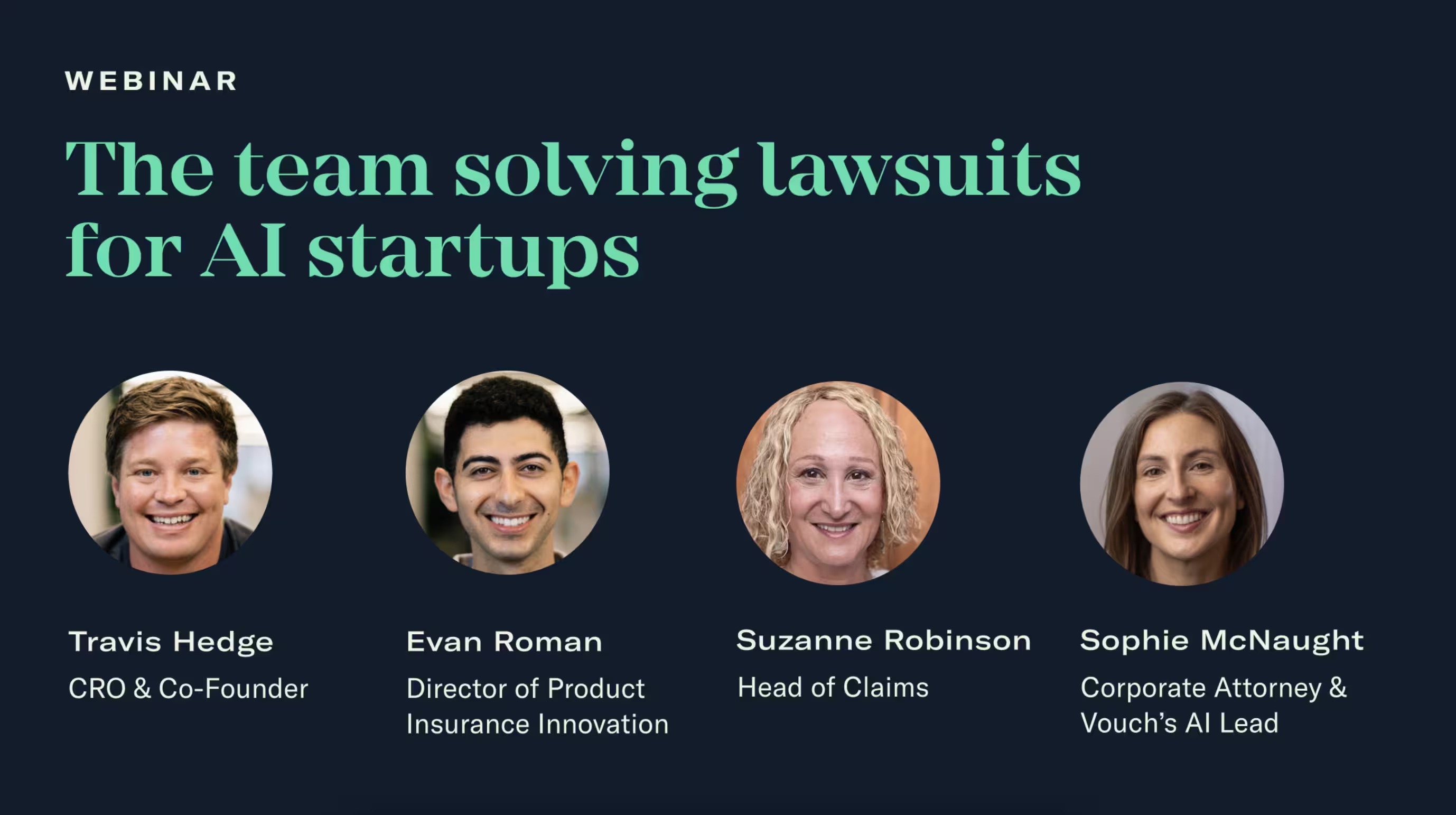
When Vouch launched its AI insurance offering, Robinson wrote that it reflected the team's understanding of regulatory and intellectual-property challenges confronting AI companies. Her enthusiasm was public, but the claims perspective supplied the ballast. Every fashionable risk eventually becomes an unfashionable task: reading allegations, testing coverage and deciding what can be defended.
The mutual at the other end of the spectrum
Minnesota Lawyers Mutual occupies a different corner of insurance culture. Founded to serve lawyers, it is a mutual company, which means policyholders rather than outside shareholders own it. The structure does not abolish commercial pressure. It changes whom the institution is designed to answer to.
Robinson succeeded Paul Ablan after his decade as CEO. During that period, the company reported that assets grew from $160 million to $275 million, capital and surplus rose from $77 million to $167 million, and its AM Best rating improved from A- to A. Ablan remained involved as a director. Robinson therefore did not inherit a dramatic rescue. She inherited the more delicate assignment of following a successful tenure without confusing motion for progress.
Her public language acknowledged the terms of that assignment. She said she was honored to join, wanted to build on the company's legacy, and looked forward to continuing its customer-service and risk-management work for the legal community. There was no reinvention slogan. The livelier version appeared on LinkedIn: “I could not be happier to take on this new challenge. Let's go!!” The contrast is appealing - fiduciary restraint in the announcement, two exclamation points in the doorway.
By 2025, Robinson had also been recognized in the National Association of Mutual Insurance Companies' Mutual Insurance Director program. She spoke for MLM about a professional-liability partnership serving defense firms, and later welcomed Harold Goldner as board chair, praising his understanding of both the practice and business of law as well as his collaborative spirit. Her emphasis landed on partnership rather than personality.
“MLM has a strong reputation for delivering unmatched customer service and risk management solutions to the legal community.”Suzanne Robinson, on joining Minnesota Lawyers Mutual
What the claims room teaches the corner office
Executive biographies often smooth a career into inevitability. Robinson's path is more useful when left slightly jagged. Litigation taught adversarial facts. Claims added contractual consequences. Ameriprise supplied regulated operations. Solera brought data and technology. Vouch brought emerging companies and emerging exposures. Minnesota Lawyers Mutual now gathers those lessons inside an institution with a long memory.
The through line is translation. A claims professional translates harm into coverage questions. A general counsel translates regulation into operations. An insurtech executive translates unfamiliar risks into products that can be sold and honored. A mutual-insurance CEO must translate between board, employees and policyholder-owners without losing the meaning of the promise in transit.
This kind of leadership is less cinematic than disruption. It has fewer hoodies and more defined terms. Yet it matters precisely because insurance sells confidence in advance and earns trust later. The customer remembers the premium once a year. The customer remembers the claim rather longer.
Robinson has described her ambition plainly: build on an established legacy and drive continued success. Her career suggests how she may define that work. Keep the contract connected to the customer. Treat technological novelty as something to understand, neither to worship nor fear. And when a complicated file arrives, begin with the facts.
There is also a useful modesty in the sequence. Robinson did not leave litigation and announce herself as a visionary of risk. She spent years close to claims, then years close to regulation, then years close to technology. The authority came after the accumulation. In a business fond of predicting the future, she advanced by studying outcomes. That distinction may matter at a mutual company, where continuity is not corporate wallpaper but part of the bargain. Policyholders expect the organization to be adventurous enough to understand new exposures and conservative enough to be present when those exposures mature. Robinson has already worked on both sides of that sentence.
The Robinson principle
Promises sound grandest before they are tested. Leadership becomes visible afterward - in the reading, the judgment and the decision to stand behind what the institution said.