The plain line in Travis Hedge's story is also unfashionable. He wanted to sell insurance. As a third grader in Columbus, while classmates were trying on the usual heroic occupations, Hedge could already picture the family trade. His parents ran an agency. Business problems and customer problems followed them home, where the dinner table became an unofficial branch office. Insurance was less an industry than weather: ever present, occasionally severe, and discussed whether anyone had asked about it or not.
He resisted destiny just enough to make it useful. After graduating from Ohio State with a double major in finance and operations, Hedge joined Nationwide. He arrived with the confidence of a young employee who had discovered an idea no institution could possibly have considered before: the insurer should invest in startups. He pitched roughly 30 senior leaders. Twenty-nine gave him some version of a fond smile.
The 30th was David Verbance, a private equity leader who had been looking for someone to help make the same case. Together they won support from Nationwide's chief investment officer and began placing money with venture funds. One commitment went to a fund at SVB Capital. After the meeting, Verbance encouraged Hedge to apply for an opening there. Hedge likes to summarize such turns with a line that leaves little room for vanity: “It's better to be lucky than good.”
The investor becomes the insurance person
SVB Capital hired Hedge to analyze investments, not source them. He asked to source anyway. An old Nationwide colleague, Alex Timm, was raising money for Root Insurance, and Hedge's family background suddenly became an advantage inside venture capital. He understood the awkward overlap between regulated finance and impatient technology. Soon he was the insurance person in the room, working across fintech and digital health and helping raise more than $1 billion from institutional investors.
There he could see a peculiar mismatch. Startups were rewriting transportation, banking, health technology, and work itself. Their commercial insurance arrived through forms and categories designed for companies that behaved more politely. A coverage gap could delay a contract or a financing round. The risk was modern; the ritual around it had the scent of a filing cabinet.
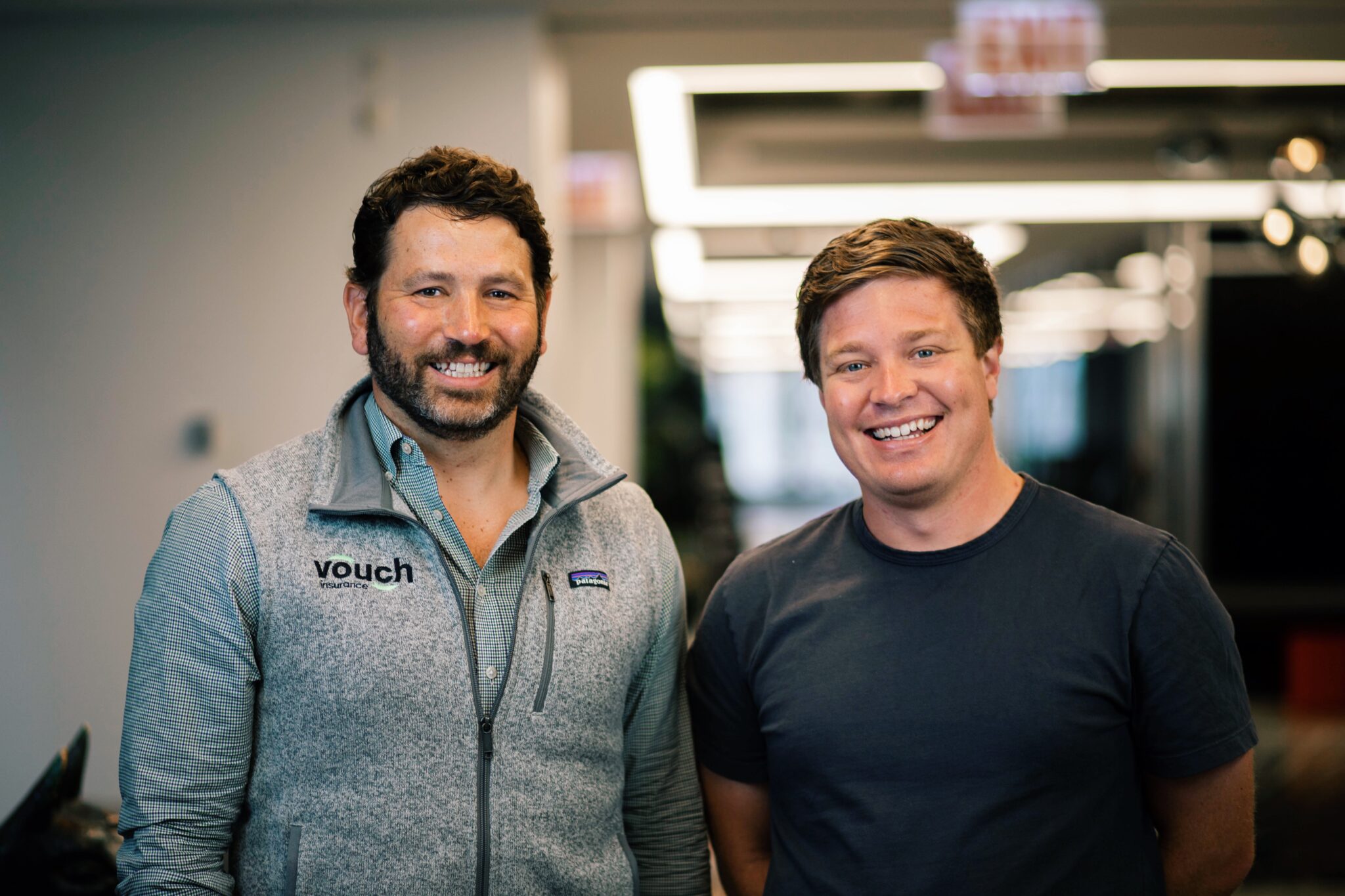
Ribbit Capital's Nick Shalek connected Hedge with Sam Hodges, the former head of Funding Circle's American business. They founded Vouch in August 2018 and gave themselves one year to ship. Their division of labor on launch day captured the company nicely. Sam was presenting at Y Combinator's Demo Day. Travis was in Utah, the first launch state, selling policies in person. TaxBit trusted them with the first one, even though Vouch's website still hid behind a password and announced “stealth mode” to anyone who found it.
A thesis with its own balance sheet
Vouch did not merely put a friendlier screen on an old brokerage. Hedge and Hodges believed the company needed control over the product itself. Carrier systems were only beginning to support instant digital quotes. Underwriters had little appetite for crypto, digital health, or other unfamiliar startup risks. Large insurers tended to notice markets only after the premiums became large enough to disturb the furniture.
So Vouch built underwriting capability, became an authorized carrier, and started taking risk on its own balance sheet in 2021. It wrote policies for categories that incumbents found difficult to classify. The architecture was expensive and highly regulated, but it let the company decide what deserved coverage. Hedge argued for the carrier model with the vigor of a person who had spent his childhood overhearing exactly why insurance products fail customers.
“The key advantage you have as a startup is to move faster.”Travis Hedge
Meanwhile, Vouch also operated a brokerage. That side was lighter, faster, and increasingly capable. The conditions supporting the carrier thesis began to move. Capital grew expensive. Established carriers improved their APIs and became more willing to insure emerging industries. Vouch had substantial cash reserved against potential claims at the same moment generative AI suggested that a brokerage could process information in radically different ways.
Why the original answer changed
Directional view of the forces Hedge says changed between Vouch's launch and its decision to sell the carrier.
Founders are rewarded for conviction until conviction becomes an alibi. Hedge had to separate the customer problem, which remained, from the corporate structure chosen to solve it, which did not have to. His verdict on the old certainty is admirably short: “I was wrong about that.”
Selling the machinery, keeping the promise
In August 2025, Hiscox announced that it would acquire Corix, Vouch's underwriting arm, and Vouch Insurance Company. The carrier portion closed in April 2026. Vouch remained independent as a broker and entered a multi-year distribution arrangement with Hiscox. The transaction released capital, narrowed the company's focus, and left the buyer with technology it could use in its own American operation.
There is a tidy version of this tale in which the sale proves that the carrier was always a temporary bridge. Hedge does not offer it. The carrier was the right instrument when existing insurers could not move quickly enough. Later, it was consuming resources that could be directed toward the brokerage. Pride, he observed, does not build a good business. This is a more interesting species of consistency: loyalty to the problem rather than to one's first solution.
The human half of an AI brokerage
Hedge's current ambition is bracingly numerical. He wants Vouch to multiply its book of business by five over five years while keeping headcount close to flat. Software will collect information, reduce repetitive document work, and help match risks with more than 100 carriers. An insurance executive can now use the phrase “AI-enabled brokerage” without causing everyone at the table to inspect the carpet.
Yet one lesson from Nationwide has survived every strategic turn. Its customer research suggested that roughly half of buyers wanted to speak with a human agent, regardless of how easy self-service became. Hedge assumed founders would be different. They were not. Even technically fluent customers want another person to explain exclusions, weigh tradeoffs, and answer for the recommendation when a claim is no longer theoretical.
His version of automation therefore gives the broker more time to behave like an advisor. This distinction matters. A machine can rescue a general counsel from copying the same facts into several PDFs. It cannot make trust an unnecessary expense. The useful outcome pairs an industrious server with an expert who arrives at the conversation already informed.
“Investors invest in lines, not dots.”Travis Hedge
Hedge applies the same logic to relationships. He spent years discussing insurance ideas with investors before Vouch existed. He hosts small founder dinners and has argued that early sales cannot be outsourced to a partnership logo. The first 20 customers teach a founder what the pitch leaves out. His own sales culture permits some theatre: after the Vouch team beat an already ambitious target, he honored a wager and got a mohawk. Few compensation plans include barbering, though perhaps more should.
El Jefe comes home
For nearly eight years, Hedge served as chief revenue officer while Sam Hodges was CEO. At Camp Vouch, the company's annual gathering in Austin, Sam marked a succession with suitable economy. He removed his cowboy hat, placed it on Travis's head, and handed him a belt buckle stamped “El Jefe.” In May 2026, Hedge became chief executive and Hodges moved to executive chairman.
The new CEO runs a San Francisco-headquartered company from Columbus, where he and his wife are raising two children near their families. He moves among Vouch's hubs in San Francisco, New York, Chicago, and Columbus. The conversations change with the city. On the West Coast, founders debate AI and humanity. Elsewhere, he hears more about applied technology inside profitable, capital-efficient companies. Hedge values the split view. Futures are easier to judge when one foot is planted somewhere that must make payroll.
Insurance has always sold confidence about events no one can schedule. Hedge's career has been a series of wagers on what institutions will need next: a venture arm inside an insurer, specialist capital for regulated startups, a carrier for companies the old categories missed, and now a brokerage where artificial intelligence makes room for more human judgment. The charming twist is that the child who wanted the family business eventually got it. He simply had to travel through venture capital, Silicon Valley, and a carrier sale to discover its next shape.