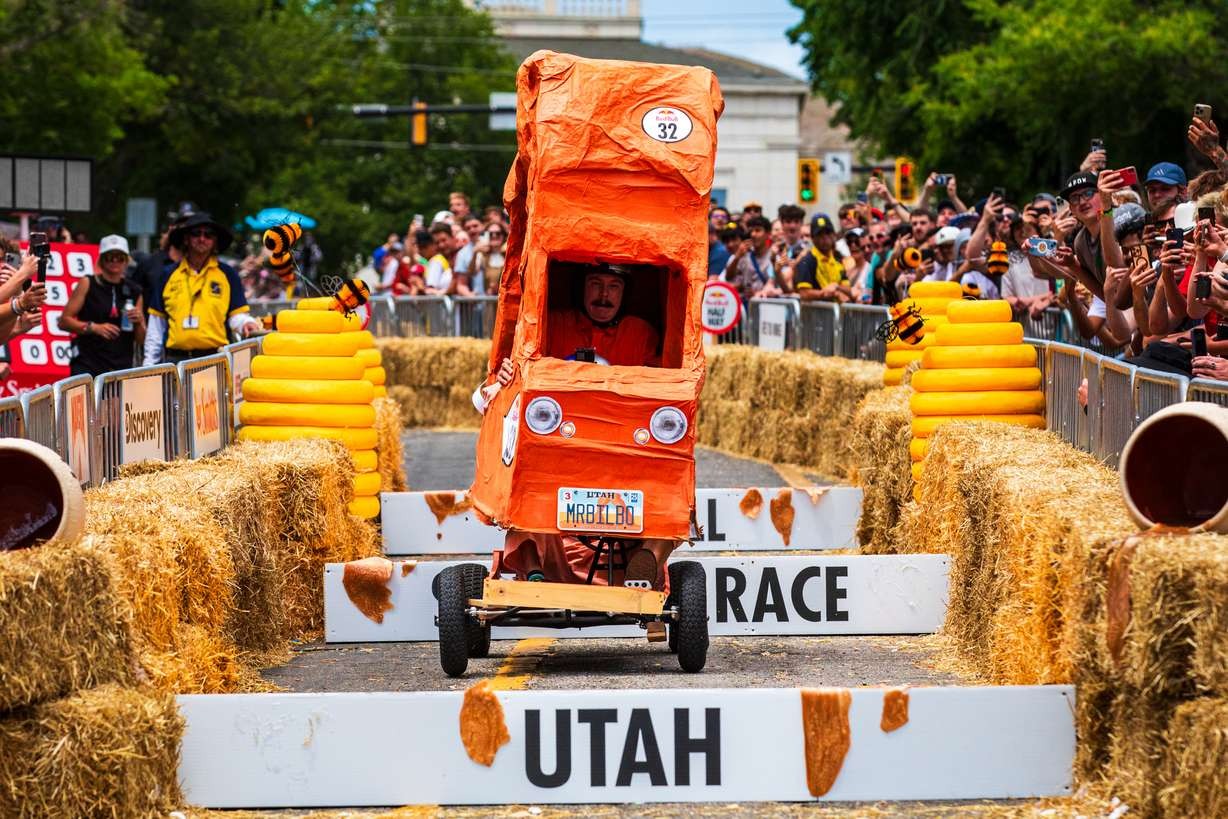
The orange arch had the dimensions of a monument and the constitution of a school play. It stood roughly six feet tall, made from papier-mâché and tape, balanced on a go-kart chassis in a Utah garage. Gideon Dushku wore orange. His brother Isaac wore orange. The object was meant to resemble Delicate Arch, the sandstone landmark stamped onto Utah license plates, and to survive a downhill soapbox race beside the state Capitol. These were separate ambitions.
Dushku was assigned the push. Isaac, the older brother and, by Gideon’s account, the artistic mastermind, would drive. Before the race, Gideon offered a declaration with the rhythm of an oath and the caution of a dare: “We ride for family. We ride for Utah, we ride for the Delicate Arch, and we ride for life or death.” He also admitted the cart was homemade and “probably not super safe,” but said he believed it would reach the bottom.
It did. The arch partly broke away during the run, obliging Isaac to hold the orange structure together while steering. Around 50,000 people had come to watch an afternoon devoted to gravity, showmanship and the practical limits of adhesive. The cart’s structural argument weakened in public. Its emotional argument held.
Before risk had a policy number
A year later, Dushku’s professional subject is risk of a more regulated kind. He works in a founding go-to-market role at Corgi, the San Francisco insurance company building coverage for technology businesses. From Salt Lake City, he talks with founders about commercial policies, the contracts that require them, and the operational hazards that arrive as a young company grows. His public profile also lists a Utah property and casualty insurance license issued in June 2026.
The jump from fantasy maps to insurance looks abrupt only if one mistakes the product for the work. Dushku spent the preceding years at Lord of Maps, the small Utah business run by Isaac. Its wares turn real places into imagined realms: hand-drawn states, countries and mountains rendered with the visual grammar of quests. Dushku has described those years in plain commercial verbs. They moved product. They told stories. They helped build something people cared about.
One product made the family method especially literal. The Highpoints: The Tallest Point in Each State, credited to brothers Isaac, Gideon and Alexander Dushku, is a 10-inch-square board book with windows cut into its 22 thick pages. The smallest state highpoints sit nearest the reader. Taller summits accumulate behind them until Denali rises at the back. Fifty elevations that would normally live in a table become a landscape you can hold.
Lord of Maps gives each brother a mock-feudal introduction. Gideon is “of the Centerville Kingdom,” the obedient younger brother summoned to write. His capsule biography notes a long moustache, a skateboard and the appearance of someone recently returned from the Dark Ages. It is a better description of the company’s sensibility than a solemn corporate history could manage. The shop sells geography, but its durable material is delight.
The map underneath the résumé
Dushku attended Brigham Young University from 2018 to 2024. His early work, as publicly listed, included landscaping, enrollment counseling at BYU-Pathway Worldwide, sales at Lord of Maps, then marketing assistance and product development there. It is a résumé assembled close to the customer: make, explain, sell, repeat. No single title announces a theory. The sequence supplies one.
At Corgi, the object on offer is harder to see. Insurance is a promise about an event everyone hopes will remain hypothetical. It becomes urgent at inconvenient moments: when an investor wants directors and officers coverage before a financing closes, when a larger customer asks for proof of insurance, or when a company’s product creates an unfamiliar category of exposure. The customer is not shopping for framed beauty. The customer wants uncertainty translated before Friday.
Corgi presents itself as a full-stack, AI-native carrier for startups, bringing underwriting, policy operations and claims into one system. Its standard packages expand with a company’s stage, from general liability, cyber, technology errors and omissions, and D&O at the early end to employment, media and fiduciary coverage as the organization grows. The point is speed and fit. Dushku’s job lives where that system meets a founder with a deadline.
Twenty-seven seconds, give or take
When Dushku announced his move, he asked readers for 27 seconds. He wrote that he had been selective about where to work because the years with his brother set a high bar. His initial theory of Corgi was comic and economical: insurance was boring; corgis were cute and fluffy. Two weeks into the job, the theory had acquired people. He had spoken with more founders than in the rest of his life combined.
What caught him was the speed of their judgment. “Founders don’t avoid risk. They price it fast,” he wrote. “They don’t sit on decisions. They compress time.” The observation contains the beginning of a salesperson’s education. Buyers under pressure have little patience for a performance that does not alter their situation. Usefulness is the admission ticket. Personality helps them remember who brought it.
Dushku does not hide the learning curve. “I’m learning faster than I ever have,” he wrote, describing an education in sales and in how companies operate under pressure. He promised to share the sharpest lessons he encountered. Then, because earnest professional posts can become their own insurance against being interesting, he appended a riddle and restricted acceptable responses to dog-related answers.
That combination of candor and mischief appears repeatedly. When Corgi announced a $160 million Series B at a $1.3 billion valuation in May 2026, weeks after he joined, Dushku celebrated the newly minted unicorn with dragons, monsters and tooth fairies. The company followed later that month with a $106 million Series B1 at a $2.6 billion valuation. Those are Corgi’s milestones, not his. His more telling update was that he had helped a founder consider coverage for bodily harm involving AI machines. The abstract future had once again arrived as a practical question.
A visible way into invisible work
Maps and policies begin with the same uncomfortable fact: the territory is larger than the page. A good map chooses what matters and makes the traveler feel oriented. A useful insurance conversation does something similar with exposure. It identifies the cliffs, marks a route, and avoids confusing detail for guidance.
Dushku is still near the start of that second craft. That is part of what makes his public account credible. He has not rewritten the past to make startup insurance seem inevitable. The connective tissue remains visible: the family shop, the product stories, the board book, the orange jumpsuit, the hill. Each episode asked how to turn an idea into something a stranger could grasp quickly.
There is also a family rhythm beneath the individual résumé. Isaac drew and directed the maps. Alexander, introduced by the shop as the brother who brought logic and reason, joined the book. Gideon moved between sales, marketing and product development. Their author notes tease one another, but the finished object required a serious division of labor: illustration, research, writing, layout, production and the uncertain work of persuading people to buy a category of book they had not seen before. Sibling comedy became an operating system.
That background explains why Dushku’s stated ambition at Corgi is modest in wording and large in practice. He wants to keep noticing the sharpest things founders teach him and share the ones that change how people operate. It is the aspiration of an observer before it is the posture of an expert. The distinction matters. Insurance is crowded with specialized language and inherited procedure. A newcomer’s advantage, when paired with a license and the discipline to listen, is remembering which parts remain baffling to everyone else.
At the soapbox race, a literal arch had to make it downhill. At Lord of Maps, a mountain system had to fit between covers. At Corgi, risk must fit inside a founder’s crowded field of view. The forms become less tangible as the stakes grow more serious. Dushku’s answer, so far, is to keep the language concrete, the pace brisk and the occasional riddle close at hand.
The orange arch did not finish in its original condition. Few worthwhile prototypes do. It reached the bottom as evidence that enthusiasm can survive contact with gravity, provided someone is willing to push.