A defenseman begins with an awkward truth: a successful shift is often defined by something that does not happen. The pass never reaches the slot. The rush loses its shape. A dangerous idea is quietly escorted into the boards. Ethan Noonan spent most of his life learning this species of useful interruption. Then, in 2026, he moved into insurance.
The joke writes itself with suspicious ease. For years Noonan protected a net; now, as a member of Corgi's founding go-to-market team, he helps sell protection to companies. Yet the neatness of that line disguises the more interesting continuity. Defense is not mainly about retreat. It is about seeing trouble early enough to keep moving forward. So is go-to-market work at a company trying to make business insurance operate at what Corgi calls “the speed of compute.”
Noonan arrived in Salt Lake City by way of Northbrook, Illinois, with several rinks already behind him. His parents enrolled him in a learn-to-skate program when he was three. Club hockey became the Highland Park Falcons, where his team finished second in its league in one season and, in the next, won the league, the state tournament and a national championship. There are children who collect trophies. Noonan collected harder schedules.
Learn to skate
AAA hockey
Junior hockey
Utah + Corgi
The child who kept choosing the faster game
After Highland Park, Noonan played two seasons of AAA hockey with the Milwaukee Jr. Admirals. Then, during high school, he moved to Rochester, Minnesota, to join the Rochester Grizzlies in the North American Tier 3 Hockey League. It was an adult choice made at a decidedly non-adult age: leave home, enter a new room, and let performance settle the question of belonging.
His first Rochester season was cut short by the pandemic, but the Grizzlies had already captured the Central Division's regular-season title. In an 11-0 win that sealed it, Noonan scored in the third period. The following season Rochester again won the division and advanced to the national championship game, finishing second. Across two regular seasons, Noonan played 71 games, scored five goals, added 21 assists and accumulated 99 penalty minutes. The line reads like a defenseman's calling card: involved, distributive and not excessively polite.
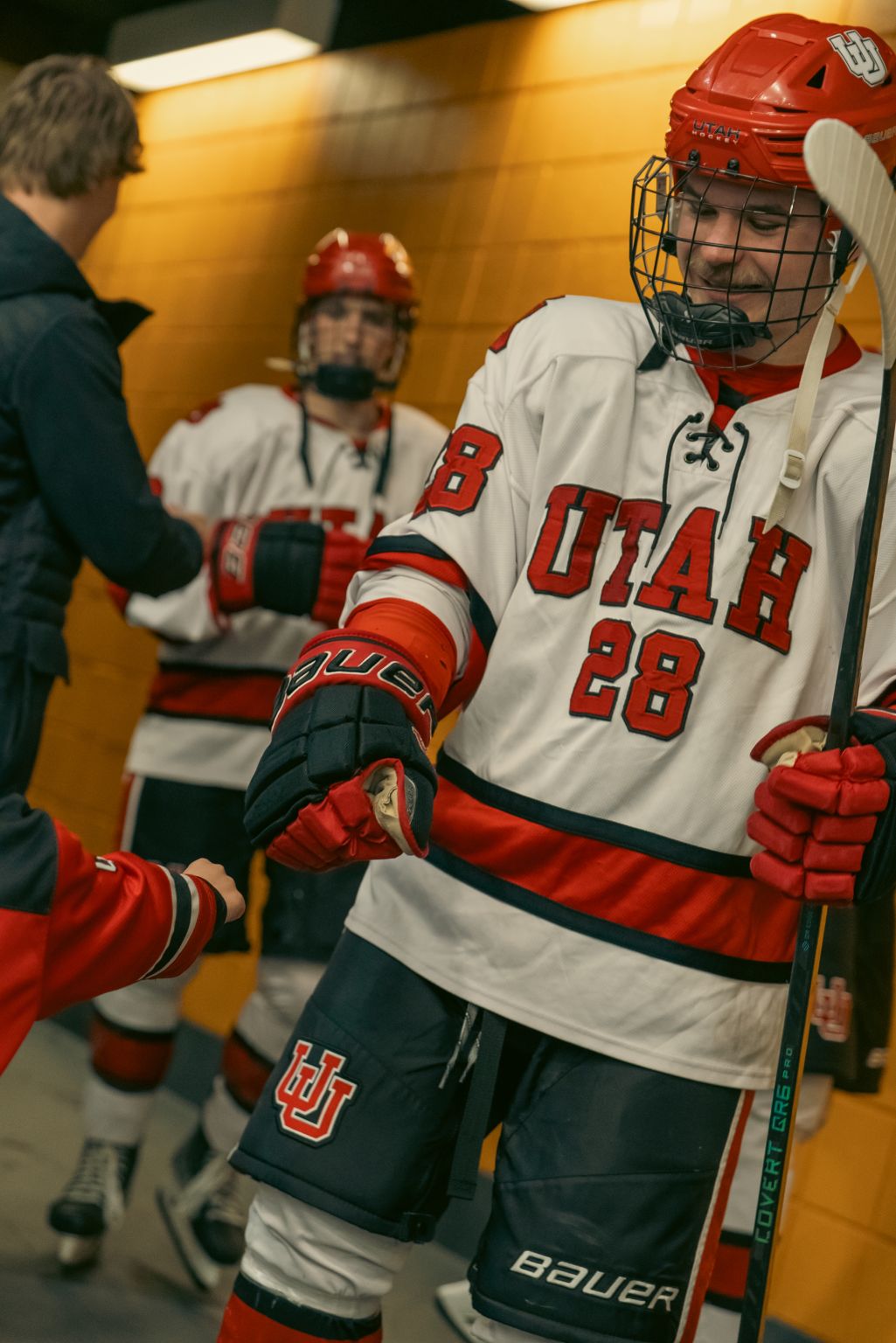
Utah announced his commitment in June 2021. Coach Morgan Feenie described a strong skater with “high hockey IQ,” playmaking ability and an edge to his game. Noonan planned to study business accounting. He would stay in the lineup far longer than the ordinary campus cameo: five ACHA seasons, 105 regular-season games, 27 points and an Iron Man Award from Utah Hockey.
Two goals in 105 games will not make a highlight editor cancel dinner plans. Twenty-five assists are more revealing. An assist belongs to the person who creates a possibility someone else completes. It requires vision, timing and a tolerance for another name appearing beside the result. In a culture addicted to personal brands, there is something refreshing about a résumé built partly from useful passes.
“Train with purpose.”Ethan Noonan, reflecting on his first month at Corgi
Repetition, with consequences
Noonan's own account of improvement is less romantic. “Skill alone does not make you unique,” he wrote while reflecting on his first month at Corgi. Attitude, effort and intensity in training were the variables that mattered. He thanked Glenn Seninger for teaching deliberate practice and Shannon Charles for pushing him toward persistence. The language is earnest, occasionally rowdy, and thoroughly hockey-shaped. Obstacles are not abstractions when they arrive wearing shoulder pads.
His public persona favors dogs, wolves, fire and the occasional rocket. The surface temperature is high. Underneath it sits a patient idea: growth comes from repeating difficult things with attention. A player can skate hard and still rehearse the wrong movement. A salesperson can make calls all day and learn nothing. Volume has to be accompanied by correction.
This is where Noonan's turn toward coaching matters. In 2026, Team Utah listed him as an assistant coach for its 10U youth group. The Utah Junior Grizzlies named him head coach of a 14U Tier II team for the 2026-27 season. Playing asks whether you can execute. Coaching asks whether you understand an action well enough to give it away in words. The second test is often more severe.
A title worth reading carefully: “Founding GTM” describes Noonan's early go-to-market role at Corgi. Corgi identifies Emily Yuan and Nico Laqua as its founders. In startups, one adjective can carry more corporate mythology than a kennel full of mascots.
What defense teaches about risk
The tempting comparison between hockey and insurance has limits. A policy is a contract, not a body check, and nobody should want an underwriter making decisions at full skating speed. Still, Noonan's old position offers a useful way to understand his new industry. Good defense begins with uncertainty. The puck changes direction. Teammates lose an edge. A routine exit becomes an odd-man rush. The defender cannot promise that nothing bad will happen. He can recognize the dangerous paths, reduce the available space and give everyone else a chance to recover.
Insurance also exists because perfect control is a fantasy. Its grammar is less theatrical: exposures, limits, exclusions, premiums. But the central question is familiar. Which risks can be prevented, which can be transferred, and which must simply be understood? Noonan has not publicly claimed that hockey made him an insurance expert, and it would be silly to put those words in his mouth. What the record does show is a young operator accustomed to making decisions inside systems where mistakes have consequences and the score remains visible.
There is another lesson in the position. A defenseman plays behind most of the action but ahead of the disaster. That location rewards attention more than drama. The work is to keep the team ambitious without leaving it exposed. For a company selling coverage to startups, it is difficult to imagine a more fitting apprenticeship.
A fast company in a slow business
Noonan joined Corgi during a particularly loud chapter. The San Francisco company announced a $160 million Series B at a $1.3 billion valuation in May 2026. Three weeks later came another $106 million and a stated $2.6 billion valuation. By August it had announced an admitted insurance carrier, adding another piece to its ambition to coordinate underwriting, policy design, servicing and claims inside one full-stack system.
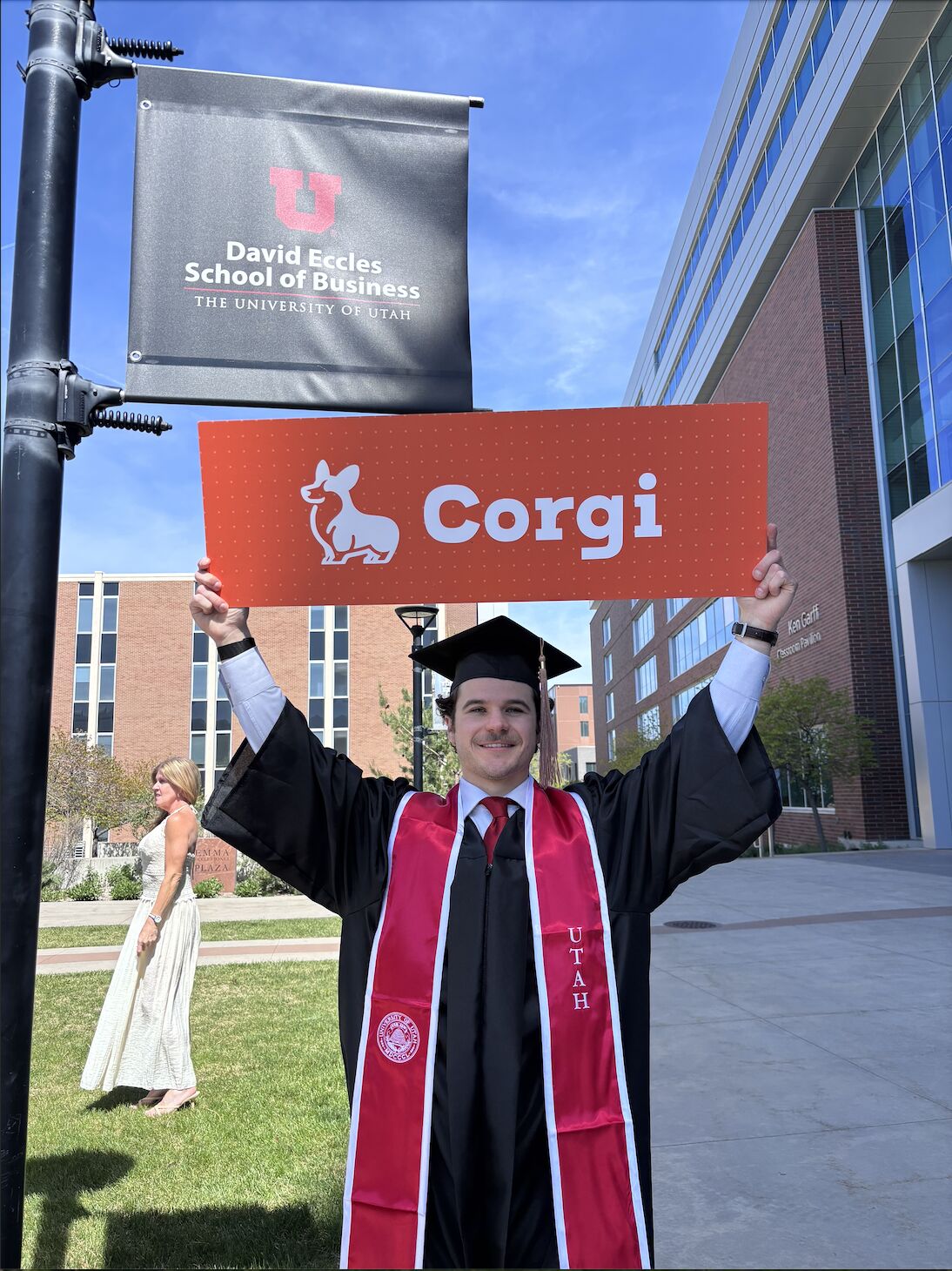
Those are company milestones, not Noonan's personal achievements, and the distinction is important. His job lives closer to the edge where a pitch meets a customer. Corgi promises founders that they can apply online, receive a quote in minutes and bind coverage the same day. That promise turns time into the product. The go-to-market team has to make an old, intricate business feel immediate without pretending the intricacy has disappeared.
A defenseman knows this balance. Move too slowly and the opening closes. Move too quickly and the mistake becomes a breakaway. Noonan received a California property and casualty insurance license in August, according to his public professional profile. It is a small but meaningful detail: velocity in a regulated business still requires credentials, just as instinctive hockey is built on drills nobody applauds.
His recruiting language carries the rink with it. When Corgi sought builders for strategic projects in Chicago, Noonan wrote that the company wanted people who “want the puck on their stick.” The phrase is better than the usual corporate invitation to take ownership because a puck is inconvenient ownership. It moves, it attracts pressure, and keeping it too long is usually a mistake.
“Surround yourself with people who genuinely care about you, and you will succeed.”Ethan Noonan
The pass is the point
Noonan writes often about persistence, but his more distinctive idea concerns company. “Surround yourself with people who genuinely care about you,” he advised. This is softer than the dog-and-wolf vocabulary around it, and much more consequential. Teams do not become close because everyone adopts the same mascot. They become close when candor survives ambition.
The Salt Lake City Corgi group appears, in public at least, to enjoy its own mythology. Teammates celebrate graduation, after-hours sushi and roadside sales calls. One University of Utah teammate teased that Corgi and Noonan provided the rare reason to sit in the campus library. Such scraps should not be inflated into legend. They do, however, suggest that Noonan's preferred unit remains the line, not the lone skater.
At 24, his professional story is still at its opening faceoff. There is no honest way to know whether startup insurance will become a career, a chapter or simply the place where years of competitive habit first met a commercial target. What is visible is a recurring choice: higher level, unfamiliar room, responsibility accepted before comfort arrives.
Hockey gave Noonan a useful education in impermanence. Every shift ends. A national title becomes an old photograph. A championship loss becomes a line in a biography. Even a fast-growing company eventually has to do the unphotogenic work of renewal, service and claims. The spectacle passes; the system remains.
This may be why the assist column feels like the right place to leave him. The defenseman scans the ice, absorbs the pressure and sends the play somewhere productive. The go-to-market operator tries to do much the same with attention. Neither controls what happens next. Both can improve the odds. For Ethan Noonan, the move from the blue line to insurance looks less like a reinvention than a change of surface.