A computer chip can perform billions of operations in a second and still lose an argument with warm air. The argument is conducted in silence. A processor runs hard, its temperature rises, and a protective system slows it down. The owner sees a pause, a dropped frame, a machine that feels less lively than the specifications promised. Deep inside, physics has quietly collected its fee.
Suryaprakash Ganti has spent much of his career in that hidden territory, where materials bend, membranes vibrate and products succeed only if microscopic structures behave by the million. At General Electric, his work touched aircraft engines, power generation and household appliances. At Qualcomm, he moved through three generations of MEMS displays and then helped carry ultrasonic fingerprint sensing from an idea into high-volume production. His engineering has often lived beneath the user interface. You may never see it, which is generally the compliment.
In 2018, after their years at Qualcomm, Ganti and Seshu Madhavapeddy asked what major problem they should tackle next. They chose thermal throttling. It was an odd sort of enemy: universally known, commercially expensive and so familiar that much of the industry treated it like weather. Faster chips were arriving inside thinner products. The usual cooling machinery had less room to breathe.
“We wanted to develop a fundamentally new approach to this problem.”Suryaprakash Ganti
The long apprenticeship of a small machine
Ganti's route to that sentence began in mechanical engineering. He earned a bachelor's degree at the Indian Institute of Technology Madras and completed his doctorate at MIT in 1997. At MIT, he worked under professors David Parks and Frank McClintock. Decades later, he remembered their mentorship as an invitation to reimagine both materials science and mechanical design. It is a revealing combination. Materials decide what is possible; design decides what becomes useful.
He joined GE after MIT and stayed for seven years as a research scientist. The range was unusually broad, from aircraft engines to consumer appliances, with nanotechnology among his responsibilities. Then came Qualcomm, where the scale became smaller and the production problem larger. As vice president and head of research and development for Qualcomm MEMS Technology, he led work on three generations of MEMS displays. Later, ultrasonic fingerprint sensing required research, engineering, manufacturing and operations to arrive at the same destination.
His patent trail records the same migration in slow motion. Early filings concern electromechanical systems and the tiny supports, layers and interconnects inside reflective displays. Later Qualcomm work reaches into micromechanical ultrasonic transducers. Frore-era filings multiply around piezoelectric devices, fluid transfer, virtual valves, filters, waterproof housings and the awkward question of how a vibrating structure survives a collision. A patent list is not a biography, but this one reveals a steady taste for engineering at the point where elegant geometry meets grubby reality.
The lesson was not merely how to invent. It was how to get an invention through the gantlet: performance, reliability, yield, cost and the stubborn particulars of a customer's device. Ganti describes his passion as building and bringing new technologies to market. The second verb carries much of the weight. Laboratories are tolerant of a promising exception. Production lines are not.
A blanket made of air
Frore started with a clear concept but no finished mechanism. Ganti says a strong team, including engineers from MIT and Stanford, needed about six months to turn the core idea into a design. Their target was the boundary layer, the thin region of slow-moving air that clings to a hot surface and acts like an insulating blanket. A conventional fan can move plenty of air around a device while remaining less effective at the precise surface where heat must escape.
AirJet approaches the surface directly. Piezoelectric structures vibrate, creating pulsating jets of air through tiny openings. The device is only a few millimeters thick. It produces high back pressure, can work with filters, and avoids the rotating blades and bearings of a fan. The trick is not one trick at all. Ganti has described a multiphysics design in which structural, fluidic, acoustic and electrical resonance must converge. Add materials, polymer chemistry, manufacturing and testing, and the simple-looking rectangle begins to resemble a very crowded meeting.
The manufacturing plan was also a departure. Silicon fabrication techniques suggested a route to wafer-scale production, but silicon itself did not suit the device. The team adapted related processes to metal, using etched structures and new ways of assembling them. This is the sort of technical pivot that receives little ceremony. The material refuses the concept; the concept politely finds another material.
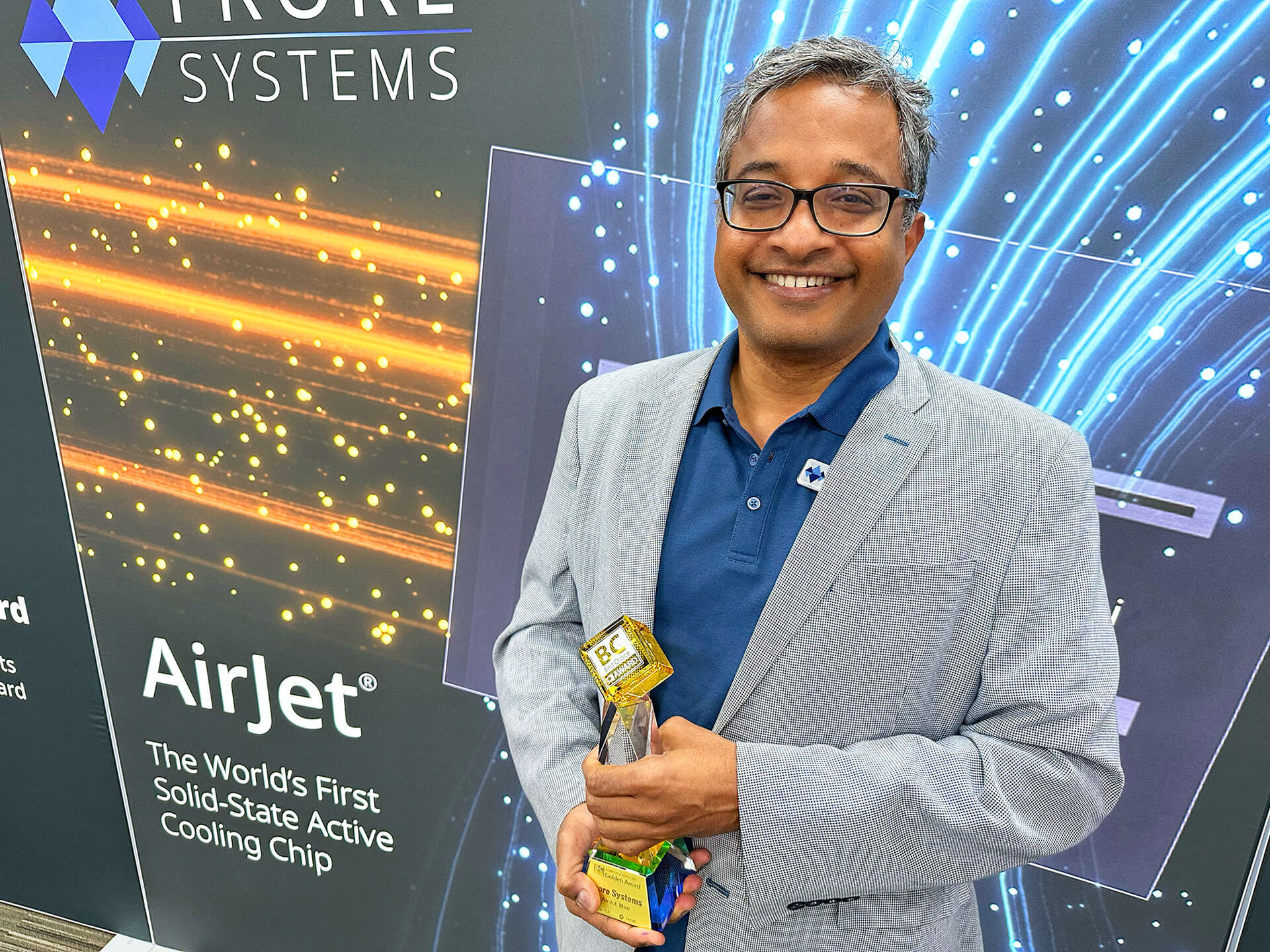
Leaving stealth at CES 2023 was only the visible beginning. Frore had working samples in notebooks and compact cameras, but customers needed evidence that AirJet could survive years of use. The company conducted reliability testing for a five-year lifetime, worked through customer qualification and built a fab for volume production. In 2023, the ZOTAC ZBOX PI430AJ became the first commercial mini PC with AirJet. A machine once explained through prototypes had entered another, less forgiving vocabulary: inventory.
Integration changed the company's job as well. Replacing a familiar fan was not a matter of swapping one rectangle for another. Device makers had decades of habits built around heat sinks, fin stacks and spinning blades. Frore engineers began providing customers with a broader thermal blueprint: where air enters, how heat spreads, where the modules sit, and how the enclosure participates. Ganti's chip therefore became an argument about the rest of the machine. Make cooling thinner and scalable, and the industrial designer receives a different set of possible shapes.
“Imagining, designing and building breakthrough technology is always inspiring, but the hard work certainly doesn't end there.”Suryaprakash Ganti
Dust, deadlines and a law of his own
Customer conversations widened the problem. Heat was not the only resident inside a laptop. Dust collects on components, blocks airflow and asks a fan to work harder. Frore added filters and an intelligent self-cleaning feature. AirJet's pressure could draw air through filters at a device inlet, protecting more than the cooling unit itself. The episode says something useful about Ganti's mode of engineering: a product is not a theorem. The customer gets a vote, and dust, rudely, gets one too.
At CES 2024, Frore introduced a slimmer version with temperature sensing. Ganti also gave a public name to an internal challenge. Frore's Law commits the company to doubling the thermal performance of its products every two years. The nod to Moore's Law is cheeky, but the intention is practical. More transistors are of limited use if the device must slow them down. Better cooling can return performance that is already present but thermally unavailable.
This promise creates an engineer's preferred form of pressure: measurable and recurring. It also turns thermal management from an accessory into a platform. Frore has since extended its attention from edge devices to AI data centers with LiquidJet, a direct-to-chip liquid-cooling system. The scale is different, but the plot remains familiar. Powerful processors make heat. Heat limits sustained work. The useful question is not how impressive a chip looks at its peak, but how long it can stay there.
When the hidden layer becomes visible
By March 2026, Frore had closed a $143 million Series D that valued the company at $1.64 billion and brought its reported total capital raised to $340 million. Money is not a verdict on physics, of course. It does show how dramatically cooling has moved from the margins of computing toward its center, particularly as AI systems pack more power into dense racks.
Ganti's own career makes that shift feel less sudden. He has moved repeatedly between disciplines and scales: engine surfaces, nanoscale textures, reflective displays, fingerprint sensors, vibrating membranes, air jets and liquid channels. The subjects change. The habit does not. Look for the physical constraint beneath the product, assemble people who speak different technical languages, and stay for the dreary middle between demonstration and manufacturing.
There is also an appealing modesty in choosing heat. Software receives launches. Processors get keynotes. Cooling has traditionally been discussed when it whines, clogs or fails. Yet every calculation becomes heat eventually. The faster the machine, the more urgent the exit.
Ganti has made that exit his main entrance. AirJet asks designers to imagine devices without the shape and habits imposed by a fan. LiquidJet asks the same question at the scale of AI infrastructure. Both begin with a mechanical engineer's suspicion that the accepted limit may merely be an accepted design. The ceiling inside the chip was invisible. He chose to work on it anyway.