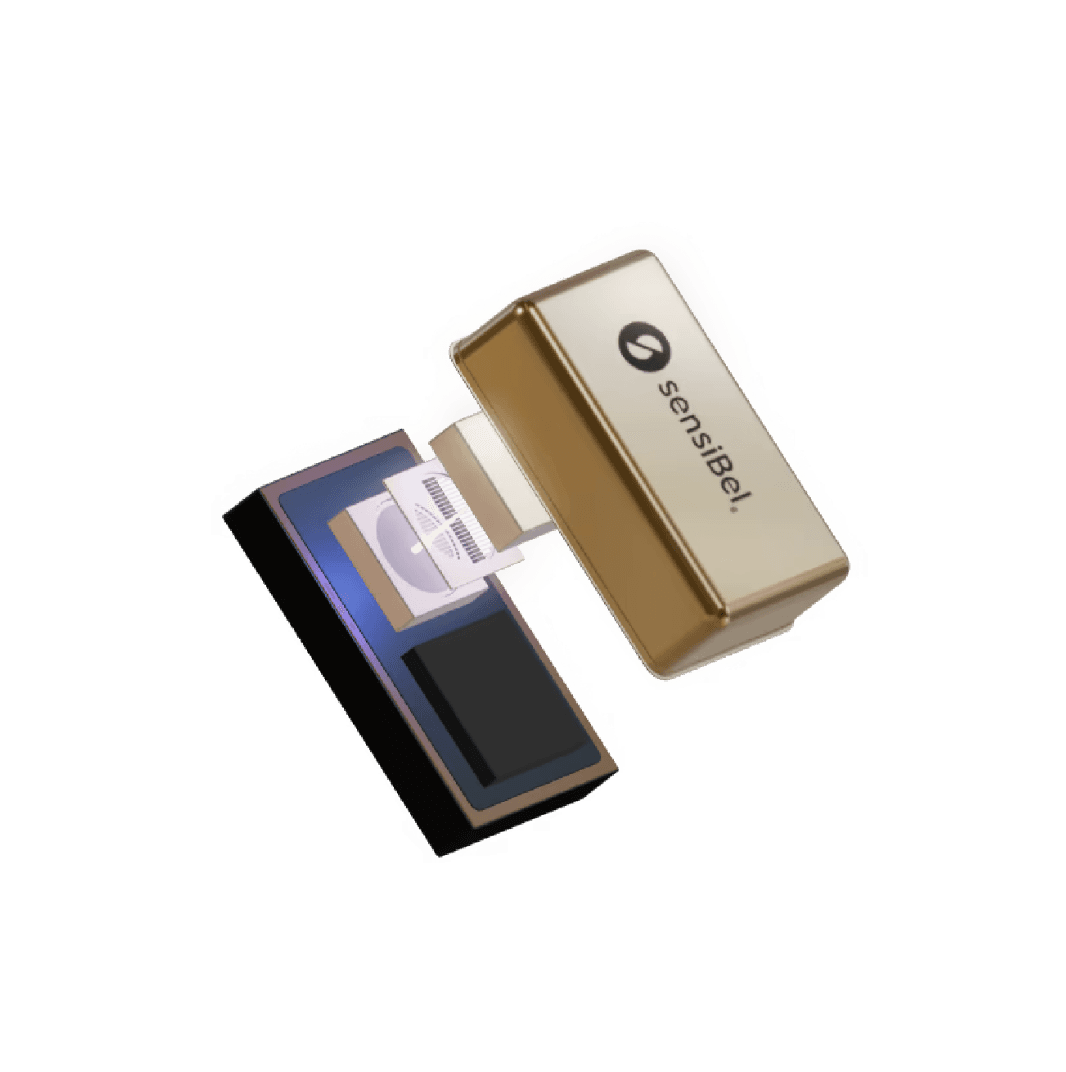
Reinventing a 100-year-old device with light
For more than a century, almost every microphone has worked the same way: sound moves a thin diaphragm, and the device measures that motion electrically, usually through a charged plate whose capacitance shifts. It is a proven approach, but a stubborn one. Shrink the microphone and the electrical signal gets noisier. That trade-off - smaller versus quieter - has shaped consumer audio for decades.
sensiBel, a semiconductor company headquartered at 21 Gaustadalleen in Oslo, Norway, took a different route. Its optical MEMS microphone does not measure the diaphragm electrically at all. Instead, a tiny laser projects light onto the membrane, and a photodetector reads the reflected beam using interferometry - the same physics that lets laboratories measure distances to a fraction of a wavelength. The result is a microphone with very low self-noise and a very wide dynamic range, packed into a MEMS chip small enough for an earbud.
The company describes the ambition plainly: "studio-quality audio everywhere." Its flagship, the SBM100B, is billed as the world's first production optical MEMS microphone - a device it says delivers the sound of a professional studio microphone many times its size.
"The only MEMS microphone to use interferometry-based optical sensing technology, delivering studio-quality audio in a compact, production-ready format." — sensiBel, on the SBM100B
A sensor, not a gadget
sensiBel does not sell microphones on a shelf. It sells the sensor inside other companies' products - a business-to-business semiconductor model. Its customers are the manufacturers who build conferencing systems, wearables, headphones, laptops, smartphones and spatial-audio rigs, and who need cleaner audio capture than a conventional capacitive MEMS mic can offer.
The problem it solves is that sensitivity-versus-headroom compromise. A microphone sensitive enough to catch a whisper has usually distorted long before a rock concert reaches full volume. sensiBel's optical approach widens the usable range at both ends, so the same chip can register a soft voice and survive a 146 dB blast without clipping.
One named integrator makes the point concretely: professional audio firm mh acoustics built 64 sensiBel optical microphones into a single em64d Eigenmike array, the kind of immersive, 3D sound-capture rig used for spatial audio. When your component is good enough, arrays and systems become the growth story - you ship by the dozen, not the one.
Target applications, per the company, run from general conferencing and industrial sound detection to microphone arrays, true-wireless and over-ear headphones, smartphones, tablets, laptops and wearables. The common thread is the same everywhere: capture more of the real sound, add less noise of your own.
The specification that started the conversation
Three figures do most of the talking. Higher SNR means less hiss; a higher acoustic overload point means more headroom before distortion; a wider dynamic range means both at once, on one chip.
From lab prototype to product line
SBM100B
The world's first production optical MEMS microphone. Interferometry-based sensing, 80 dBA SNR, 146 dB AOP, 132 dB dynamic range, 24-bit digital output.
SBM100
The original ultra-low-noise optical MEMS platform, sampled from 2022, with high AOP and low total harmonic distortion in a small digital-output package.
AURORA & POLARIS
Evaluation kits that let engineers prototype and design-in the SBM100B quickly for conferencing, wearables and array applications.
Changing the instrument, not just tuning it
Established MEMS microphone makers - Knowles, Infineon, Goertek, TDK/InvenSense, AAC Technologies - have spent years optimizing the capacitive approach. sensiBel's differentiation is that it did not join that race. By sensing with light rather than a charged plate, it competes on a different axis: studio-grade noise and dynamic-range performance in a MEMS form factor.
That distinction is why the validation from within the industry carries weight. Sennheiser, an 80-year-old name in professional audio, took a strategic stake. When a would-be competitor invests, it signals the technology is interesting to the people best placed to judge it.
The market backdrop is large. Citing analyst forecasts from the Yole Group, sensiBel points to a MEMS microphone segment projected to reach roughly $1.86 billion of an overall $19.2 billion MEMS market by 2030. Optical MEMS is a small slice of that today - which is precisely the opening.
The company's own history explains the moat. The concept traces to research at Norway's SINTEF institute in the early 2000s; sensiBel spun out in 2017 to commercialize it. Roughly two decades of physics and MEMS engineering are hard to copy on a whiteboard.
Research roots, commercial muscle
Kieran Harney
Appointed CEO in September 2025. Previously built a MEMS microphone business at Analog Devices (sold to InvenSense in 2013) and led MEMS mic businesses at InvenSense and TDK.
Matthieu Lacolle
Optical MEMS expert and co-founder, carrying the technical thread from SINTEF research into a manufacturable product.
Jason LaPointe
Appointed COO in November 2025, bringing roughly 17 years of global operations and manufacturing experience.
Also on the leadership bench: co-founder Jakob Vennerod, CFO Sondre Graff and VP of Engineering Karl Lundahl. Sverre Dale Moen led the company as CEO from 2018 until Harney's appointment in 2025.
Roughly $39M behind an optical bet
| Round | Amount | Lead / notable investors |
|---|---|---|
| Series A | ~EUR 15M | TRUMPF Venture (lead), EIC Fund, Skagerak Capital, Investinor, SINTEF Venture IV |
| Strategic investment | Undisclosed | Sennheiser |
Total funding reported at approximately $39M. Figures compiled from public sources and may be approximate.
Built to scale, not just to demo
Silex Microsystems
The world's largest pure-play MEMS foundry, engaged in 2026 to manufacture the microphone's MEMS element at high volume.
AAC Technologies
Assembly and test partner securing the back-end supply chain for the SBM100B.
mh acoustics
Integrated the SBM100B into its em64d Eigenmike ambisonics array for immersive spatial audio capture.
Sennheiser
Professional-audio leader and strategic investor validating optical MEMS for the future of miniature microphones.
How sensiBel got here
The idea forms at SINTEF
Researchers at Norway's SINTEF institute begin exploring optical technology for MEMS microphones.
sensiBel spins out
The company is founded to commercialize the optical MEMS microphone concept.
Sverre Dale Moen takes the helm
Moen becomes CEO and leads sensiBel through its early product and funding phases.
Series A
Roughly EUR 15M led by TRUMPF Venture, with EIC Fund, Skagerak, Investinor and SINTEF Venture IV, to reach production.
SBM100 sampling begins
The first optical MEMS microphone platform starts sampling to customers.
Sennheiser invests
The professional-audio leader takes a strategic stake in the company.
SBM100B launches
The commercial optical MEMS microphone ships; AAC Technologies named assembly partner; Kieran Harney becomes CEO.
Recognition and scale
SBM100B wins EDN Product of the Year, is integrated by mh acoustics, and moves to high-volume production with Silex Microsystems.
The short version
What does sensiBel make?
Optical MEMS microphones - chip-scale microphones that sense sound using a laser and photodetector instead of the traditional capacitive method. Its flagship product is the SBM100B.
How is an optical MEMS microphone different?
Conventional MEMS and electret microphones read the diaphragm electrically via a charged plate. sensiBel bounces a laser off the diaphragm and reads the reflected light, yielding much lower self-noise and a wider dynamic range in a small package.
Where is sensiBel based and how big is it?
It is headquartered in Oslo, Norway, was spun out of the SINTEF research institute in 2017, and has roughly 38 employees.
Who backs sensiBel?
Investors include TRUMPF Venture, the EIC Fund, Skagerak Capital, Investinor and SINTEF Venture IV, plus a strategic investment from Sennheiser, for around $39M in total funding.
Who uses its microphones?
Audio and electronics manufacturers building conferencing systems, wearables, headphones, laptops, smartphones and spatial-audio products. mh acoustics has integrated the SBM100B into its em64d Eigenmike array.