Five thousand copies were still in the garage. This is the detail to remember about the birth of SURFER. John Severson had made something surfers wanted, carried it into shops, and watched people buy it. He had also printed considerably more than he could sell. A promising audience and a questionable inventory decision had arrived together.
In 1960, Severson spent $3,000 printing 10,000 copies of The Surfer. The publication retailed for $2. By the end of September, roughly half the run had sold. The modest profit persuaded him to abandon the annual format and try a quarterly, priced at 75 cents. The first quarterly’s 5,000 copies sold out before its successor appeared.
That is an unusually useful origin story. The evidence was mixed, and he acted on it. A small publication about a specific obsession could find repeat buyers. The question was how much to print, how often to return, and what readers wanted to see when it did.
$3,000 printing cost. A half-sold run still led to a second act.
A sport gets to see itself
The original 36 pages brought together photographs from Severson’s work on his film Surf Fever, illustrations, writing and advertisements. Its distribution fit its subject: surf shops were places where potential readers already gathered. The publication met people inside the activity it was describing.
The early issues were wonderfully untidy in their interests. A hand-drawn map could sit alongside surf photography and a cartoon. Rick Griffin contributed while still a teenager. Readers wrote in from abroad. Severson complained about crowded waves even while publishing material that helped people discover where to go. Surf media had found one of its enduring contradictions remarkably early.
A photograph of a wave can be information, decoration, temptation or proof that somebody else understands your peculiar priorities. SURFER’s combination of images and writing gave readers several reasons to return. It also gave an advertiser a defined context: people thinking about surfing, surrounded by other people thinking about surfing.
“The original since 1960.”
SURFER’s own description of its place in the lineup
The magazine was mortal
By October 2020, that long history could no longer keep operations running. SURFER suspended publication and its full-time staff were furloughed. Reporting at the time placed the shutdown in the pandemic’s economic disruption. A publication could matter intensely to its readers and still lose the business conditions that allowed its staff to produce it.
The interruption is essential to understanding the company. Affection is difficult to put on a balance sheet. It does not automatically pay writers, photographers or printers. A familiar name may retain value after production stops, but the people who made that familiarity possible bear the immediate consequences.
In December 2022, The Arena Group announced a transaction for digital assets including SURFER, Men’s Journal, Powder and several other titles. The announced consideration was $28.5 million across the portfolio. Assigning that entire price to SURFER would turn a group acquisition into a much more flattering, and incorrect, story about one magazine.
The sequence matters: first the operational interruption, then a different owner for the digital assets, then the print return. The renewed magazine emerged from changed arrangements. Readers’ memories provided something to build on; publishing still required an organization capable of putting the next issue out.
Give paper something to do
The Arena Group announced Jake Howard as editor-in-chief in April 2024. He brought previous SURFER experience, time at the World Surf League, and a career covering the sport across publications. That background matters in a field where the interview, the photograph and the invitation onto the boat often begin with knowing the people involved.
The returning print issue put Kelly Slater on its cover. It included contributions from Slater and Carissa Moore, pairing a familiar visual identity with participants who could speak from inside competitive surfing. The 2025 anniversary edition turned to Erin Brooks for its cover. Those choices let the publication address different generations without pretending surfing’s cast had stood still.
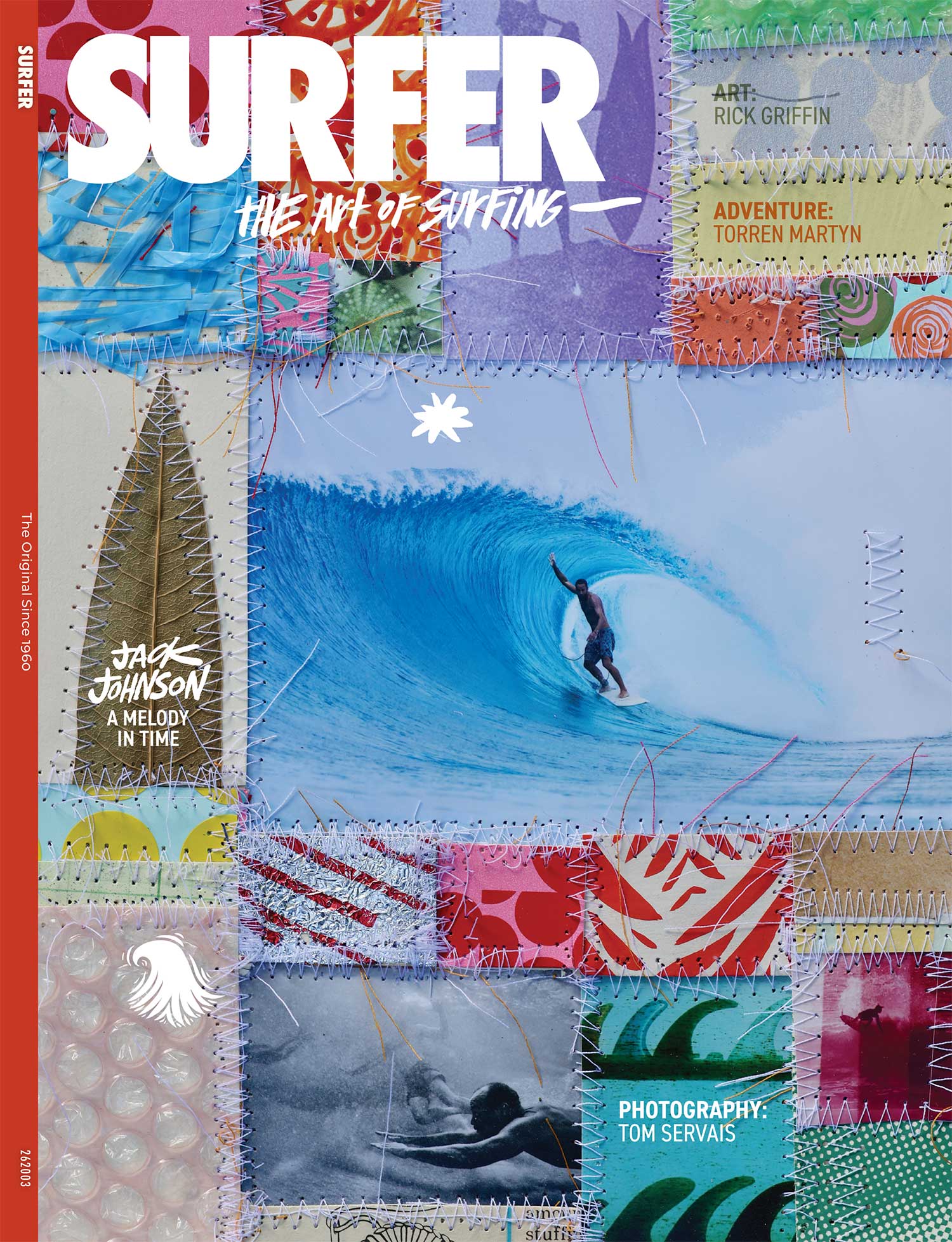
By 2026, the print proposition had become particularly tangible. The Art of Surfing, listed at US$19.99, put Jack Johnson on a cover assembled by artist Thomas Campbell. Inside were connections among surfing, music, image-making and craft. The package offered a reason to pick up an object in a world already crowded with things to watch.
The customer has more than one appetite
SURFER today serves several overlapping needs. Its website gives readers news, competition coverage, gear articles, travel stories and environmental reporting. Someone following professional surfing can keep up with events. Someone considering equipment can read about designs and the people making them. A reader interested in photography can spend time looking without needing to buy a board.
The store makes the commercial side visible. Print editions sit alongside shirts, hoodies and tank tops; the official shop lists logo T-shirts at $30 and hoodies at $57. The magazine sells editorial attention to advertisers and physical products to readers. Merchandise adds a purchase for people who want to wear their affiliation.
There is a useful distinction here between practical information and cultural company. Surfline’s cameras and forecasts address the decision to go surfing: what is happening, and when might conditions improve? SURFER’s center of gravity is the broader world surrounding the ride. Both can occupy the same surfer’s day, for different reasons.
The Surfer’s Journal offers another alternative, with reader-supported publishing, limited advertising, and print delivery every eight weeks. SURFER’s combination of a news website, special print editions, merchandise and partnered television creates a different set of entry points. The appropriate choice depends on the reading habit someone wants to buy.
Six boards and a television channel
For the 2026 issue, shaper Donald Brink made six boards as a collection called Realmotionships. A magazine assignment had produced objects you could carry into the water. That is a pleasingly literal expression of the publication’s territory: the craft belongs in the story because the craft makes the sport possible.

The same editorial territory extends to screens. Through its Fuel TV partnership, SURFER TV gathers films, documentaries, athlete profiles, travel features and original series. It draws from both archive material and new productions, with distribution through Fuel TV’s streaming ecosystem on connected televisions, mobile devices and the web.
That makes the archive more than a commemorative asset. Older work can meet viewers in a different format, beside recent material. For the audience, the convenience is curation: a place to watch surf stories without having to assemble the whole viewing list. Availability depends on the participating streaming platforms.
What to borrow from the garage
The transferable lesson begins with Severson’s willingness to read imperfect evidence. He had buyers and leftover boxes. Those facts required separate responses: keep serving the audience, adjust the product. A publisher testing a specialized idea can borrow that distinction before confusing an ambitious print order with the actual size of demand.
A second lesson sits in the modern print edition. A physical product needs something worth encountering physically: the cover, the sequence, the photograph given room. Merely collecting material that readers already skimmed online would leave the purchase harder to justify. That is an editorial judgment, rather than a claim about SURFER’s profit margins.
The limits are equally concrete. This approach depends on access to worthwhile stories, recognizable contributors, distribution and enough paying interest to cover production. An unknown title cannot assume six decades of accumulated recognition. And the 2020 suspension remains a reminder that recognition alone cannot secure the next payroll.
SURFER’s appeal lives in the particular things it chooses to notice: a young cartoonist, a musician who surfs, a shaper making an unusual board. Those choices make a broad sporting category feel like a place inhabited by people. The next issue earns its place by giving readers another reason to visit.
Read it. Watch it. Take it home.
SURFER’s latest stories ↗ · Print editions & shop ↗ · SURFER TV ↗ · YouTube films & videos ↗