A room in Marist’s Hancock Center carries the names of Rangaraju and Suseela Kothapalli. Their three sons helped pay for it. All three had earned graduate degrees at Marist; all three chose to put their parents’ names on a space for student research and collaboration. For Suresh Kothapalli, the first of the three to graduate from Marist, it is a useful place to begin. The company title tells you what he runs. The room tells you something about what he chose to support.
Kothapalli founded iSpace in 2000 and remains its chief executive. His working world includes software development, enterprise operations, staffing, and teams in the United States and India. These are businesses whose usefulness often becomes apparent when something stops working. An application fails. A project needs people. A process that looked perfectly respectable on a slide turns out to require several human beings and a spreadsheet with a troubled past.
His university gifts concern an earlier stage of that working life: the point when someone has acquired knowledge but still needs the opportunity to use it. A place to collaborate, help with graduate study, a summer spent doing research. Set beside the business career, these commitments suggest a practical reading of education. Learning acquires another kind of value when somebody can put it to work.
Three brothers, three graduation years
Before the California company came an electrical engineering degree at the Birla Institute of Technology and Science in Pilani, India. Kothapalli then earned his master’s in computer science and software development at Marist in 1991. Rajesh followed in 1992, and Vinod in 1994. The dates form a compact family sequence across the same institution.
They also make the later giving unusually specific. The brothers knew the graduate program they would eventually support because they had been its students. Their connection to the Hancock Center likewise ran through computer science and mathematics, rather than a general affection expressed at a safe distance from the curriculum.
In 2011, when the Hancock Center opened, their gift supported its Student Research and Collaboration Room. They requested the dedication to their parents. There is a modest family joke available in that arrangement: three sons acquire advanced qualifications, build careers in technology, and still give the room’s billing to Mum and Dad. The choice places gratitude in a working space, where students can use it without having to make a ceremony of it.
A building dedication can be read in seconds. A research room gets used over and over. That distinction helps explain the appeal of this particular gift. The family’s name sits alongside an activity that continues after the photographs and speeches are finished.
The business between the diplomas and the gifts
Kothapalli’s experience in technology included consulting work with IBM. Before iSpace, he was a vice president and principal at D.P. Specialists, an IT services business in Los Angeles. That company was sold to Metro in 1999. The next year he founded iSpace.
This sequence puts an existing services career behind the founder’s title. He had worked inside the business of supplying technical expertise before setting up the company he still leads. The work involves both technology and delivery: finding the people who can build something, organizing the assignment, and making the result useful to a client.
Today, iSpace’s capabilities include application development and modernization, data engineering, cloud infrastructure, and AI services. Its delivery model spans the United States and India. For a chief executive, that breadth means the company’s offer stretches beyond the moment a piece of software is written. Enterprise technology has a long afterlife. It must be deployed, maintained, integrated, and operated by people who understand what happens when ordinary work meets an extraordinary exception.
Rajesh is iSpace’s president, responsible for North American IT Solutions. The family connection therefore belongs inside the operating story as well as the university story. There is continuity in the institutions they share: an employer, an academic program, and the mechanisms they helped establish for students coming after them.
- 1991Marist master’s
- 2000iSpace founded
- 2009Alumni medal
- 2013Trustee appointment
- 2014Scholarship pledge
A return to the microphone
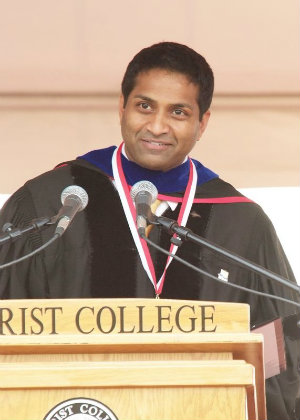
In 2009, eighteen years after completing his master’s, Kothapalli returned to Marist to address its Graduate and Adult Commencement Ceremony. He received the Distinguished Alumni Medal, an award recognizing the institution’s ideals of education, community, and service. His audience included people reaching a milestone he had reached himself.
The photograph from that occasion catches him at the lectern in academic robes, the medal hanging at his chest. A commencement ceremony briefly rearranges the relationship between a graduate and a college. The person once assessed by the institution is invited back to offer something to its next graduates. It is an agreeable reversal, especially for anyone who remembers waiting for exam results.
He joined Marist’s Board of Trustees in 2013. Reflecting on the appointment, he said Marist had “played an important role in my own professional achievements.” The phrasing matters because it assigns some credit away from the executive making the statement. His account of success includes an institution that helped prepare him.
The medal, the address, and the board appointment are different forms of return. One recognizes a career. One asks him to speak. One asks him to take responsibility. Together they show how a university relationship can continue well beyond the last tuition payment.
The $50,000 after the thank-you
In 2014, Suresh, Rajesh, and Vinod pledged $50,000 to establish an endowed scholarship for students in Marist’s computer science and software development master’s program. Their support also included the Marist Fund. The scholarship brought their giving back to the course of study all three had completed.
The sum has a useful specificity. It describes a commitment with a stated purpose, rather than a broad sentiment about the importance of learning. Endowing a scholarship also gives the commitment a structure intended to outlast a single academic year. Gratitude gets an administrative home, which is how institutions keep good intentions from depending entirely on someone remembering them.
The brothers and iSpace also established summer research fellowships in the School of Computer Science and Mathematics. The program supports an undergraduate and an international graduate student, with faculty mentorship. Scholarship and research funding solve different problems. One helps a student pursue a degree. The other makes room within that education for an investigation, with the uncertainty and responsibility that research brings.
There is no need to pretend that either gift can guarantee a career. Their usefulness is more immediate and more believable: they create a chance to study, test an idea, work with a faculty member, and produce something a student can explain beyond the classroom.
Pledged by the three brothers to establish an endowed graduate scholarship at Marist.
What a summer can put on a résumé
The first undergraduate fellowship recipient was Kostikey “Gus” Mustakas, a data science and analytics student in Marist’s class of 2020. His research began in summer 2018 and continued into spring 2019. Working with professor Eitel J. M. Lauría, he developed a predictive model using Hudson River sample data.
Mustakas later obtained a data engineering position at AT&T Labs. He described the research as a significant factor in getting hired and said it became a central subject during his interviews. His account gives the fellowship a consequence that is easy to understand: he had actual research to discuss when an employer asked what he could do.
That is a revealing outcome for a program supported by people who run a technology services company. An interview can get rather abstract when everyone is discussing potential. A completed investigation supplies particulars. What was the question? How did the method work? What needed changing? The student has a piece of work around which a serious conversation can form.
The credit for that work belongs with the student and his faculty mentor. The donors helped make the opportunity available. Keeping those roles distinct makes the story more interesting: a gift can have an effect without its giver becoming the protagonist of every result. Somewhere between a scholarship announcement and a hiring decision, another person gets to take the lead.
A room. A scholarship. Time with a faculty mentor. A piece of work to bring to an interview.
Education put to work
The company, and the next person through the door
The connection between education and employment also appears in iSpace’s community commitments. The company supports STEM Advantage, which offers paid internships, mentorship, and scholarships to women and underserved communities pursuing technical careers. Carole Schlocker, who has been at iSpace since its founding, serves on that organization’s board.
Schlocker’s company title is “Queen of iSpace.” Corporate biographies rarely give the monarchy much to do, so this is a welcome exception. Her career includes D.P. Specialists as well as iSpace, making her another connection between Kothapalli’s earlier services work and the company he founded. The title supplies some wit; the long association supplies the substance.
iSpace also supports education through its India delivery center, which has adopted a school and assists with infrastructure and upkeep. These are company commitments, carried out by an organization with colleagues and responsibilities of its own. They sit alongside the brothers’ Marist giving as further examples of attention to the conditions under which someone gets a start.
Kothapalli’s career continues at iSpace, with its current work extending into AI and enterprise operations. The university connection continues through his family, too: Rajesh joined the Marist board in 2024. Across these chapters, the most tangible objects remain surprisingly ordinary. A room. A scholarship. Time with a faculty mentor. A piece of work to bring to an interview. For an executive whose business concerns getting useful work done, they make a fitting set of contributions. The next student can walk in and begin.
Follow the connections
Explore the company, the university connection, and Kothapalli’s professional profile.
iSpace website Suresh Kothapalli on LinkedIn Marist’s profile of its alumnus iSpace’s education commitments