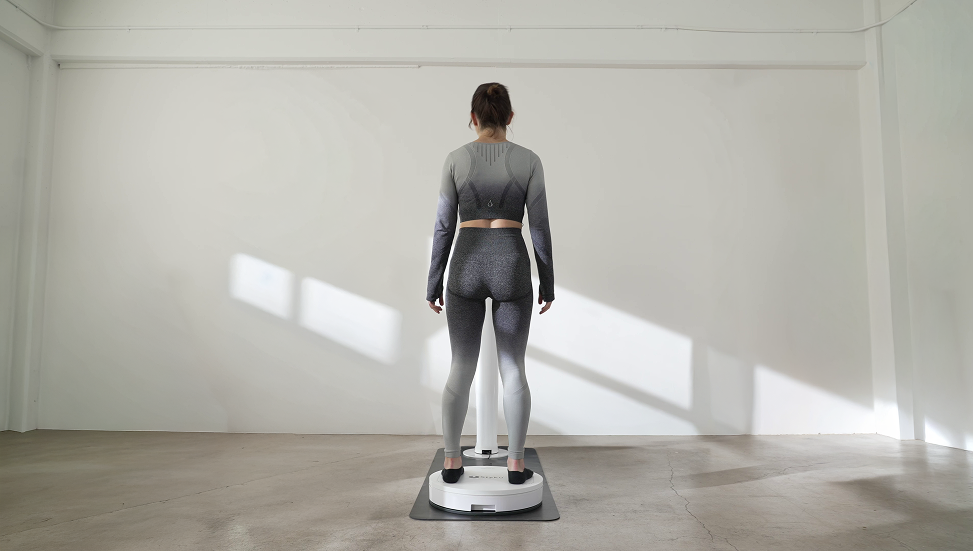
Stand on the turntable. Put your heels on the marks, hold the grips, and stay still. For the next 35 seconds a tower of infrared cameras watches you rotate, snapping something like 600 depth images. By the time you step off, a software model has stitched those frames into a 3D avatar of your own body - hundreds of measurements, an estimate of your body fat, a read on your posture, and a color map of where fat is stored. No pinch test. No electrodes. No fasting. That is the entire pitch of Styku, a Los Angeles company that decided the most broken instrument in fitness was the one almost everybody owns: the bathroom scale.
A scale gives you a single number, and that number is a liar. It rewards dehydration, punishes muscle, and stays flat during the exact weeks a beginner is transforming the most. Styku's founder, Raj Sareen, looked at the wall of diet-program dropouts and drew a blunt conclusion - people quit because progress is invisible. Fix the visibility problem, and you fix a chunk of the motivation problem. The company he built to do that now sits in gym lobbies, medspas, dietitian offices and hospital wellness suites around the world.
01What Styku actually does
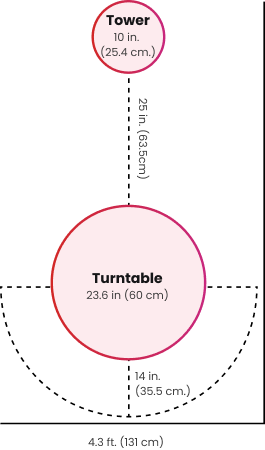
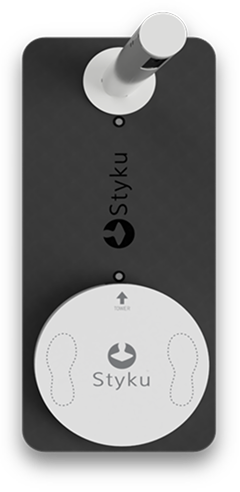
Styku is a body-composition and visualization system, sold as one connected package: a scanner, coaching software called Styku Studio, and a client-facing mobile app. The hardware is deliberately modular - a scanner tower, a rotating medical-grade scale platform, a positioning mat and a touchscreen PC. The scanner uses depth-sensing infrared cameras, the same family of technology Microsoft shipped inside the Kinect, to capture the surface of a body in three dimensions. Processing happens locally, in under two minutes, and the output is not a spreadsheet but a picture: an interactive avatar a client can rotate on screen.
Stand & spin
Heels on the mat, grips in hand. The platform rotates you slowly.
~600 frames
Infrared cameras capture depth images across a 360° turn in ~35s.
Local build
Software reconstructs a 3D avatar on-site in under two minutes.
Read & track
Measurements, body fat, posture and progress over time.
The metrics matter because they are the ones people can't feel and a scale can't show: circumferences from the neck down, body fat percentage, an estimate of visceral fat - the deep abdominal fat that actually tracks with metabolic disease risk - plus posture and body-shape asymmetry. One detail sells the whole thing better than any spec sheet: clients regularly report losing several inches while the scale barely moves. Styku's own testimonials describe a member who dropped 7 inches on a 2-pound change. The scale called that a failure. The scan called it a win.
The scale gives you one number, and it's often the wrong one. Styku's bet is that people don't want data - they want to see themselves change.
The founding thesis, in one line02Who's standing on the turntable
Styku sells to businesses, not directly to dieters, and the customer list is broader than "gyms." Personal-training studios and fitness clubs use it to make progress visible and close renewals. Medspas and aesthetics clinics use it to document body-contouring outcomes. Dietitians, weight-management programs and functional-medicine practitioners use it as an objective baseline. Universities use it for research. And health systems have started deploying it in wellness settings - Mount Sinai, for instance, pairs the scan with a clinician who walks patients through the results.
The through-line across all of them is the same emotional trick: a rotating avatar is visceral in a way a printout never is. For a trainer, that avatar is a retention tool. For a medspa, it's proof of work. For a clinician, it's a conversation starter about risk. Same hardware, different room.
03Why it's built the way it is
The origin story explains the product. Around 2010, Sareen - a physicist whose background runs through extra-solar planet research and NASA's human spaceflight program - started building 3D imaging systems for lifestyle businesses. Styku was founded in 2011. Its break came from an unlikely place: Microsoft's Kinect Accelerator, which selected Styku and handed it $20,000, technical resources and mentorship. The team took a living-room gaming sensor and pointed it at a serious question - can you measure a human body accurately without touching it?
The founding team wasn't from medtech, which is part of the charm. Co-founder Jason Delevan spent his early career doing 3D graphics for television shows including CSI and Alias before running engineering, alongside Sareen, at the apparel-software company Tukatech. Outsiders from television, garment software and astronomy built the body scanner that the fitness industry didn't know it wanted.
They took the sensor from a dance game and asked whether it could measure a person well enough to matter. The answer turned into a company.
On the Kinect Accelerator years04How it's different from the alternatives
Body composition has always been a menu of trade-offs. Calipers are cheap and crude. Bioelectrical impedance devices like InBody send a small current through you, which is fast but sensitive to hydration and prep. DEXA scans are the clinical gold standard for accuracy, but they're expensive, live in medical settings, and involve a dose of radiation. Rival 3D scanners like Fit3D and ShapeScale share Styku's basic idea. Styku's argument is about the balance point: non-invasive, no radiation, no fasting or hydration ritual, and a visual output patients actually understand.
05The business model, plainly
Styku is a hardware company that refuses to live on hardware. The scanner is the hook; the software subscription is the business. A facility buys the scanner - reported at roughly $6,500, financeable in installments - then pays an ongoing subscription of about $150-200 a month for Styku Studio and cloud analytics. The operator resells scans to end users, often around $35 each or in multi-scan bundles. The device drives recurring service revenue for the gym and recurring SaaS revenue for Styku. That structure is the whole reason a small hardware startup survived where flashier ones burned out.
The unit economics, roughly
The financial shape of the company fits the strategy: bootstrapped to seven-figure annual sales within three years on under $1 million of outside money, still a small team of roughly 14 people, with revenue estimated around $3.2 million. This is not a rocket ship. It's a durable niche, defended by patents and a software moat, that owns a corner of a lot of rooms.
06Where it's headed: the scan as a health screen
Styku's most interesting move is the newest one. With Healthpass, the company is reframing a fitness body scan as a preventative health screening. The same infrared map that motivates a gym member can surface visceral fat - the metric that actually predicts metabolic risk - and turn a 35-second stand into a body-based risk read. That's a fitness gadget quietly walking toward healthcare, and it lines up with the company's use of AI tooling (including Anthropic's Claude) to interpret body data. If the last decade was about making progress visible, the next bet is about making risk visible before symptoms are.
Turn every body scan into a preventative health screening.
Styku, on Healthpass07What you can take from it
There's a portable lesson in here for anyone building. First, sell the invisible made visible - Styku's edge isn't measurement accuracy alone, it's that clients can see their own change. Second, if you're stuck with hardware, make the hardware the hook and the software the annuity. Third, a device placed in the right room becomes its own growth channel: the scanner in the gym lobby sells the scans that sell the next scanner. It won't work everywhere - it needs a business willing to host it, a price a facility can recover, and a customer who values seeing progress over a single cheap number. But where those hold, a spinning camera beats a lying scale.