The first useful thing to know about Rick Green is that he once had to explain a robot by comparing its working end to a strand of spaghetti. The year was 2009. Green was vice president of marketing at St. Louis medical-robotics company Stereotaxis, and the subject was a catheter that could be guided by external magnets. The apparatus was formidable: magnets, screens, vectors, a three-dimensional map. Green's explanation was disarmingly physical. A clinician was trying to “drive the back end and steer the tip.” It was the sort of sentence that let a reader feel the difficulty before confronting the engineering.
That instinct - reducing a dense system without insulting its intelligence - has become the quiet constant in Green's career. His résumé runs across medical devices, robotics, life science, pharmacy automation and connected software. The products changed from capital equipment to services and platforms. The buyers changed too. The work kept returning to translation: what does the machine do, why should anybody care, and how might it alter the day in front of them?
Green is based in St. Louis, a fitting home for a career with a local spine and a national reach. His public biography is economical. Degrees from Southern Illinois University Edwardsville and Webster University. A professional diploma from the Digital Marketing Institute. Leadership posts at six healthcare-technology companies. More revealing than the list, however, are the moments when he has had to put the product into words.
Chapter one / The machine in the room
The floppy-spaghetti test
At Stereotaxis, Green marketed technology that looked as if it had wandered in from a science-fiction set and immediately demanded a purchasing committee. The Niobe system used large external magnets to navigate a flexible catheter. An operator could watch a map take shape on-screen, direct the instrument to coordinates and intervene manually. It was sophisticated, expensive and visually arresting. It was also useless as a story until someone explained the practical difference.
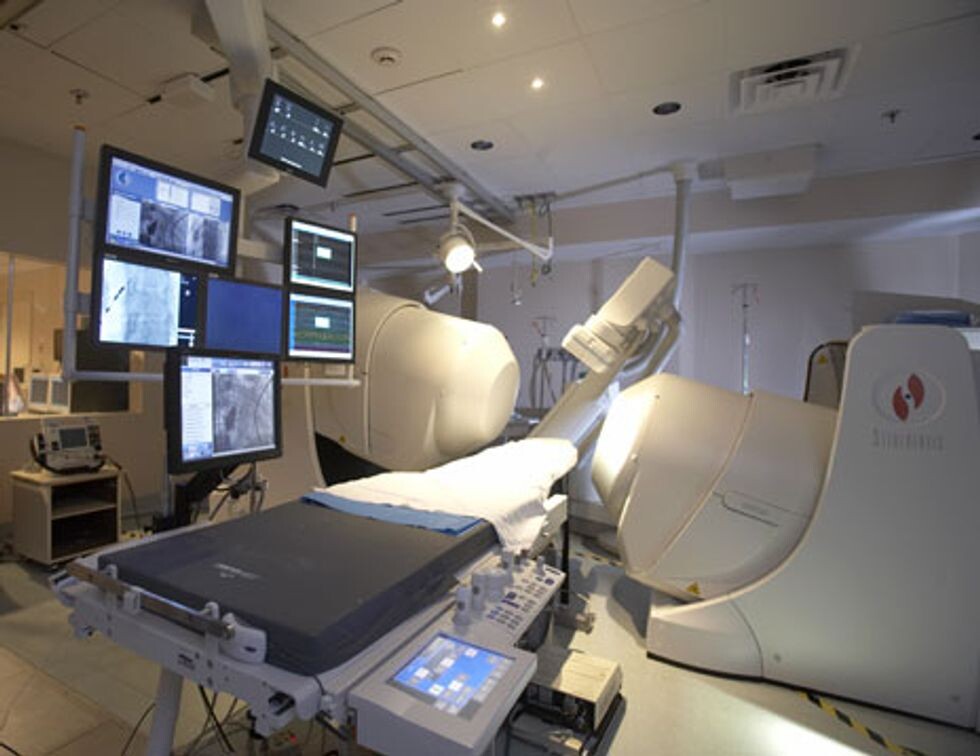
Green progressed from senior director to vice president of marketing at Stereotaxis. By 2011, his name appeared as the company's media contact while it announced product advances and a distribution collaboration with Biosense Webster. That detail matters because communications work inside a technical business is rarely confined to advertising. It sits beside launches, partnerships, investor expectations and a sales force that needs a sentence it can actually carry into the room.
He then joined Topera, a venture-backed company developing three-dimensional cardiac-mapping tools. The new system still lived among complicated screens and clinical language. Yet Green's title widened to vice president of sales and marketing. Translation had acquired a quota.
“Technology should never take precedent over sound messaging - unless of course the central messaging hinges on promoting the technology itself.”Rick Green, speaking about experiential marketing in 2014
The wording contains a small grammatical stumble and a large professional truth. New technology is wonderfully vain. It wants every light pointed at itself. Green's line puts it back in its proper place: inside the message, not sitting grandly on top of it.
Chapter two / Six screens, one idea
When spectacle knew its job
At the 2014 Atrial Fibrillation Symposium in Orlando, Green and an exhibit partner built a Topera experience around a six-screen video array and live product-demonstration systems. There was nothing shy about it. Yet his commentary on the project was notably restrained. He valued the partner's ability to blend technology into a “custom and polished branding environment.” The technology was not the message. It was the room in which the message could perform.
This is a more interesting view of marketing than the usual argument between creativity and measurement. Green's problem was choreography. A novel mapping tool, multiple screens, a physical booth, technical specialists and a passing audience all had to arrive at the same point together. Too little explanation and the display became theatre. Too much explanation and it became homework.
A useful test for technical marketing
Can the audience repeat the value after the impressive screen has gone dark?
Topera was acquired by Abbott, and Green moved into a role covering capital sales and global marketing. That passage from a smaller company into a large one is a consequential education in scale. A startup can gather its story around one product and one urgent problem. A global company brings portfolios, regions, approval layers and customers with very different definitions of useful. Green stayed for several years, working at the junction where sales and marketing are forced to stop flirting and share a calendar.
Chapter three / Hardware becomes a network
The product gets less visible
In 2018 Green moved to Merck Life Science as head of commercial and customer experience. The title marked a change in emphasis. A device can stand on a trade-show floor. Customer experience is distributed across interactions, teams and time zones. It has no handsome casing. It cannot be switched on for applause. Yet the same practical questions remain: where does friction live, what does the customer need next, and can the organization tell the difference between activity and progress?
Omnicell brought him closer to pharmacy. As vice president of marketing, Green worked in a business centered on automation and medication-management infrastructure. In 2023 he joined Long Island University pharmacy dean Arash Dabestani for a Scottsdale Institute webinar about preparing the future pharmacy workforce. The discussion framed automation less as a dazzling replacement for people than as a way to move routine work away from pharmacists so their attention could go elsewhere. It was a familiar Green construction: begin with the technology, then quickly return to what a person can do because of it.
In April 2024, Green became senior vice president and chief marketing officer at Outcomes. The setting was broader again. Outcomes brings pharmacy-management systems, clinical services, patient engagement, telepharmacy, billing and other tools into a connected portfolio for pharmacies, payers and pharmaceutical companies. The company says its network includes approximately 48,000 active pharmacies and reaches more than 130 million patients. It is less a single machine than an ecosystem - a word marketers enjoy almost as much as engineers enjoy platform.
Large platforms create an odd communications challenge. Each additional capability makes the product more useful and the explanation more dangerous. A complete description turns into a catalogue. A short description risks becoming mist. Green's public work at Outcomes sits between those failures. Recent company messages emphasize connections and workflows: putting tasks in one queue, joining previously separate systems, helping a pharmacy act on information rather than merely possess it.
The numbers provide scale. In the first half of 2025, the company reported more than 6.5 million medication-therapy-management services, up 21 percent from the same period a year earlier. It also reported roughly $93 million in service and validation revenue for pharmacies. Those figures belong to a whole network, not to one executive. Green's part is the distinctly CMO-shaped burden of making them coherent to several audiences at once.
Chapter four / The people in the sentence
What he notices in a colleague
Green's public posts are more generous toward people than self-advertising. In recommending a former colleague, he praised four things: attitude, coachability, bold learning and collaboration. He described a marketer who could think strategically and execute tactically. Elsewhere he called a former colleague “smart, steady, and genuinely good.” These are not revolutionary management doctrines. Their plainness is the point. They describe someone you would trust with a difficult Tuesday.
His own profile lists volunteer work with a food pantry, a board role with Parents as Teachers and teaching work with the College for Living. The entries are brief, and there is no need to varnish them into a grand theory. They do, however, complicate the usual picture of a commercial executive. Outside the product launches and funnel vocabulary is a person who has repeatedly made room for local, practical service.
When Green advertised an Outcomes marketing opening, he wrote that the team wanted experienced creatives who could do meaningful work, make an impact and work with leaders who “actually make work fun.” Corporate recruiting copy generally approaches fun with all the natural grace of a tax form. His phrasing at least sounds like a real preference. The job is serious; the room need not be solemn.
The lasting idea
Clarity after the novelty fades
Green's career is not a heroic tale of one invention or one company transformed by executive will. The evidence supports something subtler and more useful. For more than two decades, he has chosen industries where the thing being sold is hard to explain, consequential to adopt and impossible to market honestly with mood alone.
The work began in public view beside a flexible instrument steered by magnets. It now stretches across cloud platforms, pharmacy networks and data moving between organizations. In both cases, the temptation is to make complexity sound like sophistication. Green's better instinct is to make complexity feel navigable.
The six-screen wall from Orlando is long gone. The sentence behind it survives. Put the message first. Let the technology prove its usefulness. Make the benefit clear enough to repeat without the demo. It is modest advice, which may be why it lasts. Marketing has no shortage of fireworks. Every so often, it needs someone who remembers where to point them.