Before StockX, buying a rare sneaker online often began with theater. A seller photographed the box beside a handwritten username. A buyer squinted at stitching, asked for another angle and tried to decide whether the bargain was a trap. Price was theater too: whatever one person asked, another person haggled down. StockX's sharpest invention was to drain some of that drama from the transaction. It put every size of a standardized product on one page, displayed bids and asks, published recent sales and routed the object through a verification stop. The shoe acquired a chart. The strangers did not need to meet.
That simple loop turned a Detroit startup into a global marketplace for sneakers, apparel, accessories, electronics, trading cards and collectibles. StockX said in August 2025 that more than 65 million products had traded since launch, with customers across more than 200 countries and territories. The company is private, and the number that matters most is not sitting in an earnings report. It is the accumulation of transactions: a deep record of what people actually paid, at what moment, for which size and colorway.
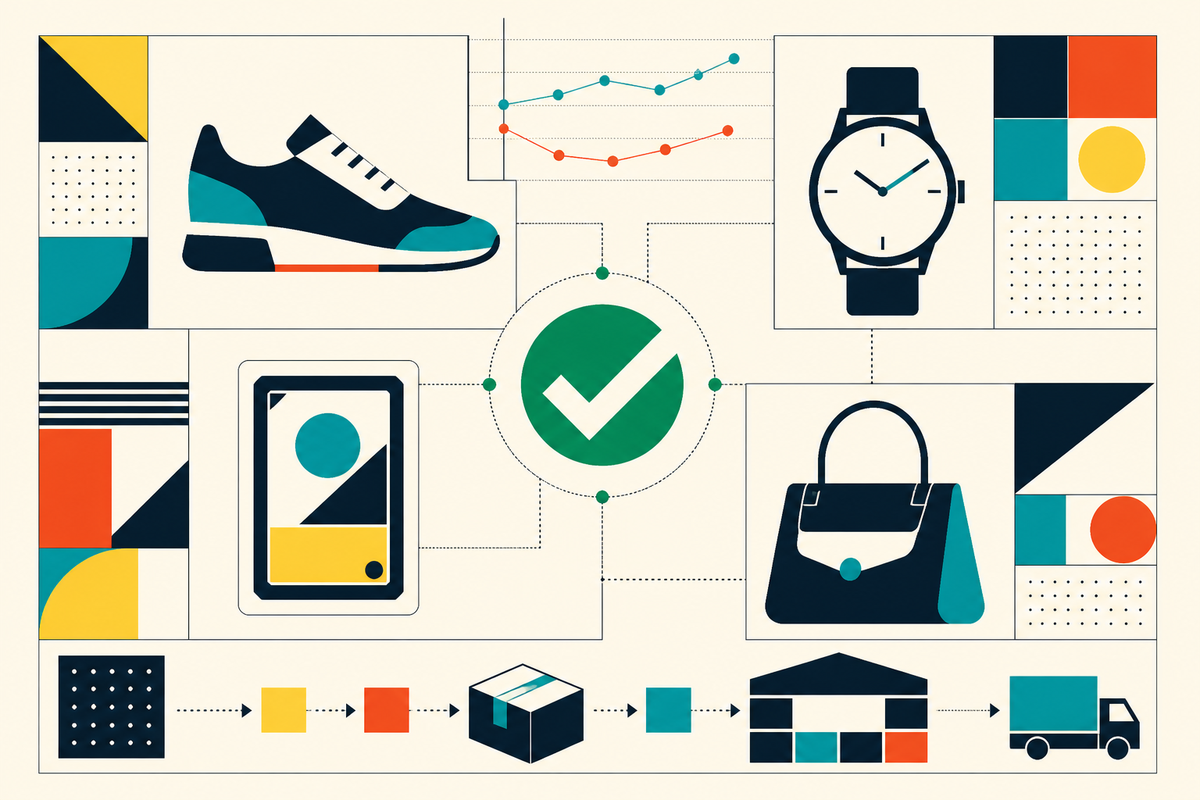
The chart was the wedge
Co-founder Josh Luber arrived with Campless, a sneaker-data project that scraped secondary sales to estimate value. Dan Gilbert brought capital and a Detroit operating orbit. Greg Schwartz and Chris Kaufman helped turn the idea into a company that launched in 2016. The founding phrase - “the stock market of things” - was more than a slogan. On a conventional marketplace, each seller creates a separate listing and reputation. StockX grouped interchangeable new items into a catalog, made trading anonymous and matched the highest bid with the lowest ask.
The problem it solved was not merely finding a pair of shoes. Buyers wanted access without gambling on authenticity. Sellers wanted reach and payment without cultivating a storefront. Both sides wanted a credible price. StockX placed itself in the middle as market maker, payment layer, data terminal, inspector and parcel conductor. It earns fees on that choreography. Rates vary with location, item and seller status, while professional tools, storage and expedited fulfillment deepen the relationship with high-volume users.
The visible product is a marketplace. The harder product is making an anonymous deal feel ordinary.
Verification is the physical hinge in a digital proposition. In its classic flow, a seller ships to StockX, specialists examine the product and the approved item continues to the buyer. The company says it uses product knowledge, market data and technology, and backs purchases with its Buyer Promise. Its 2025 brand-protection report said 370,000-plus suspected counterfeit items, worth nearly $74 million, were rejected during the covered 12 months. No inspection system is infallible, and customer disputes remain a reputational hazard. The moat is not a green tag by itself; it is the process, facilities, data and remediation promise around that tag.
A price signal with a cultural accent
StockX sits between retail and financial metaphor. It does not issue the products and generally does not set their value. Brands create scarcity; musicians, athletes, designers and internet jokes create attention; buyers and sellers convert both into a clearing price. The platform then packages those movements as useful information. A collector can see whether a release is climbing or merely noisy. A reseller can compare sizes before tying up cash. A brand strategist can watch an unfamiliar label turn into repeat transactions.
Its annual Current Culture Index makes the point with unusually specific clues. In 2025, nearly 200 brands set annual StockX sales records. Pop Mart passed LEGO as the platform's most-traded collectible brand. Canon's PowerShot G7 X Mark III became its best-selling electronics product. Uniqlo apparel sales rose on the back of collaborations with Needles and KAWS. The dataset does not describe all retail, but it catches the moment desire becomes a receipt - a more useful signal than likes alone.
The exchange becomes a bazaar
For most of its first decade, StockX's discipline was also its limit. A curated catalog works beautifully when one new, unworn pair should be interchangeable with another. It works less neatly for a faded concert shirt, a scuffed sneaker or an object with a biography. In 2026, StockX Listings opened that door. Identity-verified sellers can list used sneakers and vintage apparel; AI-assisted photo analysis matches items to a decade of product data; eligible buyers can add optional verification. At launch, sellers kept the full sale price.
Listings is not a feature tucked into checkout. It changes the ontology of StockX. The old unit was a standardized product with a market around it. The new unit can be an individual object with its own condition and photographs. That puts StockX more directly against eBay, GOAT, Grailed, The RealReal and consignment stores. Its advantage is the ability to place used and new pricing beside one another, supported by a familiar catalog and buyer-protection system. Its risk is confusing a promise customers once understood at a glance.
Two other experiments stretch time in opposite directions. StockX Live, announced for summer 2026, accelerates the sale into entertainment: real-time auctions, chat, giveaways and direct seller contact. Store at StockX slows the physical object almost to rest. Select U.S. users can buy an eligible item, have it verified into managed storage, then relist it without taking delivery. Shipping and buyer processing fees are deferred unless the owner requests the product. A sneaker can change economic hands while remaining on the same shelf.
That custody model reveals StockX's operational ambition. Flex lets approved sellers store inventory inside the network; pre-verification helps Xpress Ship move orders faster. Verified Seller allows a small, vetted group to ship directly to buyers. Auctions handle the opposite of interchangeable inventory: one-offs and unreleased rarities, starting at $1 with no reserve. Each route asks the same question differently: how much of the transaction must pass through a verification center for buyers to trust the result?
The expensive middle
StockX raised venture money to build this middle. A $44 million Series B in 2018 funded international expansion and verification capacity. A $110 million Series C in 2019 put the valuation above $1 billion. The company raised $275 million in late 2020, followed in April 2021 by $60 million in new primary shares alongside a $195 million secondary tender, at a $3.8 billion valuation. StockX said 2020 revenue exceeded $400 million. It does not publish current audited financials, so later revenue estimates should be treated as estimates.
The capital bought reach, but the business remains exposed to the awkward economics of moving real things. Every inspection adds labor and time. Every extra leg adds freight. Counterfeiters adapt. Fees can make a seemingly clear market price less clear at checkout. Brands can alter supply, change distribution or challenge how their intellectual property appears in resale. Competitors can subsidize verification or make listing easier. The platform must be trusted by buyers, useful to sellers and fast enough for both - a triangle that rarely stays still.
StockX began by making resale more like an exchange. Its second decade asks whether an exchange can also be a warehouse, auction house and television set.
Greg Schwartz, now chief executive, has described the core as trust, data and transparency. That core is visible in the company's best product decisions: one page instead of a thicket of duplicates, an observable price instead of private haggling, and a process between payment and delivery. The latest products add selection and speed, but also personality, condition and multiple levels of verification. StockX is becoming more useful precisely as it becomes less uniform.
For shoppers, the practical proposition is broad. Buy a sold-out release at the current ask. Place a lower bid and wait. Check the recent sales before deciding whether a price is absurd. Sell without photographing a standardized new item. List a worn pair when the newer marketplace opens to you. Bid on a rare object, watch a live show or, if eligible, trade inventory that never reaches your closet. For brands and curious observers, the platform doubles as a cultural seismograph. Its needle moves only when somebody pays.
The original StockX idea was clean enough to explain on a napkin. The next version needs a legend. That is not automatically a flaw; mature marketplaces accrete formats because customers arrive with different objects and motives. The test is whether the company can keep one sentence intact beneath all of them: you know what you are buying, you can see what the market has paid, and there is a credible promise if the transaction goes wrong. Hype got its chart. Now the chart has to survive the bazaar.