Steve McBee once helped look for the person who should run a new energy business. Then his own name entered the search. This is an occupational hazard of giving persuasive advice: somebody may ask you to take it. In 2014, the founder of a Washington consulting firm agreed to become the first president and CEO of NRG Home. He was leaving a business with his name on the door for a company that wanted to change what happened behind the electricity meter.
He joked that the move was “a midlife crisis.” His explanation was more consequential. He had grown frustrated with Washington’s ability to address climate change and saw a commercial opening where business growth could advance the change he wanted. Twelve years later, he is building AMPED, an organization devoted to clean energy’s political and cultural influence. The journey has given him two quite different answers to the same question: where does power come from?
The two Washingtons
McBee grew up in Bellingham, Washington, and attended Western Washington University. An internship with Representative Al Swift led to a full-time congressional job; he left university without completing his degree. When military installations in Swift’s district faced possible closure, the young aide helped examine the Navy’s analysis with constituents. It was an early education in how a technical argument becomes a political one.
His subsequent congressional work included advising Maria Cantwell on foreign policy, technology, trade, and national security, then four years as Norm Dicks’s national security assistant. Dicks’s committee assignments put defense appropriations and intelligence among McBee’s responsibilities. He moved into consulting and became chief operating officer at Denny Miller McBee Associates before starting McBee Strategic in 2002.
That sequence matters. The future energy investor first learned his trade around federal budgets, committees, and the practical concerns of Washington state. His early professional map connected the Pacific Northwest with Capitol Hill. Silicon Valley and the electricity industry would eventually enlarge it.
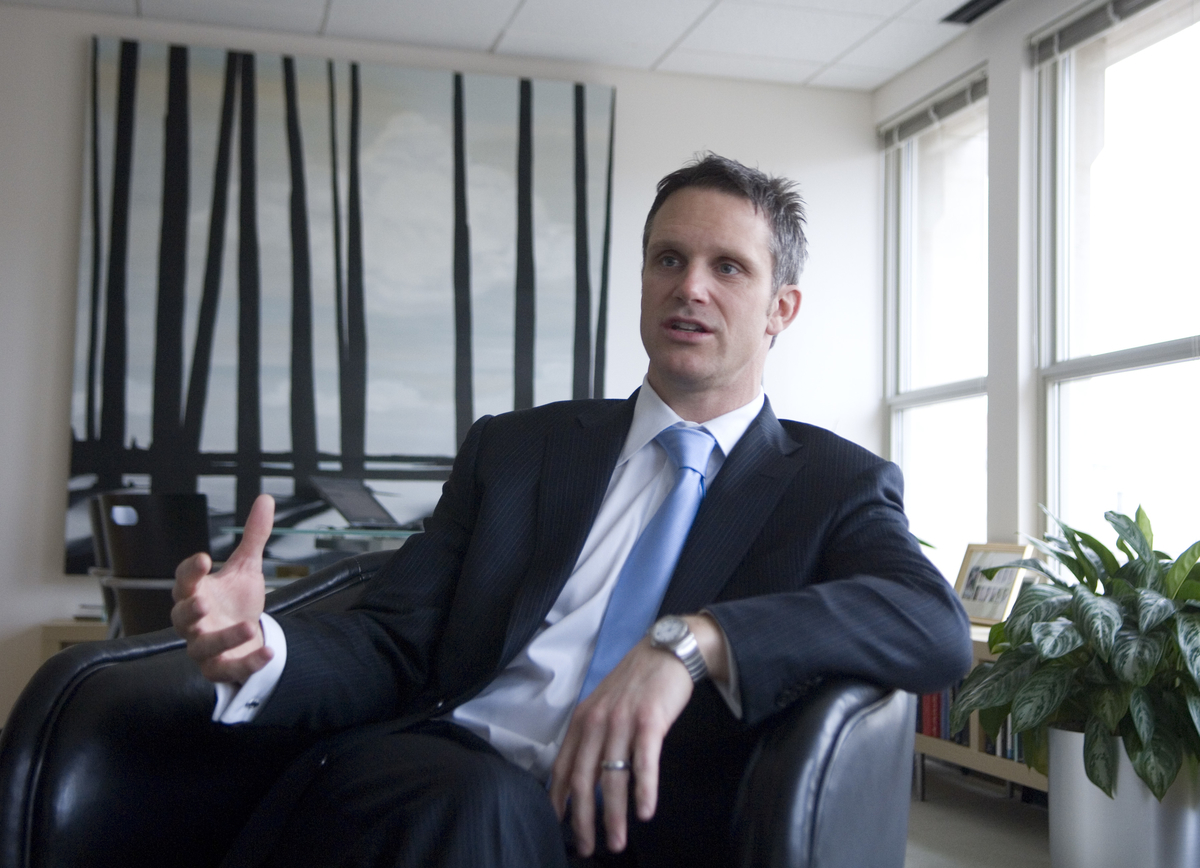
A consultant volunteers for the experiment
McBee Strategic combined advocacy with communications and business advice. Its approach was to connect policy work to clients’ commercial interests. The firm eventually became Signal Group, although that name arrived after its founder’s departure. Wiley Rein acquired the business in 2014; the Signal rebrand followed in 2016. In 2024, Blake Androff bought it back from the law firm. McBee’s name disappeared from the sign, while the business continued through several changes of ownership and leadership.
The route to his next job began at an X Prize Foundation dinner in Los Angeles, where he sat beside NRG chief executive David Crane. NRG later became a client. McBee was consulting on the search for an NRG Home leader when NRG Renew’s Tom Doyle put his name into consideration. An adviser had become a candidate. Accepting meant handing over the company he had built.
NRG announced the appointment on November 13, 2014, with a December 1 start. The assignment joined retail electricity, residential solar, and other consumer energy offerings. McBee would have to turn an argument about the future into something a household could actually buy.
- 2002McBee StrategicAdvising businesses
- 2014NRG HomeRunning an energy business
- 2019Huck CapitalFinancing energy companies
- 2026AMPEDOrganizing industry influence
The customer acquires a vote
The idea behind NRG Home was unusually domestic for a company associated with power generation. A home could generate electricity, manage consumption, and use storage. The customer could gain more control over a service usually encountered as a monthly bill. The business was intended to combine NRG’s consumer offerings and make that collection simpler to use.
McBee’s argument in 2015 started with changes in other industries. Technology had given customers more choice and had weakened centralized, provider-led models. He expected energy customers to demand affordable, reliable, sustainable products tailored to their needs. An electric vehicle, he observed, could make someone newly attentive to electricity: checking a charge, watching an app, thinking about efficiency. The supposedly passive customer had acquired a dashboard.
The experiment also met the constraints of a public company. NRG’s wider green strategy faltered, Crane was removed, and McBee resigned in January 2016 after roughly a year leading Home. Commercial ambition still had to survive investors, organizational priorities, and the timetable on which a transformation could pay. His departure belongs in the story alongside his appointment. A career spent advocating change includes occasions when the organization changes direction first.
Put the capital behind the customer
Huck Capital, established in late 2019, gave McBee another way to work on the energy transition. The firm brought investment together with operating experience, focusing on customer-facing energy companies. Its approach set out three tests: growth, carbon avoidance, and improvement through executive and operational expertise. Huck also declared a lifetime ambition to avoid one gigaton of carbon emissions through its investments. That is a target, rather than a tally of completed results.
Carbon emissions avoided through investments.
A goal the firm set itself, not an achieved total.
In August 2020, Huck and Schneider Electric announced a partnership to provide energy as a service to commercial and industrial buildings in North America. The proposition moved a complicated capital project away from the building owner: a provider would develop and operate on-site microgrids, while customers bought the energy service without upfront investment in the equipment.
That was a practical version of an old McBee concern. A customer may want lower costs, more dependable electricity, and fewer emissions without wanting a second occupation as a microgrid expert. Financing and operations could make the purchase easier. The arrangement was intended to bring clean energy into a building owner’s ordinary business decisions.
Software supplied another route. In March 2021, Uplight announced an investment at a $1.5 billion valuation from a consortium including Schneider Electric, AES, and a Huck-led private equity group. Its tools helped energy providers engage customers and coordinate connected devices. McBee called software “the fuel driving the energy transition.” He emphasized getting closer to the end customer. The interest in the household had survived the change of job title.
“Software is the fuel driving the energy transition.”
Steve McBee, on the Uplight investment, 2021
Back to the argument
By April 2025, McBee had joined the board of the Sustainable Energy and Environment Coalition Institute. He wanted to bring a commercial perspective to the relationship between policy and markets. He had also been pushing for marketplaces that would make it easier for consumers to access and switch to clean energy. Once again, the transaction itself was part of the problem he wanted to solve.
AMPED, which he introduced publicly in 2026, widens the question. Its premise is McBee’s diagnosis: clean energy’s commercial progress has failed to produce enough durable political and cultural support. Cheaper technology and successful companies do not automatically organize voters, sustain policy, or win public arguments. He wants the industry to build those capabilities deliberately.
The organization describes work spanning communications, relationships between industry leaders and policymakers, market development, and policy. Its proposed communications operation is built around creators and the channels people actually use. Its market work addresses obstacles such as transmission and distributed energy. These are different kinds of work, linked by the belief that a growing industry needs institutions capable of defending and expanding its position.
There is an irony here worth keeping. McBee left Washington convinced that corporations could accomplish changes government was failing to deliver. Now, with experience inside an energy company and an investment platform, he is making the case that industry must organize its relationship with government more effectively. The intervening years have complicated his answer. They have also given him something more useful than a tidy conversion story.
Someone should build that
His AMPED newsletter began in July 2026 and developed into a sequence of arguments about communications, political organization, and market barriers. In September’s “Paying Our Way,” he described hearing broad agreement that the industry needed shared capabilities, followed by the familiar response: “Someone should build that!” Every group project has met Someone. Someone has a remarkably crowded calendar.
McBee’s answer is that these functions need sustained funding and organization. In “Building Clean Energy’s Powerbase,” he traced a chain from investment to policy certainty, and from durable policy to public support and organized influence. The point is more demanding than asking executives to tell a better story. It asks them to support institutions whose benefits extend beyond their own companies.
On September 30, he urged the industry to rally behind a bipartisan permitting agreement. On October 1, he published a video conversation with Senator Sheldon Whitehouse about permitting and the need for a more organized industry response. The investor was again doing something recognizable from his congressional beginnings: connecting policy machinery with the people who need it to work.
For all the shifts in institution and vocabulary, McBee has kept some less abstract interests. He snowboards and mountain bikes, and lives between San Francisco and Sun Valley with his wife and three sons. The outdoor pursuits fit a career concerned with changing energy systems, though a mountain bike has the courtesy to make its power source fairly obvious.
In a May 2026 conversation about AMPED, host David Roberts opened with doubts about the new effort. McBee responded with the confidence of someone still willing to start an organization in order to test an idea. “We have to be ambitious,” he said. His latest wager is that the energy industry can learn to organize the influence its commercial scale should make possible. He has already tried advising, operating, and investing. Now he is asking who will pay for the work everyone agrees Someone ought to do.
Follow the argument
Read McBee’s writing, hear him explain AMPED, and explore the organizations behind the career.
- AMPED - the current initiative ↗
- Steve McBee’s AMPED newsletter ↗
- Huck Capital - biography ↗
- Steve McBee on LinkedIn ↗
- Steve McBee on X ↗
- Listen: the May 2026 Volts conversation ↗
- Watch: McBee’s conversation with Senator Whitehouse ↗
- Watch: the 2020 Schneider Electric partnership address ↗
- Read: the decision to leave his consulting firm ↗
- The firm’s next chapter: becoming Signal Group ↗