Few places make progress feel less convincing than a checkout queue. You have found the thing, carried the thing, and agreed to buy the thing. Then you wait for permission to pay for it. The final few feet can acquire the dignity and pace of a minor border crossing.
For Steve Gu and Ying Zheng, that familiar inconvenience became more pressing after they became parents. Gu has described waiting in line as part of the inspiration for an autonomous store. They founded AiFi in 2016, with a name that expressed a larger ambition: artificial intelligence should become as accessible as Wi-Fi.
The domestic detail matters. A founder can spend years learning how to make computers recognize movement and objects, then discover a reason to use that knowledge while trying to get ordinary shopping done. The queue supplies something a technical paper cannot: an impatient customer with somewhere else to be.
Zheng has described her own frustration with the time consumed by errands and grocery shopping. She wanted more of that time for family. The two founders brought computer-vision experience to a complaint that needed no advanced degree to understand. Anyone holding a basket could appreciate the proposed improvement.
Before the basket, a moving target
Gu was born in Shanghai. His academic path took him through a computer-science bachelor’s degree at Tsinghua University in 2007 and a master’s at Duke University in 2010. At Duke, he completed his PhD in 2012 under Carlo Tomasi, with a dissertation titled Extended Subwindow Search and Pictorial Structures.
The title is unlikely to move a supermarket queue. The underlying interest is more recognizable: how does a computer find and understand an object inside an image? A camera records appearances. Understanding which appearance belongs to which object is another task, especially when things move, overlap or resemble one another.
In the 2011 paper Branch and Track, Gu and Tomasi examined tracking an object among other similar objects. Their approach also tracked the surrounding lookalikes, explicitly accounting for sources of confusion. A distracting object could become useful information. There is a pleasing economy to the idea: pay attention to the nuisance and it may help you solve the problem.
A 2012 paper with Zheng and Tomasi, Twisted Window Search for Efficient Shape Localization, took on another compromise. Rectangular boxes make an object easier to locate computationally, but a rectangle is a rather blunt description of a changing shape. Their work generalized that search to better accommodate orientation, scale and deformation.
These papers give Gu’s later retail work a longer history than the arrival of fashionable AI vocabulary. He was already working on the awkwardness of seeing: similar objects, changing shapes, ambiguous frames. A grocery shelf would eventually offer those problems in brightly colored packaging.
A chip bag is an examination
Before founding AiFi, Gu worked at Apple on input technology and at Google on Google Glass. Both put computing close to the person using it. The device had to accommodate a hand, a gesture or a glance. In his account of those years, the attraction of founding a company included the chance to work on a broader vision.
At AiFi, that vision became a shop where customers could choose products and leave without a conventional checkout stop. Cameras and software had to connect people, products and actions. The shopper would get a simpler experience because the system accepted a more complicated job.
An interview about Gu’s work framed one of those complications with two bags of chips: one weighing 80 grams, the other 120. For a hungry customer, the distinction is a snack decision. For the store, it is a different product that must be identified and charged correctly. An impressive demonstration becomes useful only when it survives the small distinctions.
“Focus is very important,” Gu said in that interview. He described learning the lesson through the startup’s early experience. A large ambition needed a clear pain point. The two chip bags make a good editorial companion to that advice: the grand vision is allowed into the shop, but it still has to read the packet.
“Focus is very important.”Steve Gu · 2021 interview
A trophy, then the shop floor
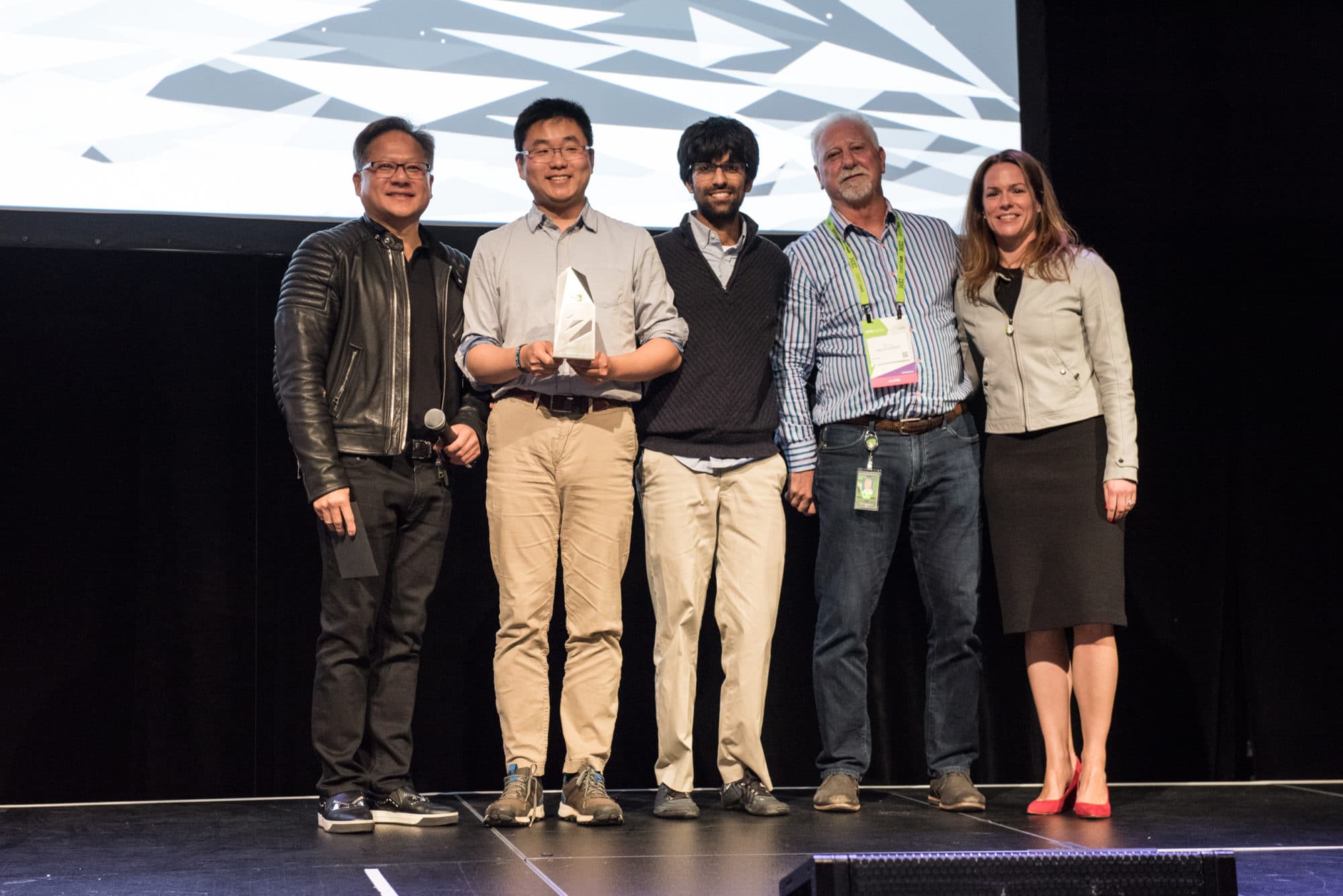
In 2018, AiFi won the enterprise category of NVIDIA’s Inception Awards. It was one of three winning startups sharing a $1 million prize pool. In the award photograph, Gu stands holding the trophy beside AiFi technology director Kaushal Patel, with NVIDIA’s Jensen Huang and Chris Malachowsky also on stage.
An earlier account of the competition described Gu’s proposed use for a win: opening a physical shop in Palo Alto where the team could continue refining the technology. That is a useful detail in a business full of presentation slides. His proposed laboratory had a front door and merchandise.
A trophy can confirm that other people find an idea promising. A store asks less flattering questions. Can someone enter easily? Can the system account for what they take? Can the operator arrange the shop in a way that suits the business? The customer is unlikely to offer extra patience because an algorithm has won something.
In February 2019, Swiss retailer Valora announced a collaboration with AiFi on a k kiosk box concept. The planned shop was roughly 20 square metres. Modularity was part of the proposition: the NanoStore could be adapted to local requirements. Here was a particular footprint and a particular retail partner, rather than a universal store imagined in the abstract.
Twenty-five doors in six months
Żabka’s first Nano store opened in Poznań in June 2021. By the following January, the Polish retailer announced 25 locations launched within six months in partnership with AiFi. The concept used cameras and machine learning to recognize products removed from shelves and complete payment when a customer left.
The entry method also evolved. Early stores used the retailer’s mobile app; the store-within-a-store format allowed entry with a payment card. That detail belongs beside the deployment count. Removing a checkout queue would be a peculiar victory if getting through the entrance became an elaborate homework assignment.
Another setting was the workplace. In December 2021, Compass Group Ireland announced plans for a frictionless food store using AiFi. The appeal was ordinary and immediate: workers could pick up food around the demands of their day. Gu’s technology was finding settings where a few saved minutes could have a clear purpose.
The company announced a $65 million Series B in March 2022, with participants including ALDI South Group, Żabka Group, REWE, Verizon Ventures and Qualcomm Ventures. Retail customers were also among the investors. That put people who understood store operations closer to the company’s next stage.
Then there was a less conventional sign of recognition. In a March 2022 conversation, Gu pointed to Saturday Night Live’s Amazon Go parody as evidence that checkout-free shopping was becoming familiar. Comedy had joined the market education department. Once the audience knows enough to get the joke, a founder can spend a little less time explaining the premise.
The next interface has a face
Gu’s time as AiFi CEO ended before his next company took shape. Steve Carlin assumed AiFi’s CEO role in August 2022. Gu went on to co-found bitHuman, founded in 2023, and became its CEO. The new project brought him back to the question of how people interact with a computer.
The change is visually striking. AiFi asked cameras to understand what people were doing. bitHuman gives an AI interaction a visible character. The link between them is an editorial reading of the career: both bring computing into places where people are occupied with something more immediate than operating software.
At the 2024 National Retail Federation show, Gu described agents deployed at eight locations to greet attendees, answer questions and direct them to booths. He also discussed characters that could be cartoonish rather than humanlike. A helpful guide need not arrive wearing the digital equivalent of a business suit.
His public bitHuman launch post emphasized curiosity, audacity and innovation. The company’s site now offers characters with names including Wise Pup and Grumblewick, along with tools for developers to put avatars into apps. It is a more playful cast than a row of checkout machines. The practical question remains: what can the visitor get done?
Thirty seconds is a very long hello
For an interactive character, waiting creates a fresh version of the old problem. A digital assistant that appears slowly has already made the customer spend time before it offers to save any. The queue has migrated from the till to the screen.
A Cerebrium case study describes bitHuman instances that had taken more than 30 seconds to start. After an infrastructure change, it reported cold starts below 10 seconds and warm starts below three. Those figures concern starting the service, rather than a guarantee about every conversational response. The distinction matters when the product promises an immediate encounter.
The account also contains a small founder’s surprise. Gu, whose work had centered on management and technology direction, found himself able to deploy and manage services directly. The chief executive could get closer to the operational machinery. After years of building interfaces for other people, he had become a beneficiary of a simpler one.
His GitHub profile uses the description “Professional Daydreamer.” The repositories underneath it include an example bitHuman viewer and video-gallery projects. On the page, the whimsical job description sits above practical code. The juxtaposition suits a career in which imagining the interaction is followed by the less glamorous task of making it run.
What happens to the saved minute?
Gu’s path gives the word interface a rather expansive meaning. A touch-sensitive device is an interface. So is the entrance to a checkout-free shop. So is a talking character that helps someone find a product. Each decides how much effort a person must spend to get an ordinary result.
As of October 2026, bitHuman’s public site describes avatars that can run on a device, inside an app or through its cloud. It shows a barista character, a shopping guide and a presentation that can be interrupted. These are examples the company offers today, alongside the broader ambitions Gu has voiced for interactive AI.
The interesting measure for the customer is smaller than the ambition. A purchase is completed. A direction is understood. A question receives a useful answer before the person loses interest. The machinery can be complicated; the person’s purpose often has the refreshing simplicity of wanting to get on with the day.
That brings the story back to the basket. Parenting helped make the checkout queue feel like a problem worth solving. Years of research supplied the means to attempt it. A second company has given Gu another place to work on the interval between wanting something and getting it. The saved minute, after all, belongs to someone.