A mobile tower has a peculiar place in modern life. People want the signal and tend to have fewer affectionate thoughts about the steelwork. Steve Butler built a business around that gap between what a network promises and what somebody must actually install. Years later, his attention has moved to another piece of essential infrastructure with limited glamour: the connection that lets electricity projects join the grid.
Butler is the founder and chief executive of Symphony Infrastructure Partners, a business established in 2022. Its territory includes the substations, switchyards and transmission infrastructure serving energy and digital projects. The equipment is substantial; the underlying proposition is compact. Bring together the people who can deliver a connection, the capital to support it and the responsibility for its operation.
Read his career across the two industries and a pattern comes into view. He keeps returning to the infrastructure behind somebody else’s product. Mobile carriers sell communications. Renewable developers build generation. Each needs a physical route into a wider network. Butler has made that route the business.
A tower business before the turbines
The first chapter was Stilmark, established in 2013. As founder and CEO, Butler led a specialist developer, owner and operator of mobile-network towers. Its partners included carriers, councils and communities. A tower business must bring those interests together in a particular place, then make the resulting asset useful over a much longer period than its construction takes.
The distinction between building and owning matters here. A builder can finish a job and move on. An infrastructure owner remains attached to the economics and usefulness of the asset. Stilmark’s model placed the company in that longer relationship. The mast stayed in the landscape; the commercial relationship was designed to stay with it.
“Onwards!”
Steve Butler’s recurring public sign-off
By 2018, Butler was also part of South Australia’s wider entrepreneurial conversation. When the FIXE start-up hub at Lot Fourteen was launched, he was named on the newly established Entrepreneurship Advisory Board. His fellow members included founders working in solar, cybersecurity, space technology and virtual reality. Telecommunications infrastructure had a seat among businesses whose products could otherwise appear far removed from towers.
His 2020 conference biography also recorded a 2018 EY Entrepreneur of the Year award for the Central region. At that conference, the subject attached to his appearance was telecommunications infrastructure and resilience in local communities. It was a practical setting for a business whose assets had to work beyond the boundaries of a metropolitan sales pitch.
Institutional partnerships became part of the Stilmark story. In 2020, the company announced a consortium with OMERS Infrastructure and ATN International to pursue Australian telecommunications infrastructure opportunities. Butler spoke about competition and partnerships with customers. New sites and existing infrastructure both figured in the opportunity, alongside the deployment of 5G networks.
Those details are useful because they precede Symphony. The ingredients were already present: infrastructure ownership, customers planning their own expansion, and an investment partner able to help finance growth. Butler was working on the relationship between the physical asset and the commercial arrangement around it. A tower required steel, but steel alone was an incomplete business model.
The second network
On 22 June 2022, OMERS announced an agreement to acquire Stilmark. The company had delivered development and construction projects for TPG and Optus, and had assembled a national tower portfolio and pipeline. Its sites were secured under long-term revenue agreements. OMERS did not disclose the transaction terms.
The buyer had recently agreed to acquire TPG Telecom’s tower and rooftop portfolio as well. Stilmark would join a broader Australian digital infrastructure investment effort. In his public response, Butler thanked the team and others who had helped reach the milestone. He ended with a word that appears repeatedly in his posts: “Onwards!”
For Butler, onwards led to electricity. Blackstone dates Symphony’s founding to 2022, putting the beginning of the new business in the same year as the Stilmark acquisition agreement. The two milestones make an unusually clear hinge in his career: one network business entering a larger ownership structure while another began taking shape.
By the public launch chapter, the cast included Richard Phillips, Nathan Gooley, Richard Lowe and Will Jacobsen. The proposition brought investment in delivery capability together with a network infrastructure offering. Butler’s response to the launch was brisk: “A big lift from the team to reach the start line, now we get on with it.”
There is a small but telling choice in calling a launch the start line. Announcing a platform is the easy part to put into a paragraph. Making its constituent businesses work together is the continuing assignment. Symphony’s clients require engineering and construction as well as a commercial arrangement that lasts beyond the announcement.
A$488 million, with work attached
Blackstone announced its investment on 18 July 2024. The money came through its Tactical Opportunities strategy. Butler’s comment centred on access to capital and the ability to grow the business. He described the partnership as bringing “incredible scale and access to capital”. Those six words explain the immediate attraction without requiring much translation.
The wider package combined A$300 million from Blackstone with a A$188 million senior debt facility from Commonwealth Bank of Australia. Together, the A$488 million financed a substantial assembly job. Symphony completed the acquisition of five portfolio companies, adding to its existing businesses and bringing the workforce above 1,000 at the time.
The financing also exposes the number of relationships behind a founder’s apparent solo act. Gooley was identified as CFO, Damien Hughes as general counsel, and Louise Sexton in governance and company secretarial work. Lazard Australia was financial adviser. Allens and Kain Lawyers assisted with the transaction and acquisitions. An infrastructure platform has a considerable backstage crew.
The operational question after such a transaction is whether the assembled capability can behave as a coherent business for customers. Symphony’s offering spans connection strategy, engineering, construction, commissioning and operation. Ownership is part of the proposition too. The point of bringing those activities together is to keep responsibility attached as a project moves between them.
The company now reports more than 1,300 people in its in-house national team. It also reports team experience covering more than 11.7 gigawatts of managed grid connections and more than 100 high-voltage substations delivered. These are measures of the capability gathered around Butler; they should be read as the team’s record, rather than a personal construction tally.
The argument behind the engineering
Butler’s second infrastructure chapter also includes a public argument about competition. On 28 January 2025, he signed Symphony’s submission to the Australian Energy Regulator on proposed transmission ring-fencing changes. The issue was the relationship between regulated network providers and businesses competing to deliver connection services.
Symphony supported stronger separation and argued that independent providers needed a fair opportunity to compete. It raised concerns about access, commercially sensitive information and the advantages available to network providers’ related businesses. Those were the company’s positions in a regulatory debate, with direct consequences for the market it wanted to serve.
For a reader following Butler from towers to transmission, the continuity is striking. His earlier public comments at Stilmark had also emphasised competition in infrastructure. Both businesses involve customers seeking access to a network. Both depend on capital committed to physical assets. The rules around that access can shape the opportunity as much as the ability to build.
That gives his founder story a less decorative centre than a new technology reveal. He is working on the organisation of delivery and ownership, and on the conditions under which customers can choose a provider. A better connection requires the equipment to work. His commercial argument adds another requirement: the market around it must permit a workable choice.
- 2013Stilmark established
Mobile towers - 2022OMERS acquisition agreement
Symphony founded the same year - 2024Blackstone investment
Five acquisitions supported by financing - 2025The competition argument
Submission to the energy regulator
A home-state connection
Tasmania supplies a more personal thread. Butler describes it publicly as his home state and has voiced support for Westcoast Renewable Energy’s projects. His comments place Symphony within a larger regional effort, alongside developers and public decision-makers. The language becomes warmer when the location is home.
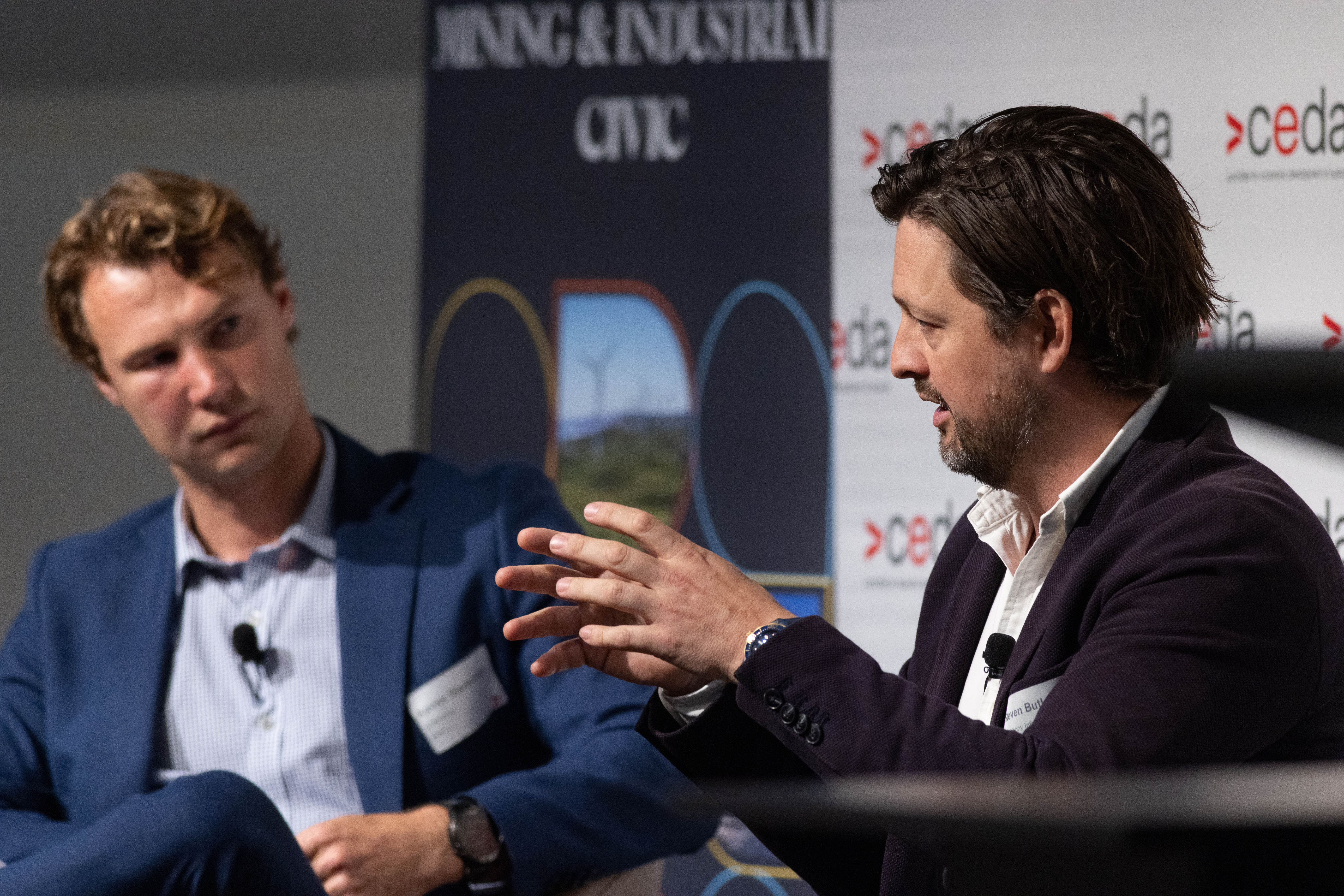
He has also appeared at CEDA’s discussion of Tasmania as a digital infrastructure location. The event brought together government, education and industry participants to consider investment, approvals and workforce needs. In the panel photograph, Butler is speaking with one hand raised, among people discussing what the state would need to make that opportunity practical.
The digital connection is becoming increasingly explicit in Symphony’s work. Butler has publicly welcomed a partnership with Nexthop combining high-voltage power infrastructure and fibre connectivity. It brings his old and new sectors into the same conversation: customers planning digital infrastructure need both an electricity connection and a data connection.
His updates also direct attention towards people doing the physical work, including ART field crews installing wind-measurement equipment. The tone is appreciative and forward-looking. Read alongside the transaction announcements and policy submissions, those posts show the range of the chief executive’s public attention: finance, regulation, regional partners and the teams out on the job.
That range is the substance of Butler’s second act. The business he founded must turn a collection of capabilities and commitments into functioning connections. The promise will be tested through delivery and years of operation. A tower, a substation and a fibre route each have their own engineering. Butler’s recurring interest is in getting the people and the obligations to meet at the same place.
Keep the connection
Explore Butler’s work, public updates and the milestones in this story.