Steve Burke once had conference shirts printed with his company’s name backwards. AGORA became AROGA. For an executive whose business depends on getting complicated numbers into the right order, the alphabet had staged a modest rebellion. He has since entrusted proofreading to his team. It is a useful introduction to a founder prepared to put his own mistake into circulation.
His more consequential preoccupation concerns the order in which money moves after somebody buys a car. A dealer finds the vehicle, prepares it and makes the sale. A financing contract can continue producing income long after the customer has driven away. Burke has spent much of his career working around that contract: creating it, buying it, managing it and finding capital against it.
Today he is the co-founder and chief executive of Agora Data, the Arlington, Texas business launched in 2017. Its work connects auto-loan originators with analytics and financing. The customer Burke keeps returning to is the smaller dealer trying to operate in a market where larger financial institutions arrive with rather more equipment.
The view from both sides of the desk
Burke began as an owner and operator in the Texas buy-here-pay-here dealership business, where the dealer also provides financing. In that setting, access to money affects how much business can be done. The financing question arrives with the inventory question. Knowing how to sell another vehicle does not, by itself, supply the capital to finance it.
He moved into point-of-sale subprime lending and helped build One Hour Acceptance, which financed its business through pools of auto loans. By his account, he was working with securitization in the early 1990s. He later led FSB Financial, buying existing loans from banks, credit unions, dealers and finance companies. A contract already written became the starting point of another transaction.
FSB was sold to BB&T and its Regional Acceptance subsidiary. Burke stayed to manage acquisitions, then went on to SFG Finance and Center Street Finance. The latter managed portfolios for banks and hedge funds. These were different jobs, but they kept him close to the same questions: what a loan was worth, how it might perform, and who could finance it.
That route gave him experience with the dealer seeking capital and the institution deciding what to buy. By the time Agora appeared, he had occupied both seats. His proposed customer was someone whose work he had done; the institutional machinery was something he had operated. The distance between those two worlds became the company’s territory.
First, make the numbers speak to one another
Agora’s April 2017 launch addressed the trading of auto-loan portfolios. Its cloud-based exchange let buyers and sellers deal directly. Burke identified inconsistent data, opaque brokerage practices and the handling of consumer information as problems in the existing process. Before the company could offer a different financing route, it needed to make the underlying transactions easier to understand.
There is little glamour in standardizing records from different systems. There is, however, considerable difficulty in comparing information that refuses to line up. Agora integrated with ten systems in 2017 so dealers could send native data into its platform. Burke’s early data pool of $8 billion in non-prime loans grew to $12 billion.
Agora Insights followed in 2018, giving dealers ways to compare their portfolios with those of other operators. Book-value tools addressed another uncomfortable part of selling a portfolio: knowing what it might be worth before a potential buyer names a price. Information became something a dealer could bring to the negotiation.
Burke described the early exchange as reciprocal. Dealers supplied data and received useful analysis. The attraction was practical: a better view of their own business. Aggregated information also gave Agora the material with which to develop its models. The platform’s progress depended on enough individual operators deciding that this exchange was worth their time.
- 2017Connect loan buyers
and sellers - 2020Pool smaller
originators’ loans - 2025Complete a first
rated transaction - 2026Add Figure’s
blockchain rails
A small dealer, in a larger pool
On December 29, 2020, Agora completed the transaction it described as the first crowdsourced auto securitization. The important idea was aggregation. Smaller originators could participate together in a financing structure whose demands for scale and analysis had helped keep it out of their individual reach.
The second transaction, ACAST 2021-1, closed on May 27, 2021. By that point the AgoraCapital program had connected forty buy-here-pay-here dealers and finance companies, representing nearly $200 million in subprime auto loans, with capital-market financing. The figures describe a program across two transactions, rather than one dealer suddenly becoming a very large bank.
For Burke, the attraction was room for operators to plan and grow. An owner might be capable of making more loans yet constrained by the financing available to the business. Pooling gave those individual portfolios a collective route outward. The company’s role included the technology and analysis needed to make that route workable.
In June 2025, Agora announced its first rated asset-backed securitization, a $112 million transaction following four private securitizations. The announcement put annual lending capacity above $1 billion. Capacity and lending actually completed are different measures, but the development showed the business adding another funding channel. A marketplace had become a participant in a more varied financing system.
Agora’s first rated asset-backed securitization, following four private transactions.
“Our number one driver is really creating a community”STEVE BURKE · CONSUMERFI, 2021
The family has stayed in the business
Burke’s career also has a family chronology. He joined SFG Finance, a company his father had started. Later, his own sons became part of Agora’s founding story. His son Matt is now its president and chief operating officer. Finance here has passed between generations as actual work, with portfolios and operating responsibilities attached.
There is a parallel history outside the company. Steve helped establish the National Automotive Finance Association. In a 2021 conversation with fellow founder Jack Tracey, the association’s early days were already twenty-five years behind them. The exchange included the sort of teasing about the passage of time that survives only among people with a long acquaintance.
In June 2026, Matt became the association’s president. Thirty years after Steve’s role in its founding, the family connection had reached the leadership of the same trade organization. It is an unusually concrete measure of continuity: the next generation taking a formal role in a professional community the previous one helped assemble.
Burke’s network has also brought legal experience into the company’s orbit. Consumer-finance attorney Tom Hudson joined Agora’s advisory board in 2018, after years of working with Burke. The connection fits the work. Loan trading requires attention to documentation and compliance alongside pricing, modelling and sales. A useful financing idea must survive contact with the paperwork.
A founder who keeps explaining the loan
Much of Burke’s public work consists of explaining this business to the people who might use it. At CBT Now in 2024, he appeared with finance-and-insurance specialist Becky Chernek to discuss how dealers could participate in financing income. The proposition extended the dealership’s attention beyond the margin on the vehicle itself.
The discussion included staff training, portfolio dashboards and support for dealers adopting unfamiliar processes. That detail matters. A new financing arrangement still has to be understood by the people working the deal. The dealership cannot simply add a sophisticated model to its stationery and expect everyone to know what happens next.
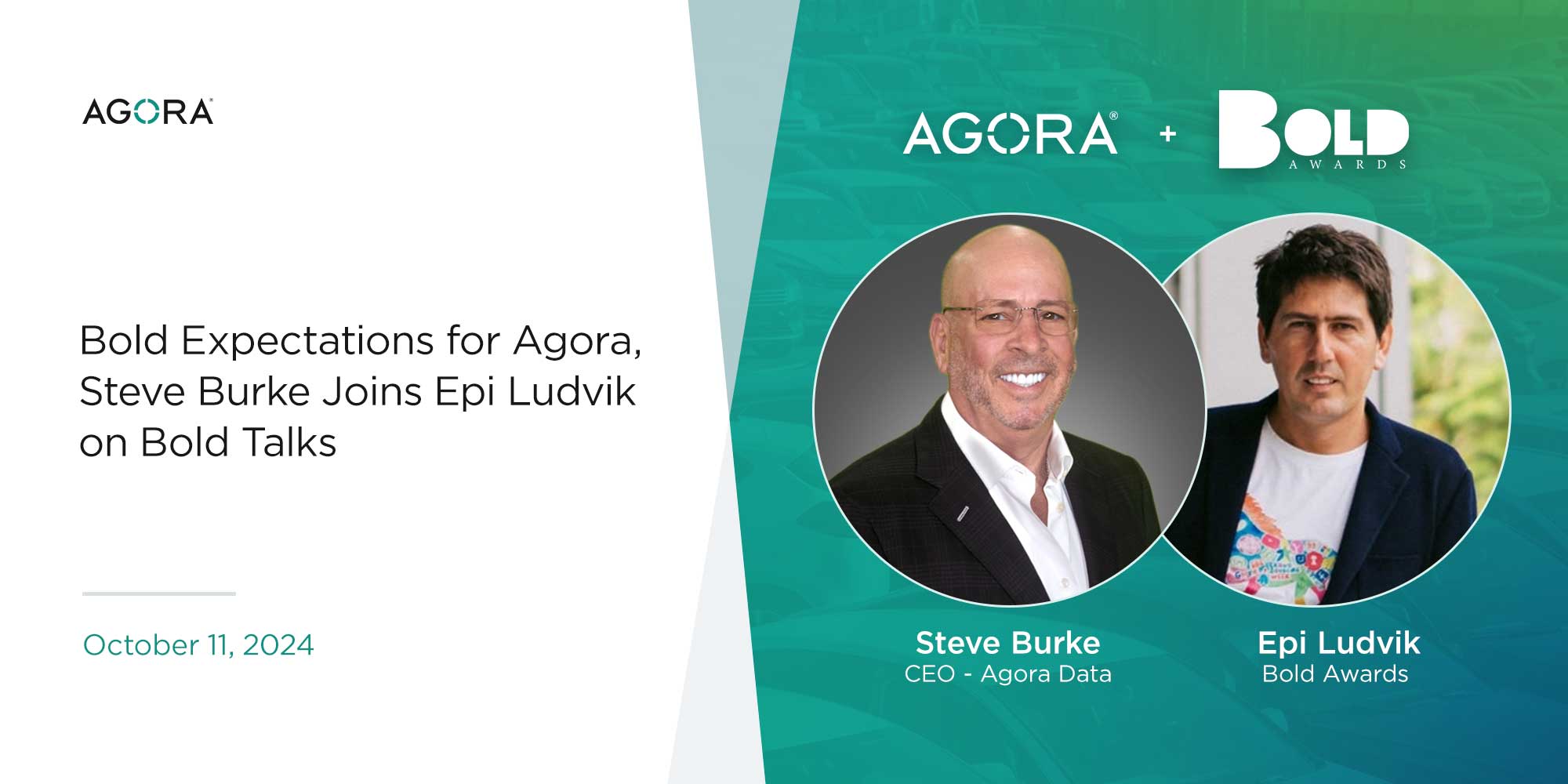
His 2024 conversation with Epi Ludvik returned to the obstacles of scale and sophisticated modelling. That year he was also named one of forty-seven EY Entrepreneur Of The Year Southwest finalists. It was recognition of his work as a founder, alongside the continuing, less ceremonial job of persuading dealers to consider a different approach to finance.
By July 2025, he remained conspicuously optimistic. Speaking at the independent dealers’ annual convention in Las Vegas, he suggested 2026 could be an especially strong year for the car business. It was an outlook, rather than a result. In a career concerned with forecasts, the distinction deserves to remain visible.
The blockchain chapter begins at the car lot
In February 2026, Agora and Figure announced a partnership involving tokenized auto loans. Agora’s ALTRUVO platform would use Figure’s infrastructure and marketplace to bring those assets to investors. Figure also announced an equity investment in Agora. For Burke, the new technology supplied another possible funding route for the business he had already been building.
The responsibilities were specific. Agora would continue originating loans within its own systems and underwriting framework. Figure would perform quality-control checks, ingest the data and tokenize it on the Provenance Blockchain. The loans could then connect with warehouse funding, whole-loan sales and securitization through Figure’s marketplace.
“We’ll maintain control of origination, servicing, and underwriting,” Burke said when the partnership was announced. The allocation is revealing. His company would keep the operational work closest to the borrower and dealer, while its partner supplied additional capital-market infrastructure. The announcement expected tens of millions of dollars in assets to follow in the coming months.
On March 9, Burke reported, Agora tokenized auto loans and received US dollars. His subsequent public posts tied the development to ALTRUVO and Figure. The vocabulary had changed considerably since his dealership days. The underlying ambition remained familiar: find another way for the originator to reach money beyond the limits of the local operation.
There is a pleasing persistence to that career. Burke has changed institutions, products and technologies while continuing to examine the contract that follows the car out of the lot. It is work that has involved his father, his sons, long-standing colleagues and a growing collection of financing structures. The vehicle sale remains the beginning. Burke keeps attending to what the dealer can build after it.