Before a car becomes transportation, it is somebody’s financial decision. Someone must put up the money. Someone must hold the title. Someone must decide whether the person who needs the keys is a reasonable bet. FAM AUTOS rearranges those roles around a familiar cast: the driver, the people who know them, and the dealer with a car to sell. The result is a vehicle-funding proposition with an unusually personal question at its center. What kind of help do you want to give?
- Support a vehicle campaign with a gift or a fractional investment.
- FAM says it buys fully funded cars; a vehicle-specific LLC holds title.
- Dealer listings are free. Optional Inventory Boost costs $149 a month.
A gift with a privacy setting
The company calls its platform Family & More. A campaign presents a vehicle, a creator’s story and a funding goal. Supporters choose between giving money with no expected return and investing for fractional ownership. Both choices move the same campaign forward. They create very different relationships with the car.
Then comes the detail that makes this more interesting than another fundraising page. The creator sees the total raised, while the gift-versus-investment split stays private.
There is a social observation inside that interface. Helping a relative can involve more than deciding how much to send. Is it a present? An obligation? Something to be repaid? FAM lets the contributor choose a financial position without making the campaign’s public progress depend on advertising that choice.
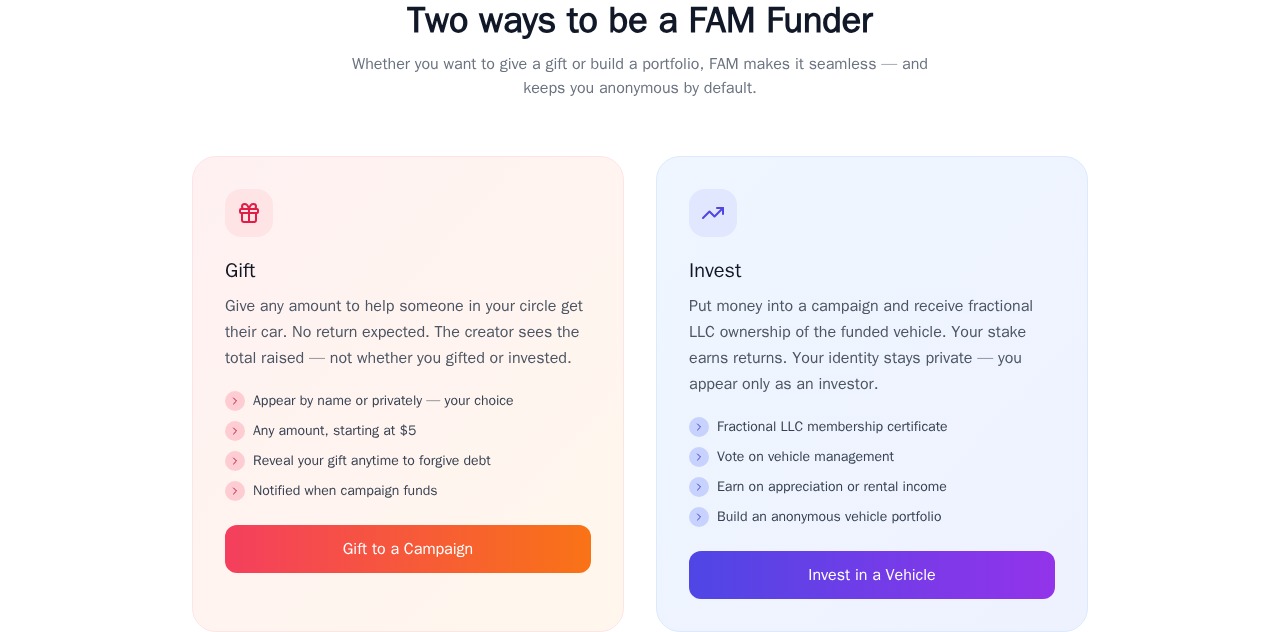
The funder page advertises gifts starting at $5 and lets contributors choose whether to appear by name or privately. It also describes a later option to reveal a gift and forgive the corresponding part of the creator’s balance. Privacy, in this design, concerns the relationship between participants as well as the information on a screen.
“The creator sees the goal. Not the split.”
FAM Funder · Public product page
The car has its own company
The decisive moment arrives after fundraising. In FAM’s published account, a fully funded campaign leads to FAM purchasing the vehicle outright from the dealer. A separate limited liability company holds the vehicle title. The driver accesses the car through a retail contract, and investors receive membership certificates representing fractional interests in that LLC.
This matters because helping to buy a car can sound simpler than the arrangement actually is. The person driving and the people holding an ownership interest occupy different positions. FAM’s explanation separates them, then supplies an administrative structure for the relationship that continues after the campaign closes.
- 01Choose a campaignVehicle + story + funding goal
- 02Gift or investSeparate choices; one visible total
- 03FAM purchasesDealer receives a cash purchase
- 04Ownership continuesLLC, driver contract, investor interests
The company says payments from the driver flow through the LLC and are distributed proportionally to members. FAM manages the ledger. Its post-funding guide also describes investor votes on maintenance, insurance, payment difficulties and eventual disposal. FAM says its own stake never exceeds 10%.
The pitch therefore reaches beyond finding money for a purchase. It includes administering a small ownership group around a working asset. A campaign can finish in a burst of enthusiasm; a car still needs decisions months later. That is where the proposed service becomes less like a collection jar and more like an ongoing financial relationship.
A dealer’s $149 choice
For dealers, FAM presents a different attraction: sell the vehicle for cash after a campaign funds. Its dealer page describes inventory synchronization from a dealership website, a standing-offer process and payment within five business days after title transfer. The advertised acceptance window is 24 hours.
The basic listing tier costs nothing. It includes unlimited vehicles, QR-code materials and an embeddable inventory widget. Inventory Boost, advertised at $149 per month, adds prominent placement, a featured dealer badge, priority in campaign matching and monthly performance reporting.
That paid upgrade supplies a concrete business-model detail. FAM offers access at no listing charge and sells extra visibility to dealers who want it. Its dealer article makes a particular case for older vehicles, higher mileage and awkward inventory that conventional financing may struggle to accommodate. Those are the cars its model is intended to help move.
The marketplace has to appeal to three parties at once. Drivers want access. Supporters want a clear choice about their money. Dealers want a completed sale. The product’s work is to make those interests meet around one vehicle.
Three friends count as a Power FAM
FAM’s group-funding idea comes with an unexpectedly ordinary instruction: share a link. Its Power FAM guide describes families, friends, community organizations and workplace groups coordinating around a campaign. Each person contributes individually, choosing an amount and whether to give or invest.
The guide says three contributors can constitute a Power FAM. No special group application is necessary for that coordination. Each investor keeps an individual position rather than acquiring a slice of one shared group stake. Coordinating contributions does not automatically turn the participants into a voting bloc.
There is a distinction between that published playbook and a dedicated group product. The funder page marks group creation, investment clubs, support pools and managed group accounts as coming soon. Readers can borrow the coordination method today: identify one goal, give everyone the same link, and let each participant make a separate choice.
Familiarity is the proposition
FAM sits between the familiar options of borrowing for a vehicle and asking people to help pay for one. Its distinction is the combination: a campaign that accepts gifts alongside fractional investment, followed by a vehicle-level ownership arrangement and dealer purchase.
That combination depends on willing contributors, sufficient funding, an available vehicle and a driver able to meet the continuing contract. Knowing someone gives a supporter context. It cannot, by itself, keep a car running or make every payment affordable. Ownership and maintenance still need an arrangement everyone understands.
The useful idea to copy is the separation of choices. A group can pursue one practical outcome while its members participate on different terms. FAM AUTOS builds its proposition around making those terms coexist. The fundraising total gets the attention. The quieter work is deciding what everyone owns afterward.