A paragraph can live a surprisingly complicated life. It can appear in a letter, acquire a cousin in another department, change its wording for a different product, and turn up years later in a document nobody remembers commissioning. Steve Biancaniello has spent much of his working life attending to this sort of administrative genealogy. Where a reader sees a few lines of text, the Messagepoint co-founder sees a system that somebody will eventually have to maintain.
His interest reaches down to the exceptions. In a 2016 essay, he asked readers to consider a piece of language that appears just once in a collection of 1,000 letters. Does it deserve its solitary existence? Sometimes it does. Sometimes it has simply survived. The distinction matters when an organization wants to change what it says without inspecting every document by hand.
It is an unusually small object around which to build a software career. Yet the paragraph is a useful place to meet Biancaniello: an engineer, a founder, a former professional services leader, and now the CEO of a company trying to make complex communications easier for people to control.
The engineer at the sentence level
Biancaniello studied systems design engineering at the University of Waterloo, earning a Bachelor of Applied Science. He followed it with a Master of Applied Science in management sciences, specializing in information systems. His official biography still puts the professional engineering designation beside his name. The education is relevant to the way he describes his work.
“I am an engineer by training,” he wrote in that 2016 article. His interest was in recognizing recurring structures within correspondence and reducing the inventory to reusable components. A company could define those components consistently, then assemble them into the communications it needed.
The choice of language is revealing. He writes about pieces, patterns and assembly. There is an editorial consequence to that technical vocabulary: a company has to decide which variations convey something meaningful and which merely make its collection harder to maintain. Better typography cannot settle that question. Someone has to read the words.
An illustration of the approach in Biancaniello’s writing, rather than a product performance measurement.
Before the platform had the company’s name
Biancaniello and Nick Romano co-founded Prinova in 1998. The business began with consulting in document automation and later developed software. That order gives his career a particular shape: the company spent its early years helping organizations implement communications systems before its own product became the center of attention.
In a 2011 announcement expanding the management team, Biancaniello was identified as co-founder and vice president of professional services. By the time of his 2016 essay, his biography described him as co-founder and chief operating officer. These were roles close to the machinery of delivery: the people, processes and customer work through which an enterprise software business has to make its promises concrete.
There was a technical contribution, too. A patent application published in 2008 for a system and method of customer touchpoint management named Biancaniello among its inventors, alongside Romano and four others. Its subject was the management, delivery and tracking of dynamic content. The vocabulary has evolved since then; the interest in controlling how information reaches customers is recognizable.
In 2014, the Canadian insurer The Co-operators selected Prinova and Messagepoint for customer communications work, including transactional communications and business-user control of policy and letter content. The product was already serving the practical purpose that would recur in Biancaniello’s writing: letting the people responsible for a message make changes more directly.
A business built around the work
Prinova received a $17 million investment from Volition Capital in 2016. The stated purpose was to support growth and further innovation in the Messagepoint software platform. Roger Hurwitz and Jake Colognesi joined the board as part of that investment. The business had attracted capital around a problem that sounds mundane until a company has to solve it at scale.
Effective March 1, 2017, Prinova became Messagepoint. The announcement explained that the platform had become the organization’s primary focus. Romano was still named CEO in that announcement. By the company’s 2018 NewSpring investment announcement, Biancaniello was identified as co-founder and CEO.
His responsibilities now extend across strategy and operations, and the leadership page also lists him on the board. The transition from services and operations to company leadership is a more useful account of his progress than the familiar shortcut in which a founder appears to occupy every job from the first day.
- 1998Prinova begins
- 2016$17m Volition investment
- 2017Messagepoint becomes the company name
- 2026Sefas acquisition announced
The quotation beside his desk
One of the more personal details in Biancaniello’s published writing concerns his desk. In his essay “Clean and Simple,” he described keeping a Steve Jobs quotation nearby. It concerns the effort required to think clearly enough to make something simple. For a software executive, this is a demanding item of office decoration.
His application of the idea is concrete. Give business users more control over authoring. Keep content somewhere people can find and reuse it. Reduce the complexity of managing communications across different channels. Simplicity, in this account, involves reorganizing the work that happens before a customer receives anything.
There is a pleasing tension here. The customer wants a clear message and a straightforward next step. The organization sending it may need rules for products, regions, approvals and individual circumstances. A clean result can depend on considerable structure underneath. Biancaniello’s work is occupied with that structure, including the unglamorous question of who has permission to change a sentence.
AI, before the conversation grew louder
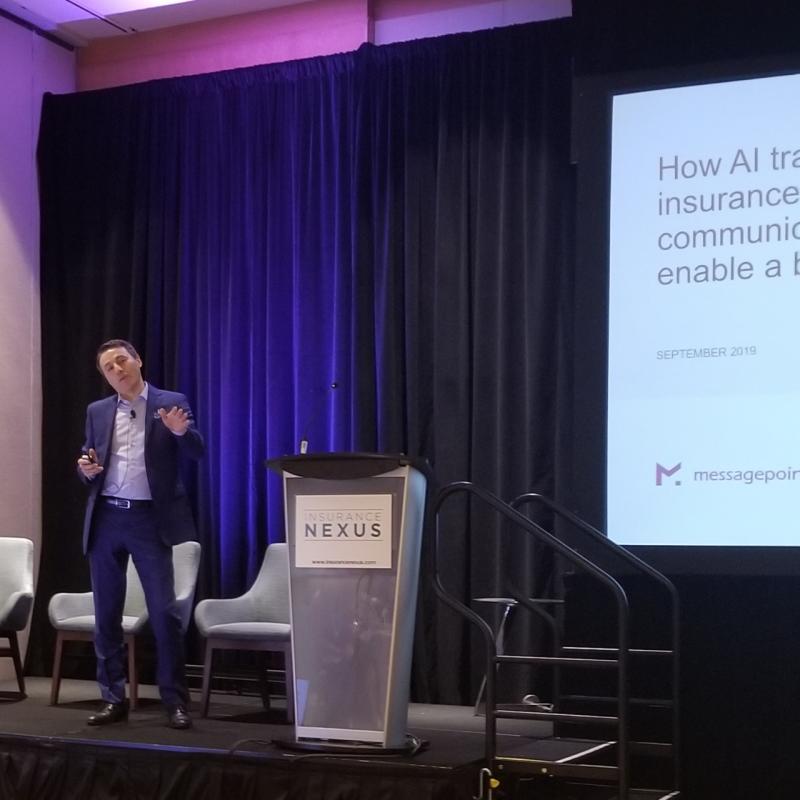
In July 2019, Biancaniello published an article about using AI to improve customer communications. The applications were specific: find duplicate or similar content, check brand consistency, assess reading levels and examine sentiment. These are recognizably editorial chores. They also become difficult to carry out consistently across a large inventory.
He was interested in tools that could flag problems and offer improvements while people were authoring content. One example involved telling an author that the material they were about to create already existed. The useful intervention happens before another duplicate joins the collection.
His public appearances followed the same thread. At Messagepoint’s February 2020 Content Centricity conference in Orlando, he opened with a presentation about content intelligence. The program included customer experience specialist Jeannie Walters, Adam Toporek on the psychology of language, and Aspire founder Kaspar Roos on AI’s role in the communications market. The agenda placed software, language and the recipient’s experience in the same conversation.
A PDF still carries the habits of paper
In a 2023 conversation with Roos, Biancaniello discussed organizations whose digital efforts remained concentrated on email and PDF versions of printed documents. His concern extended to the internal arrangement of the work. Separate channel teams could duplicate effort and produce inconsistent content.
He argued for central management that could supply personalized information to different destinations, including mobile applications. The organizational implication is substantial: each additional channel need not acquire an entirely separate content operation. A message still needs to remain coherent as it moves between formats.
This also explains why his career keeps returning to content rather than the finished page. A page is one destination. A reusable piece of information can serve several. For a reader, the benefit is ordinary and worthwhile: the company should be able to tell the same story wherever the conversation continues.
From a partnership to a larger remit
Messagepoint’s relationship with Sefas began as an OEM partnership announced in 2021. Sefas brought composition and enterprise communications processing capabilities into the offering. In March 2026, Messagepoint announced that it had acquired the company, extending a relationship that already involved working products.
The acquisition added scope across production, orchestration and digital delivery. Biancaniello described the aim in terms of more integrated customer communications. The mechanics matter to that ambition: deciding what a message says is one responsibility; composing, delivering and tracking it creates several more.
There is continuity with the services background here. An enterprise customer needs the whole process to function. A well-managed paragraph still has somewhere to go.
An assistant that needs an undo button
Messagepoint announced MARCIEAssist in June 2026. Users describe a desired outcome in ordinary language, and the software plans and executes supported actions across content, rules, data and templates. Its published controls include role-based permissions, audit trails and rollback. The proposed work remains subject to human oversight.
In July, Biancaniello summed up one obstacle with unusual economy: “For regulated industries, autonomy can be a scary word.” His stated ambition is a communications system in which AI can carry out work within established governance. The emphasis falls as much on the boundaries as on the activity inside them.
“For regulated industries, autonomy can be a scary word.”
Steve Biancaniello · July 2026
On September 30, Messagepoint announced a Stratus Award for MARCIEAssist in the Agentic AI/Autonomous Cloud Operations category. Biancaniello emphasized useful work completed under enterprise controls. The product pairs AI planning with a deterministic execution engine, preserving an approval step and a record of actions.
The latest chapter brings him back to a familiar concern. Somewhere inside the organization, someone needs to change what a customer will read. The system should help them make that change, understand its consequences and keep control of the result. After a career spent examining the pieces, Biancaniello is still working on how they fit.
Continue the conversation
Explore Biancaniello’s work, writing and public conversations.
- Messagepoint - company and platform ↗
- Steven Biancaniello on LinkedIn ↗
- Biancaniello’s writing at Messagepoint ↗
- The 2016 essay on patterns and correspondence ↗
- Clean and Simple - the quotation beside his desk ↗
- The July 2026 conversation about governed AI ↗
- Content Centricity 2020 - conference recap ↗
- MARCIEAssist’s September 2026 Stratus recognition ↗