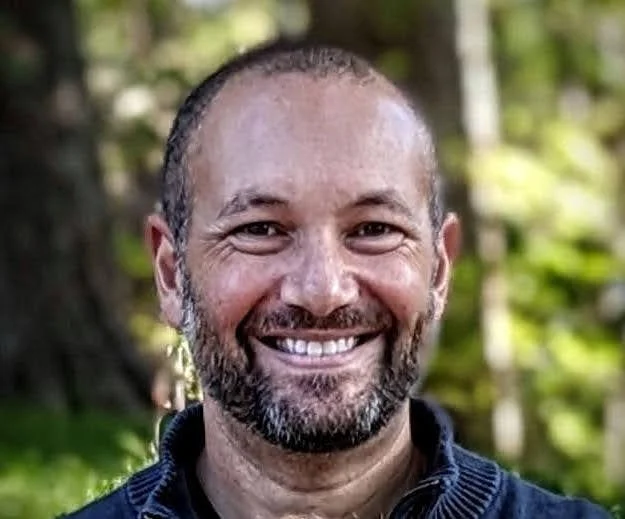
There is a particular species of person in the video game industry who never appears on a poster. They do not design the combat system. They do not write the twist. They are the ones who look at a calendar, then at a build that crashes on Tuesdays, and quietly work out how to get from one to the other without anybody having a breakdown. The trade calls them producers. Steve Arnold has been one for over twenty years, and the résumé that resulted is so scattered across genres that it reads like a dare.
Consider the range. Golf simulations. Plastic guitars. A Crytek shooter. A surrealist reimagining of Lewis Carroll. Then virtual reality at the exact moment virtual reality was deciding whether it was a revolution or an expensive hat. And now, in 2026, an Arctic folktale, an ocean documentary you can swim through, and a city-building game rendered in claymation.
You could call that a lack of focus. You would be wrong, but you could call it that.
Economics, With a Specialization in Computing
Arnold arrived at UCLA in 1999 and left in 2003 with a BA in Economics, specialization in Computing. Note what that degree is not. It is not a game design MFA. It is not computer science. It is the qualification of somebody who wanted to understand how systems allocate scarce things, and who also wanted to know how the machine worked. In hindsight this is almost suspiciously well-suited to a career in production, which is the discipline of allocating scarce things - money, weeks, engineers, patience - inside a machine.
His first game credits, earned while still an undergraduate, are on Tiger Woods PGA Tour 2002 and 2003, where he is listed as a production intern. There is something delightful about this. The person who would one day decide what Oculus Studios funded began his career fetching things for a golf game. Every empire has a humble first act; few are quite this literal about it.
He stayed at Electronic Arts for roughly a decade, and the credits accumulate in a pattern that will be familiar to anyone who has watched a producer's career mature. Production team on Tiger Woods through the 2004, 2005, 06 and 07 editions. Then associate producer on the EA Partners side, which is where things get louder: Rock Band. AC/DC Live: Rock Band Track Pack. The Beatles: Rock Band. Then producer on Rock Band 3.
Pause on that stretch. EA Partners was the arm that published other studios' games, which means the job was less about creative authority and more about diplomacy under deadline - taking Harmonix's genius and EA's logistics and making them agree with one another. He also worked on the business integration of Harmonix into EA, and later led a redesign of the Origin store. These are not tasks that generate fan art. They are the tasks that determine whether anybody gets to see the fan art.
By the end of his EA run he was an Executive Producer, with credits including Alice: Madness Returns and North American production support on Crysis and Crysis 2, plus a long tail of "special thanks" appearances on Mass Effect, Medal of Honor: Airborne, Hellgate: London, Shank, DeathSpank and Shadows of the Damned. A special thanks credit is the industry's way of saying somebody helped and nobody could quite categorise how. It is, in its way, the highest compliment a producer receives.
"The way you did something before probably won't work anymore… so plan to spend a lot more time in pre-production iterating on your core ideas."
Steve Arnold, GDC Spotlight Interview, February 2017The Headset Years
In May 2014 he joined Oculus as Head of Production. This was a peculiar moment to bet a career. Facebook had just acquired the company. The consumer Rift did not exist yet. Nobody knew whether VR was a platform, a novelty, or a very well-funded way to make people motion sick.
On 14 June 2016, during E3 week, Oculus reshuffled. Jason Rubin moved up to Head of Content. Arnold was promoted to Head of Oculus Studios, taking over the group that funded and shipped the platform's games. Brendan Iribe, then chief executive, offered the sort of statement chief executives offer on such occasions - something about an incredible team building the best VR content across mobile and PC platforms. It was not a sentence designed to be remembered, and it has not been.
What Arnold did with the job is more interesting than how he got it. Over the following three and a half years, Oculus Studios shipped or supported a slate that VR enthusiasts still cite: The Climb, Chronos, Lone Echo, Robo Recall, Wilson's Heart, Landfall, Augmented Empire, Time Stall, Journey of the Gods, National Geographic: Explore VR. Lone Echo in particular is routinely named among the best things VR has ever produced. His own company biography credits the period with establishing Oculus Studios as one of the best publishers in the industry, built on partnerships with Epic, Insomniac, Ubisoft, Marvel and Lucasfilm - which is to say, on precisely the diplomatic muscle he had spent a decade developing at EA Partners.
In February 2017 he gave what appears to be his only substantial public interview, a Q&A published by the Game Developers Conference. Read now, it is unexpectedly humble for a platform executive. Asked what advice he would give experienced developers entering VR, he did not tell them their expertise would transfer. He told them the opposite.
"So much of what goes into early VR development is re-writing the decades worth of design expectations and language that the industry has developed. This means whole new concepts are still waiting to be discovered."
GDC Spotlight Interview, 27 February 2017This is an odd thing for a production person to say. Production people are supposed to worship process. He was effectively telling a room full of veterans that their hard-won process was now a liability, and that they should budget for confusion. Whether or not they listened, he was right.
The same interview contains the single best thing on the public record about him. The interviewer, evidently having run out of serious questions, asked whether we would ever see a VR Troopers game - a reference to a mid-nineties children's television tie-in of no consequence whatsoever. Arnold did not deflect. He engaged.
"I don't think anyone can top the original Genesis game, though I preferred the Game Gear version even if it did cost an arm and a leg in AA batteries to play. Plus, what would we call it? VR VR Troopers? VR Troopers VR? No, best to leave it be."
Steve Arnold, on the prospect of a VR Troopers revivalOne learns more about an executive from how they handle the joke question than from four paragraphs of strategy. He took the bait, ran with it, produced a genuine grievance about battery costs from three decades earlier, and landed a punchline. It is a small thing. It is also the only unguarded moment he appears to have left lying around in public.
Five Years in the Dark
He left Meta in November 2019. In August 2020 he co-founded a studio in Santa Clara, and for a long stretch afterwards his own LinkedIn described it with two words: Stealth Gaming Startup. It eventually surfaced under the name Imagination Games, and E-Line's official biography now calls it simply "his own studio." What it built has never been publicly detailed. There is a certain nerve required to spend five years working on something and decline to announce it, and it fits a pattern.
Then, in 2025, ToyChest.AI - a venture with a thesis so tidy it is almost annoying. Toys-to-life was once a category worth billions: Skylanders, Amiibo, Disney Infinity. Children loved it. It collapsed anyway, and not because the demand went away. It collapsed because of a piece of plastic. Every toy needed an NFC chip. Every game needed a reader base station. That meant manufacturing, shipping, warehousing and enormous inventory risk on physical goods that might not sell.
ToyChest.AI's answer is to delete the hardware. Point a phone camera at a toy - any toy - and computer vision recognises it and unlocks content in the game. The company sells a toy recognition engine, a game SDK for Unity and Unreal, a scanner app, and an admin portal for mapping toys to rewards. Its pitch line is unromantic and effective: works with any toy and any game, no special hardware required.
Innovation is usually described as addition. Occasionally it is subtraction - finding the component that was quietly killing the business and removing it. This is the second kind.
A Game in the Museum of Modern Art
Sometime around July 2026, E-Line Media's About page changed. Michael Angst, co-founder and long-serving chief executive, became Vice Chairman. Gloria O'Neill appeared as Executive Chair. Co-founder Alan Gershenfeld remained President. And Steve Arnold appeared as CEO.
There was no press release. No trade coverage. No announcement post. Executive-tracking databases picked it up for the plainest possible reason: the website said so. In an industry that will convene a livestream to announce a logo refresh, a chief executive arriving by silent page edit is close to eccentric.
What he inherited is unusual. E-Line Media, founded in 2008, makes games with meaningful themes across three stated pillars - Voice, Planet and Society. Its defining work is Never Alone (Kisima Ingitchuna), an Arctic adventure built with the Iñupiat community through Cook Inlet Tribal Council, drawing on the traditional story of Kunuuksaayuka. It won Best Debut Game at the 2015 BAFTA Games Awards. It won a Peabody. It has been exhibited at the Smithsonian and Chicago's Field Museum, and it is in the permanent collection of the Museum of Modern Art.
The studio's own description of its method contains a preposition doing an enormous amount of work: "We don't make a game about these partners, we make a game with these partners." Marine scientists on Beyond Blue. Alaska Native elders and storytellers on Never Alone. Players unlock short video insights featuring the actual people who informed the gameplay.
The current slate is busy. Never Alone 2 is in development, a 3D co-operative sequel returning to Nuna and Fox. Beyond Blue: After the Storm extends the ocean work into VR. And Neighborhoods, revealed at the MIX Summer Showcase on 1 June 2026, is a claymation-styled city builder reframed as a city fixer - which may be the most quietly subversive premise in the catalogue.
None of these are obvious commercial certainties. All of them required somebody to decide they were worth making, and then somebody to make sure they actually got made. Arnold has spent twenty-four years being the second person. He arrives from EA and Oculus - two organisations that know precisely how to count a return - to a studio whose greatest asset is a game in a museum.
He said something in 2017 that has aged into a decent description of his own career: "We're still so early in the life cycle of this brand new medium that there's almost always something to be learned from each experience that's available today." He was talking about VR headsets. It applies just as well to a golf game, a plastic drum kit, a toy scanned by a phone camera, and a folktale from the Arctic.
Milestones
- 1999–2003Reads Economics with a specialization in Computing at UCLA.
- 2002First game credit: production intern on Tiger Woods PGA Tour 2002, later 2003.
- 2003–2007Production team across the Tiger Woods PGA Tour 2004, 2005, 06 and 07 releases at Electronic Arts.
- 2008–2009Associate producer, EA Partners: Rock Band, AC/DC Live Track Pack, The Beatles: Rock Band.
- 2010Producer on Rock Band 3; works on integrating Harmonix's business with EA.
- 2010–2014Executive Producer at EA / Origin. Leads a redesign of the Origin store. Credits include Alice: Madness Returns and Crysis 2.
- MAY 2014Joins Oculus as Head of Production, two months after the Facebook acquisition and before the consumer Rift exists.
- 14 JUNE 2016Promoted to Head of Oculus Studios during E3 week, succeeding Jason Rubin.
- 2016–2019Oversees a slate including Lone Echo, Robo Recall, The Climb, Chronos, Wilson's Heart, Journey of the Gods and National Geographic: Explore VR.
- NOV 2019Departs Meta after five and a half years.
- AUG 2020Co-founds Imagination Games in Santa Clara. Listed publicly as "Stealth Gaming Startup" for years.
- 2025Founds ToyChest.AI as Executive Chairman - computer vision for hardware-free toys-to-life.
- 2026Named CEO of E-Line Media. Michael Angst moves to Vice Chairman. No press release is issued.
Where the Years Went
Approximate tenure by organisation, in years. The chart makes a point the résumé buries: he is not a job-hopper. He is a long-stay operator who changes medium, not employer.
Three Careers, One Skill
Diplomacy Under Deadline
EA Partners published other studios' games, which made the job about translation rather than authority. Rock Band, The Beatles: Rock Band, Crysis 2, Alice: Madness Returns. He also led a redesign of the Origin store and worked on folding Harmonix's business into EA.
Betting Before the Bet Was Safe
Joined in May 2014, before a consumer headset existed. Ran Oculus Studios from June 2016 to November 2019, building partner relationships with Epic, Insomniac, Ubisoft, Marvel and Lucasfilm while the medium invented its own grammar.
Subtraction as Strategy
Imagination Games stayed stealth for five years. ToyChest.AI took the opposite approach to the toys-to-life problem: rather than build better hardware, remove it entirely and let a phone camera do the recognising.
The Studio He Now Runs
In His Own Words
"We want to show the world a glimpse of the future of gaming and entertainment. Now that hardware is out there, the real interesting part is to see what developers will make."
GDC, February 2017"Our team loves GDC because it's such a great opportunity to interact directly with the developers that are creating amazing VR content."
GDC, February 2017"We feel extremely lucky to be able to have a first-hand look at all the ways narrative entertainment is changing… the experimentation in storytelling and immersion has been massive."
On VR narrative, 2017"We're still so early in the life cycle of this brand new medium that there's almost always something to be learned from each experience that's available today."
Advice to new VR developers, 2017Notes in the Margin
- His degree is in Economics with a specialization in Computing - neither game design nor computer science.
- His earliest credits are golf: Tiger Woods PGA Tour, 2002 through 07.
- He appears in the "special thanks" credits of Mass Effect, Hellgate: London, DeathSpank and Shadows of the Damned.
- The headshot file on E-Line's site is named SKA_headshot - the initials of Steven K. Arnold, which is also how the credit databases list him.
- His promotion to Head of Oculus Studios landed on 14 June 2016, in the middle of E3 week.
- For roughly five years his own company appeared on his LinkedIn only as "Stealth Gaming Startup."
- Despite two decades in games, he has no verified public X account, no personal site and no known podcast appearances. LinkedIn is the only confirmed profile.
- His single memorable public quote is a digression about the AA battery consumption of a 1994 Game Gear tie-in.