Stephen Gallagher ended his Dotmatics farewell with a coffee appointment. After thanking employees, customers and his co-founder Alastair Hill, he reminded Hill that they would see each other the following week. A company that had begun with two people in a spare bedroom had become an international business with hundreds of employees. The calendar still had room for the person who had been there at the beginning.
There was golf in the farewell, too, along with an intention to help startups. Gallagher sounded pleased with what the team had built and interested in what might come next. His account gave the early customers a particular place in the story: they had trusted a supplier whose entire workforce could fit comfortably around a kitchen table. For a scientist buying software, that required a different sort of experiment.
The work before the company
Gallagher came to entrepreneurship through research. He earned his doctorate in biochemistry at the University of Warwick, then held a postdoctoral research position at Los Alamos from 1997 to 2000. His professional biography connects that period with his belief in collaboration across disciplines and geographical boundaries. Research was already teaching him something about how people work together, as well as what they discover.
In 2000 he joined Merck, where he worked as a senior systems analyst until 2005. His responsibilities included applications for information management, data mining, decision support and text mining. Those are businesslike names for a practical problem: someone has information that someone else needs, and the route between them is unnecessarily difficult. A laboratory can produce an impressive quantity of knowledge while making it surprisingly awkward to retrieve.
That experience matters to the shape of his career. The scientific training and the software work were connected before there was a company to sell either of them. Gallagher had been on the inside of the organisation that needed the tools. He had seen the distance between collecting information and making it useful.
Two people, one portable problem
At Merck, Gallagher and Hill worked on improving access to research data. In 2005 they left, obtained rights to technology they had developed and founded Dotmatics. The early coding happened in a spare bedroom. They had to turn an answer to one organisation’s problem into something other organisations could use. Every extra assumption embedded in the software risked making that journey harder.
Their first customer, UCB, arrived about six months in. The University of Dundee and BioFocus followed. Gallagher later recalled that prospective customers liked the products but questioned whether the young supplier would survive. The question was reasonable. Scientific records have a longer working life than many software businesses. Buying a tool also means placing a small bet on the people who will maintain it.
“If it works here, it can work elsewhere.”Stephen Gallagher, recalling the founding idea
The founding idea was modest enough to test. It also travelled. The problems of searching, recording and sharing research were hardly confined to a single employer. Dotmatics gave the two founders a way to take their experience beyond the place where they had acquired it.
A seventeenth-century address for new software
By December 2010, Dotmatics was moving into The Old Monastery in central Bishop’s Stortford. The building dated from the seventeenth century. A historic address made an agreeable setting for a business selling better ways to handle information: several centuries of architecture outside, rather newer systems inside.
Gallagher described the move as a response to growing demand and a way to expand development and support. The second part deserves attention. Software does not finish its job at the demonstration. Customers need it configured, maintained and explained, and the people answering their questions need somewhere to work. The office move was a tangible sign of those obligations accumulating.
The contrast with the spare bedroom is useful because it measures something more concrete than entrepreneurial confidence. There were now enough customers, employees and responsibilities to require a different physical arrangement. An old building had acquired a very contemporary administrative problem: making space for a growing software team.
A chemistry set you could carry
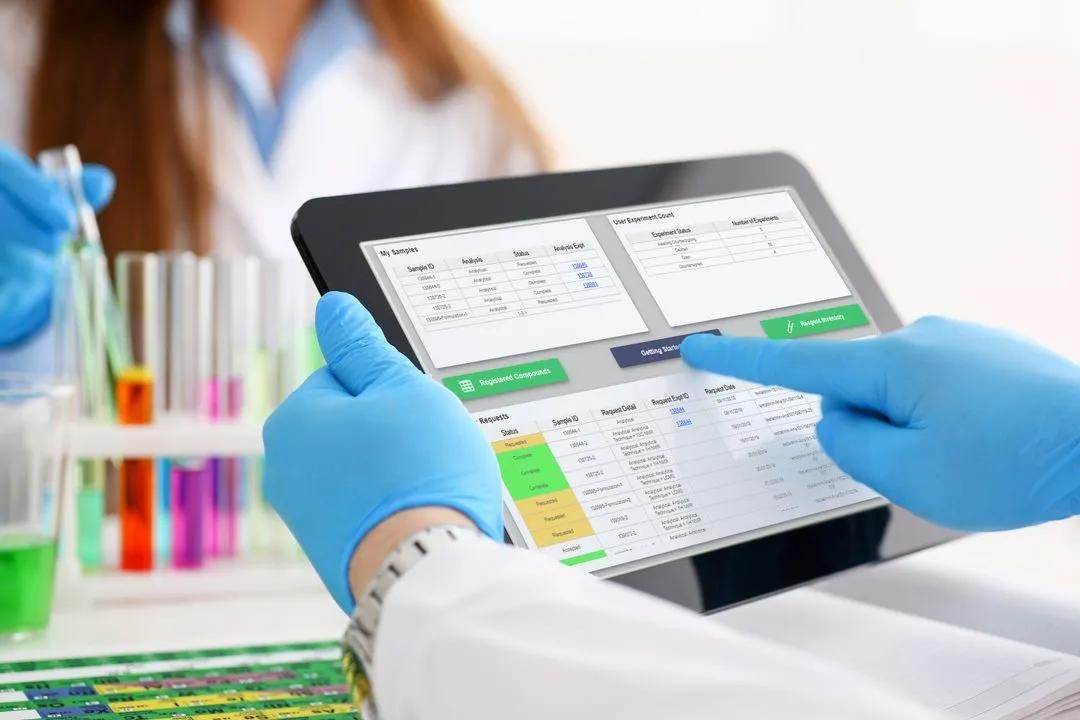
In May 2012, Dotmatics released Elemental, a free iPad application for drawing and editing chemical structures. Its purpose was unusually easy to picture. A scientist could sketch a molecule on a touchscreen, change it, and work with its structure on a device already designed to be carried around.
Gallagher explained the commercial thinking in terms of putting the technology into scientists’ hands. Free access could introduce users to the company’s wider software. There was a practical product decision inside that sales strategy: meeting researchers on a newer device rather than insisting that every task begin at a conventional workstation.
An enterprise platform and a free tablet app ask for different commitments. One requires an organisational decision; the other invites an individual to try something. Dotmatics was experimenting with both routes. For a business built around access to information, access to the tool itself was another variable worth changing.
When the business needed more people
Scottish Equity Partners invested in October 2017. Dotmatics then employed more than 100 people across Europe, the United States and Asia Pacific, including chemists, biologists and software engineers. The funding was intended to support product development, customer support and operations in its established markets.
Gallagher described a business that had grown organically from its founding. His plans for the investment included hiring in application science, product development and professional services. The list reveals how many different kinds of work sit behind a scientific software sale. Someone must understand the experiment, someone must build the application, and someone must help it function in a customer’s particular setting.
Those roles make the founder’s job more complicated. A useful piece of code can begin with two people. A supplier serving researchers across continents needs a larger organisation around it. Capital helped fund that organisation, including the less photogenic work that allows a promising product to become a dependable purchase.
The export business behind the lab door
The 2019 Queen’s Awards press book recorded Dotmatics’ international trade award and a striking change in overseas sales: from £3 million to £14.9 million over six years. Exports accounted for 84 percent of sales at the end of that period, up from 69 percent. The principal markets included the United States, Switzerland, Germany, Japan and Italy.
These were sales of specialist software from a business founded in Hertfordshire. Its customer problem was local in the everyday sense - a particular scientist needed a particular result - but repeated across borders. The export figures show how often the company had persuaded organisations elsewhere that it could help.
The same account recorded its first cloud customer in 2011. That detail belongs beside the trade figures. Delivering software and supporting customers internationally requires decisions about how the product reaches them. Geography remained relevant, but the installation no longer had to tell the whole story of the relationship.
The nuisance of learning another system
When Dotmatics released version 5.4 in April 2019, Gallagher talked about making data accessible and reducing the burden of learning software. The release included changes to search, the electronic notebook interface and the handling of large experimental datasets. These are the sorts of improvements that can sound small until you have to repeat a task several hundred times.
His emphasis was on scientists’ time. A new interface makes demands on its users even when the developers consider it an improvement. People must learn where things have moved, which steps have changed and whether their old habits still work. Gallagher’s comments acknowledged that cost. Ease of use had a place beside technical capability.
In a 2020 article for founders, he returned to the everyday mess of organising research. He discussed spreadsheets, email, duplicated files and the difficulty of teaching new employees how an improvised information system works. His argument for electronic notebooks began with those ordinary frustrations. The scientific ambition might be sophisticated; the filing problem could still be painfully familiar.
Eight hundred researchers, many different workflows
In April 2021, materials company Arkema selected Dotmatics for an R&D digitalisation project. The planned deployment covered 800 researchers in France over at least five years. Its scope included experimental records, sample tracking, search and analysis across work in synthetic chemistry, formulations and polymers.
Here was a concrete test of the platform’s flexibility. A materials business contains different kinds of experiments, and an electronic notebook has to accommodate the people performing them. The agreement aimed to improve continuity across those workflows and allow research information to be tracked and shared.
Gallagher welcomed Arkema as a partner in that work. The agreement also makes the company’s range visible. The information problems he had worked on earlier in his career appeared again in materials research, among scientists pursuing different products with different experimental routines.
Handing over the introduction
Insightful Science acquired Dotmatics in April 2021. By the announcement of that transaction, Scottish Equity Partners reported that employee numbers had trebled to 300 since its investment. A business once concerned with persuading customers it would endure was becoming part of a larger scientific software group.
Later that year Mike McKee took over the executive leadership. Gallagher became Chief Strategy Officer, with a remit that included investments, acquisitions and product expansion. At the company’s virtual user symposium, Gallagher introduced McKee to customers. The handover had a public, practical form: the founder brought the next leader into the conversation.
Gallagher left Dotmatics in March 2024. The company’s next ownership milestone came in July 2025, when Siemens completed its acquisition for an enterprise value of $5.1 billion. That transaction belongs to the business’s subsequent history. Gallagher’s own next chapter includes Smytec, the forensic imaging technology company that lists him as Director of Business Development.
It is a fitting place to leave his story for now: another technical business, another task of bringing specialist work to customers. And somewhere in the diary, one hopes, the coffee with Hill. A founding partnership can outlast its last executive meeting.