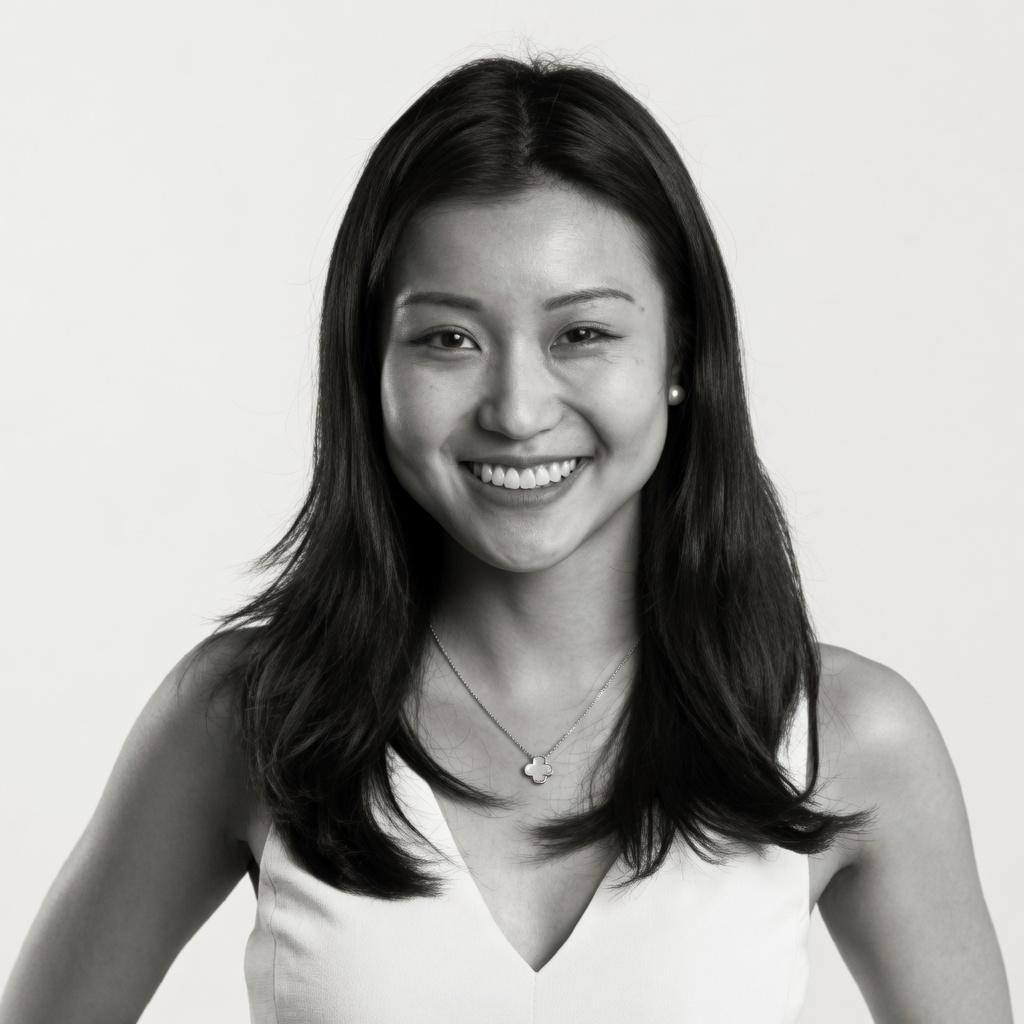
01 The Bet She Keeps Making
She was in Greg Brockman's apartment in 2015 when the people who would go on to found OpenAI were still figuring out what they were building. That detail - that specific apartment, that specific moment before history had a name for it - tells you something about how Stephanie Zhan operates. She doesn't find the future. She keeps ending up in the room where it's being assembled.
Zhan grew up crossing between Hong Kong and Beijing during the early internet era, attending the Chinese International School and then the International School of Beijing - both institutions where fluency in two worlds wasn't a skill so much as a survival requirement. By the time she arrived at Stanford to study computer science under Andrew Ng (the AI research legend who would go on to become one of the most influential voices in machine learning), she had already absorbed a useful truth: the interesting things happen at the edges, not the center.
She didn't come to venture capital through an investment bank. She came through Google Maps and then Nest - two different flavors of "what happens when technology meets the physical world." As a product manager, she learned to think about users before she thought about returns. That sequence matters. It explains why founders like working with her. She's spent time on their side of the table.
"I used to love planning every little bit of my life. I loved knowing what the next 5 or 20 years might look like. I've now learned that the best things in life are often unexpected."- Stephanie Zhan, Seven Questions with Stephanie Zhan (Sequoia, 2018)
02 What She Actually Looks For
Zhan joined Sequoia in July 2015 as an early-stage investor - and she has stayed on the early-stage team ever since, which is itself a statement. In a firm full of people who want to be everywhere across a company's lifecycle, she chose to stay at the moment before everything is certain. The seed round. The Series A. The two founders who are right about something the world hasn't recognized yet.
Her language for what she's looking for: "thoughtful" founders with "high slope," who are action-oriented and have strong character. That phrase - high slope - is a mathematician's way of saying she wants people who are learning faster than the rate at which their problem is growing. It's also a polite way of saying she can spot the difference between a founder who has already figured it all out and one who will.
On the Art of the Early-Stage Bet
"I always go into a meeting with a positive outlook on what the company could become." That sentence, from a 2018 profile, might sound like optimism. It's actually a methodology. You can't write the first check if you've already constructed all the reasons something won't work. Zhan's edge is that she walks in looking for the version where it does.
The portfolio tells the story more clearly than any investment thesis document would. Linear, in 2019: a project management tool for software teams with an almost absurd commitment to speed and design quality. Nobody needed another Jira - until they used Linear. Middesk, also 2019: helping businesses verify the identity of other businesses, a problem so unsexy it had been largely ignored. Rec Room in 2016: a social gaming platform for virtual reality before VR was something most investors would touch. Each one of these arrived before its category was legible. Each one was her call.
03 The Superintelligence Phase
The investments she's making now have a different register. Reflection AI is building autonomous coding systems - software that writes software, at a level of capability that starts to blur the line between tool and collaborator. Skild AI is working on physical superintelligence: AI models that can run across any robot body, a kind of operating system for machines that move. Ricursive Intelligence is applying AI to chip design - the hardware layer underneath everything else. These aren't applications built on top of AI. They are AI, thinking about itself and its own substrate.
In November 2024, she gave a TED AI talk in San Francisco titled "Dreaming of daily life with superintelligent AI." The title is worth sitting with. She's not dreaming of superintelligent AI in the abstract. She's dreaming about what daily life looks like when it arrives - the mundane, specific texture of a world reshaped. That's a different kind of ambition than "the singularity is coming." It's the vision of someone who has already backed three or four pieces of the infrastructure required to get there.
04 The Personal Operating System
Zhan speaks openly about switching from FOMO to JOMO - the joy of missing out. She used to say yes to everything, attend every event, try to be everywhere. She stopped. The shift wasn't philosophical so much as practical: she needed to be present for the founders she was already backing, and you can't do that if you're perpetually scattered across the social calendar of Silicon Valley.
She's a dog owner - Ares is a Rhodesian Ridgeback, a breed developed in southern Africa to track lions. She paddle-boards and snowshoes. She reads widely enough that in 2018 she was citing "Hitmakers: The Science of Popularity in an Age of Distraction" in a professional context. The single word she uses when asked what she would tell her younger self: Agency. The world is yours to will into a reality you dream of.
She's also a parent, which adds a particular dimension to her bet on AI. She's not building for shareholders or for legacy. She's building for the world her kid is going to live in. That's a longer time horizon than most venture funds formally require.
"Agency. The world is yours to will into a reality you dream of."- Stephanie Zhan, on what she'd tell her younger self
05 A Decade at Sequoia
In April 2025, Zhan posted a tribute to Roelof Botha, who had been leading Sequoia's US operations: "I'm endlessly grateful to Roelof Botha for bringing me into Sequoia, and for teaching me the craft of early-stage investing over the last decade under his leadership. He instilled in us the ability to dream, to believe in just two founders and an idea, to build conviction in a..." The post cuts off there in public, but the sentiment is complete. A decade. The ability to dream. Two founders and an idea.
That's the job description she's given herself. And it has produced, so far: a developer tool used by engineering teams that actually enjoy their project management software, a business identity verification platform that helps small businesses access capital, a VR social world where people feel genuinely at home, an AI that writes code, a robot brain that can run on any body, a chip design system built for the AI era, and a defense technology company for the next century of infrastructure.
None of these were obvious when she wrote the check. That's the whole point. She's not investing in what's obvious. She's investing in what's right - and waiting for the world to catch up.