The retirement cheque was supposed to be reassuring. Stephan Crétier was about 30, working in a family security business and proposing a future rather larger than the owner had in mind. He wanted to buy a stake and expand across Canada. The owner preferred to keep the company in the family. Crétier could look forward to a nice cheque when he retired at 65. Thirty-five years is a long time to wait for permission.
He left. In 1995, he founded the business that became GardaWorld, financing the start with C$25,000 raised through a second mortgage on his home. He also sold his car. The decision placed an unusually literal price on independence: the place he lived helped pay for the company he wanted to run. It was a small beginning with a substantial personal consequence if things went wrong.
By March 2025, Crétier was arranging ownership on a different scale. A recapitalization valued GardaWorld at C$14 billion. He and selected members of management held approximately 70 percent when the transaction closed. The remaining equity belonged to outside investors. Across three decades, the recurring question had survived every change in the numbers: how much say would the people running the business have over its future?
That question makes his career more interesting than a tidy account of expansion. He has taken the business public, taken it private, brought in financial partners and increased management ownership. Money has been the means of changing the arrangement. The pleasure seems to lie in keeping a hand on the controls.
Before the boardroom, a baseball diamond
Crétier was born in Montreal in 1963 to immigrant parents, an Italian father and a Swiss mother. His father worked in restaurants and became a union leader; his mother worked as an esthetician. He grew up in Laval, in Saint-Vincent-de-Paul, where a prison was part of the neighbourhood scenery. Childhood baseball came with a particular hazard: a sufficiently ambitious hit could put the ball over the prison wall.
Baseball offered a possible profession. Crétier began umpiring as a teenager and pursued the work in the United States. Major League Baseball scouts noticed him, and he attended training in Florida. Eventually he stepped away. The prospect of a long, uncertain climb through umpiring did not offer the stability he wanted. A career devoted to judging other people's decisions had given him plenty of practice making his own.
His route into security was less deliberate. A recruiter noticed a store-detective job at Hudson's Bay on his résumé and directed him toward security employers. A youthful job became the hinge of an adult career. He discovered an industry full of smaller businesses and saw room to organize them differently. The attraction was commercial: a service could be managed, repeated and sold beyond its original territory.
The earlier ambition never entirely disappeared. In a 2020 conversation, he described management through the composition of a baseball team. Different positions require different strengths. Hiring agreeable copies of oneself will not produce a useful lineup. It is a pleasingly practical image for a chief executive: before discussing the scoreboard, check who is actually on the field.
“I run my business like a baseball game.”
Stephan Crétier · Speaking of Business, 2020
A growing company still has to make payroll
The mortgage story is easy to polish because the ending is now visible. Living through the early business was less elegant. Crétier has spoken about recurring brushes with bankruptcy and the pressure of keeping the company financed while it expanded. Fast growth could bring more work and more obligations before the cash to meet them arrived. Revenue made a handsome headline; payday required money in the bank.
His account of the Quebec ice storm captures the awkwardness. The company's office retained power because it was near a prison, while much of the surrounding region went dark. Security demand increased, but the opportunity arrived alongside an immediate financing problem. With payroll approaching and no credit line, he tracked down a client who was on holiday to obtain a payment. An emergency contract could be good business and still leave the owner chasing a cheque.
The business gradually acquired a financial architecture beyond its founder's house. It went public in 2003. In 2012, Crétier and Apax Partners took it private in a transaction valued at about C$1.1 billion. BC Partners became a major partner in a 2019 recapitalization valuing GardaWorld at C$5.2 billion. Each arrangement supplied a different setting for the same appetite to expand.
Those milestones deserve separate labels. A company's valuation is different from its sales, and either can be large while an individual owner holds only a portion of the equity. The C$14 billion attached to the 2025 transaction describes the business valuation. The roughly 70 percent belongs collectively to Crétier and selected managers. Arithmetic is a useful antidote to the tendency of large numbers to wander into the wrong sentence.
- 1995C$25,000 starting investment
- 2003Public listing
- 2012Private again, with Apax
- 2019BC Partners recapitalization
- 2025Founder + management take majority ownership
The bid he did not win
In 2020, GardaWorld pursued Britain's G4S, bringing Crétier into a prolonged contest with Allied Universal. It was the sort of proposed acquisition that could redraw a company's place in its industry. It also put a limit on the familiar portrait of a founder whose ambition always finds a way. Another bidder wanted the same prize and offered more.
The contest ended in February 2021. GardaWorld held its final offer at 235 pence a share; Allied offered 245 pence and prevailed. Crétier said GardaWorld would not overpay. That was his explanation for stopping, and the outcome remains straightforward: GardaWorld did not acquire G4S. A profile of an acquisitive entrepreneur needs room for the deal that went elsewhere.
There is a useful tension here. A founder can describe the company as a relentless competitor and still face a price beyond which he declines to proceed. The failed bid supplies a concrete boundary to an otherwise expansive story. It also reminds us that a buying strategy depends on sellers, rivals, financiers and shareholders, all of whom arrive with their own preferences.
Seventy percent, shared
The March 5, 2025 closing brought Crétier and his management partners into majority ownership. HPS Investment Partners, Oak Hill Advisors, One Investment Management and other minority investors participated, while BC Partners retained a minority position. The arrangement joined outside financial backing to a larger collective stake for the operators. It was a return to control with considerable company at the table.
By then GardaWorld encompassed several kinds of work. GardaWorld Security provided security services. Crisis24 dealt with intelligence and risk management. ECAM brought together remote surveillance operations, while Sesami addressed cash automation. The founder who once wanted to extend a Quebec security company across Canada was now overseeing businesses with different customers, technologies and operating demands.
The technology strand continued in September 2026, when Crisis24 and Dataminr announced an integration of real-time intelligence and agentic AI into Crisis24 Horizon. The stated purpose was to connect information about emerging events with organizational decisions and response. It is a specific example of how far the portfolio has travelled from the image of a guard at a door. The work increasingly includes deciding which information deserves someone's attention.
Crétier remains founder, chairman, president and chief executive. GardaWorld reports a workforce of more than 132,000. At that scale, the lineup question becomes less sporting metaphor than organizational necessity. No single executive can perform all the work represented by the businesses under his name. Ownership can align interests; choosing managers and judging their decisions remains a continuing assignment.
Crétier + selected management
Collective ownership of GardaWorld
A vineyard refuses to follow the schedule
Away from GardaWorld, Crétier and his wife, Stéphany Maillery, became proprietors of Roy Estate in Napa Valley in 2017. The opportunity grew out of a conversation about wine at a dinner in Venice. He had not set out with a plan to own a winery. Some acquisitions apparently begin with a balance sheet; this one began with a table conversation.
The timing was brutal. Soon after the purchase, the Atlas wildfire destroyed four of the property's five buildings, including the house. The vines survived. Crétier and Maillery rebuilt, taking on the work of restoring the estate alongside the business of producing wine. A purchase intended to open one chapter required them to reconstruct much of the setting first.
His comment about the undertaking is refreshingly unromantic: “Being in the wine business is agriculture, as it is a farm before anything.” There is room in that sentence for both the bottle and the dirt. Roy Estate works with winemaker Philippe Melka, and its history reaches back to founding vintners Shirley and Charles Roy in 1999. The present owners inherited an existing place and a craft that requires other people's expertise.
A vineyard adds a different clock to the life of an executive accustomed to transactions. A closing date can settle ownership. It cannot settle what the weather will do. That contrast gives the wine story its charm: an enthusiast may purchase the estate, but the growing season retains a thoroughly independent board of directors.
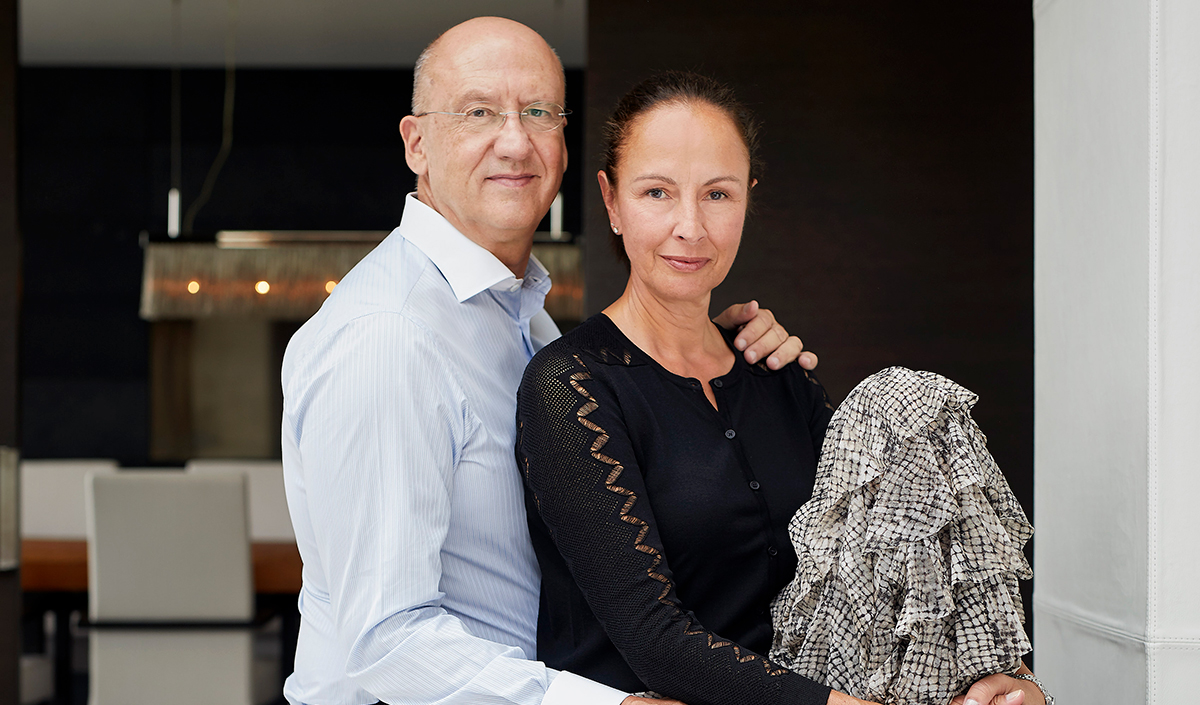
Photograph: Michael Abril / Dolce Magazine, 2022.
Places that keep the connection
Crétier and Maillery have lived in Dubai since 2010 while maintaining philanthropic ties to Canada. They established the Stéphan Crétier Foundation in 2006. Its work includes the Bolo Program, launched in 2018 to amplify public appeals for Canada's wanted fugitives. The initiative applies publicity and public attention to a problem recognizably connected to his professional world.
Their support for the Montreal Museum of Fine Arts took a different form. In November 2019, the museum opened the Stephan Crétier and Stéphany Maillery Wing for the Arts of One World. Ten refurbished galleries brought together more than 1,500 objects and artworks from different cultures and periods. The result is a public place to encounter work that crosses the boundaries a security business is often hired to watch.
In France, their foundation funded the Peace Circle at the Vimy Foundation Centennial Park. It opened on April 8, 2024, as a place for remembrance and reflection. Their earlier support had helped create the Vimy Visitor Education Centre. These are durable connections to a country where their business story began, expressed through places people can actually visit.
In 2025, Crétier received the International Horatio Alger Award. The recognition arrived in the same year that the management group completed its majority buyout. Yet the old retirement offer remains a revealing place to end. At 30, he had been invited to wait until 65 for a cheque. He chose the mortgage, the payroll worries, the partners and the negotiations instead. The numbers changed enormously. The wish to decide what happened next stayed recognizable.
Follow the conversation
Interviews, projects and places from this story.