The GardaWorld origin story has the tidy proportions of a business-school fable. In 1995, a 31-year-old Montrealer named Stephan Crétier borrowed C$25,000 against his house and opened Trans-Quebec Security. The company billed more than C$600,000 in its first year. Three decades later, the descendant of that small guard operation employs more than 132,000 people, works from over 1,300 locations, serves roughly 35,000 clients and carries a C$14 billion valuation.
But the useful story is not “founder mortgages house, becomes billionaire.” It is how an operator in a low-margin, labor-heavy and stubbornly local trade learned to sell several different kinds of certainty. GardaWorld supplies the person at the gate, the armored truck on the road, the screening officer at the airport, the analyst watching a coup unfold, the camera that verifies an intrusion and the software that tells a retailer where its cash went. The company has assembled an operating system for physical risk.
01 / The offerFour businesses hiding inside one shield
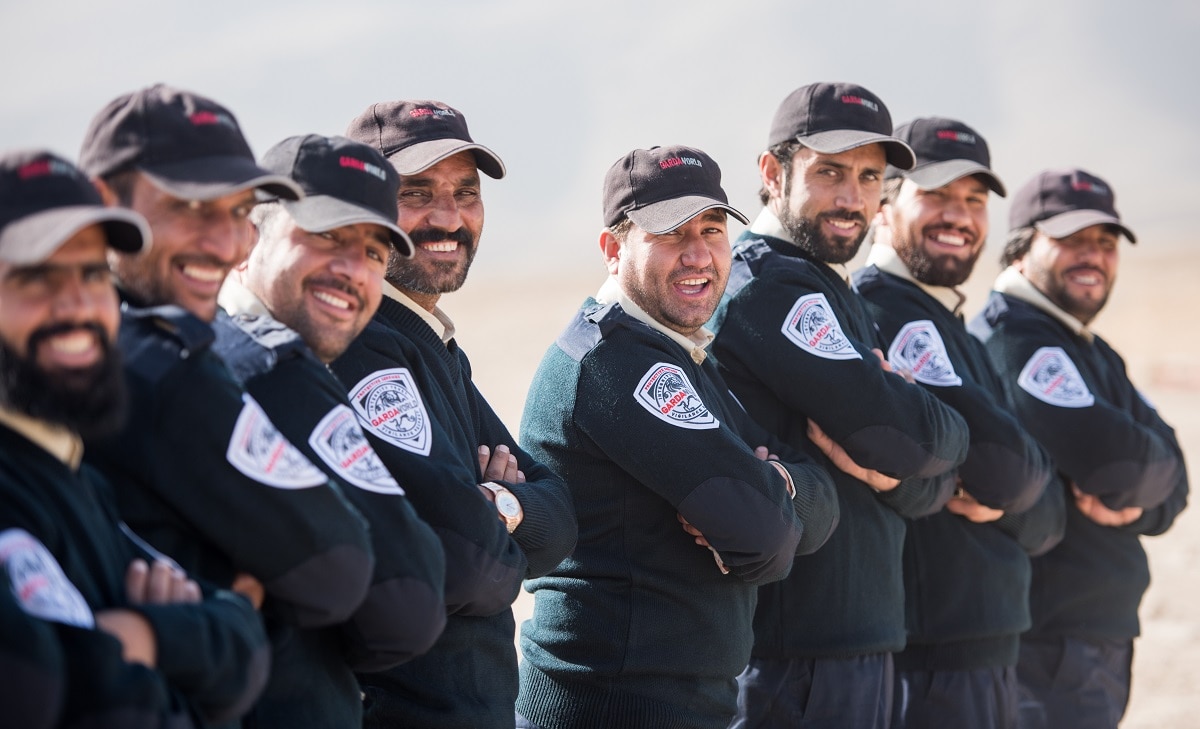
Start with the obvious division: security officers. GardaWorld recruits, screens, trains, schedules and supervises guards for offices, hospitals, factories, universities, retailers, logistics hubs and government facilities. It adds mobile patrols, K9 teams, industrial fire protection, executive protection and crowd management through BEST, its large-event specialist. In Canadian aviation, its relationship with the Canadian Air Transport Security Authority dates to 2004; the company says it now provides services at 36 airports.
Then comes cash. GardaWorld entered armored transport in 2003 by buying Secur, Desjardins’ C$48 million armored-truck operation. Today the cash business transports deposits, operates vaults, replenishes ATMs and processes notes for banks and retailers. Its newer sibling, Sesami, connects smart safes, devices, forecasting and reconciliation software. That distinction matters. An armored route earns a fee; a cash-management platform can earn recurring revenue while becoming part of a customer’s treasury workflow.
Crisis24 handles the situations that do not fit neatly behind a reception desk: travel risk, threat intelligence, mass notifications, crisis response, medical assistance and protection for executives or families. Its Horizon platform maps threats and alerts; the 2024 purchase of OnSolve added critical-event management and mass communications. The 2025 AiiA platform, built with Palantir, pushes further toward anticipatory intelligence for senior leaders.
Finally, ECAM sells monitored sight. It combines the former ECAMSECURE operation with Stealth Monitoring, acquired in 2024, to run mobile and permanent camera units backed by live intervention. The pitch is practical: analytics filter motion, trained operators verify an incident, and a response follows. A camera without response is evidence. A camera connected to a local operation is a service.
02 / The buyerWho pays for peace of mind?
GardaWorld’s customer is usually an organization for which interruption costs more than prevention: a bank that cannot leave cash stranded, an airport that cannot wave passengers around a checkpoint, a distribution center losing trailers overnight, a hospital whose security staff must de-escalate rather than merely eject, or a multinational deciding whether employees should travel during unrest. Wealthy families and governments buy the most specialized end of the portfolio.
The business model changes with the problem. Guarding is commonly billed by hour, post or contract. Cash logistics adds route, stop and processing economics. Systems installation produces project revenue. Monitoring, risk intelligence and automation lean toward subscriptions and managed-service fees. Multiyear agreements reward reliability and make switching painful because a new provider must absorb schedules, licenses, routes, site knowledge and response protocols.
“Our mission is clear: to make the world a safer place by protecting our clients’ people, assets and operations.”GardaWorld Security
That breadth separates GardaWorld from a local guard agency, but not from every global rival. Allied Universal and Securitas compete for large guarding accounts. Brink’s, Loomis and Prosegur fight for cash routes. Control Risks and International SOS compete in global risk. Video monitoring has its own crowded bench. GardaWorld’s advantage is the option to combine those budgets, backed by local branch density and management that says it keeps one supervisor for roughly every ten officers.
03 / The scar tissueWhat failed first
The growth machine once ran too hot. During the mid-2000s, GardaWorld bought aggressively, including ATI Systems International. By 2008, poor financial performance collided with leverage and the financial crisis; its publicly traded shares fell by more than 90 percent. The company restructured debt and, in 2009, sold its U.S. and Mexican guarding operations for US$44.25 million. International demand and improved results helped it recover, but the episode exposed the familiar roll-up danger: buying revenue is faster than integrating operations.
The reset changed GardaWorld’s ownership path. Crétier and Apax Partners took it private in 2012. Rhône later replaced Apax, then BC Partners invested in 2019. In March 2025, a recapitalization valued the group at C$14 billion and put approximately 70 percent in the hands of Crétier and selected managers. HPS Investment Partners, Oak Hill Advisors, One Investment Management, BC Partners and others retained minority interests. The company calls this an owner-operator culture. The concrete test is whether local managers have authority and consequences, not whether the phrase appears on a wall.
A second moment showed a different kind of discipline. GardaWorld pursued G4S in a hostile takeover contest during 2020 and 2021, raising its offer to 235 pence a share. Allied Universal offered 245 pence. GardaWorld declined to bid again, saying integration would require substantial investment and it would not overpay. Allied won at £3.8 billion. Walking away did not shrink GardaWorld’s ambition; it preserved the balance sheet for narrower acquisitions such as OnSolve and Stealth Monitoring.
Those later deals reveal what changed management’s mind about where growth should come from. OnSolve brought software used by companies and government agencies to warn people during critical events. Stealth brought a large installed base of monitored cameras. Both could be attached to businesses GardaWorld already understood, and both moved the mix toward recurring, technology-supported revenue. Instead of swallowing another giant labor platform, GardaWorld bought nervous systems.
What changed
From buying scale at almost any speed to buying adjacent capabilities that can plug into existing clients, branches and control rooms.
What did it cost?
C$25,000 to begin; more than 90% of public equity value at the 2008 low; a US$44.25 million divestiture; and a G4S deal deliberately left on the table.
04 / The copyable bitKeep the worker. Upgrade the system.
The most portable GardaWorld lesson is not “buy 100 security companies.” It is to locate the unavoidable human action in an industry and build technology around it. Guards still judge intent, calm people and take responsibility. Drivers still move physical currency. Analysts still interpret ambiguous signals. Cameras, routing, alerts and software make each person cover more ground, produce better records and respond with more context.
A founder can copy five moves. First, enter through one narrow service where reliability is visible. Second, build local density before drawing a global map. Third, standardize screening, training, scheduling and incident data - the boring middle where quality leaks. Fourth, add adjacent products that the same buyer already budgets for. Fifth, set a walk-away price on acquisitions. GardaWorld learned the last point in public.
There is another clever bet in cash. The lazy forecast says physical currency disappears. GardaWorld’s wager is more nuanced: as cash becomes a smaller share of payments, managing it can become more annoying per dollar. Retailers still need pickup, reconciliation, forecasting and visibility, but they want fewer manual touches. Sesami sells the removal of that friction. It follows the headache rather than the headline.
05 / The limitWhen the playbook stops working
Integrated security fails when integration exists only in the sales presentation. A weak local branch cannot be rescued by an AI label. Monitoring does not help if no one responds. An acquisition destroys value when incompatible schedules, labor practices and customer systems remain untouched. And scale can magnify the industry’s hardest problems: thin contract margins, staff turnover, inconsistent training, regulatory differences and the moral weight of work performed in public spaces or conflict zones.
The model also fits some buyers poorly. A single small site may get faster attention from a strong local operator. A company that wants independent checks may prefer separate vendors for guarding and monitoring. Cash automation is a weak investment where volumes are already negligible. High-risk protection cannot be standardized like parcel delivery. The conditions matter: enough customer concentration to cross-sell, enough local density to respond, and enough management attention to make a giant workforce behave consistently.
Labor remains the sharp edge. Security officers often work long, quiet shifts punctuated by moments requiring judgment. A contract won at the wrong price leaves little room for wages, training or supervision, and turnover can erase site knowledge. Technology may reduce routine patrols or false alarms, but it can also create more alerts and more screens. The economic promise works only if some of the productivity gain returns to recruitment, coaching and retention. Otherwise the dashboard gets smarter while the service gets thinner.
Reputation risk is equally structural. GardaWorld works in airports, streets, detention settings, embassies and conflict-affected regions where private authority meets public consequence. The company’s stated values - integrity, vigilance, trust and respect - must survive far from Montreal and beyond direct executive sight. For a firm this dispersed, culture is not a speech. It is who gets hired, what gets reported, which shortcuts are punished and whether a local manager will stop a profitable practice that creates unacceptable risk.
The market will keep pulling GardaWorld in two directions. Customers want fewer vendors and more automation, which favors its broad portfolio. They also want proof that a vast contractor can deliver local judgment, which favors smaller specialists. The group has to be both: a common technical backbone with branches that know the building, the regulator and the names on the night shift. Centralize the intelligence; decentralize the responsibility.
That formula is hard to reproduce quickly. Capital can buy cameras and competitors, but it cannot instantly create licensed staff, dense routes, trusted control rooms and years of incident history. GardaWorld’s moat is therefore less cinematic than the armored vehicles suggest. It is accumulated permission to operate. Every contract renewal either thickens that permission or exposes a crack in it.
C$25,000 from a second mortgage starts Trans-Quebec Security.
A financial crisis, debt pressure and poor performance force restructuring and a major divestiture.
GardaWorld refuses to top 235 pence in the auction for G4S.
OnSolve and Stealth join; ECAM and AiiA launch; management regains majority ownership.
GardaWorld sits in an odd market position: too broad to call a guard company, too physical to call a software platform and too private to inspect like a listed peer. That ambiguity is part of the design. It can sell labor where judgment matters, hardware where coverage matters, and recurring software where visibility matters. The result is not frictionless or futuristic. It is a large, complicated promise that someone will notice trouble and act before the client’s day comes apart.