There is a decent chance Bausch Health has been near your bathroom cabinet without introducing itself. Xifaxan may have come from a gastroenterologist. Arestin can appear during periodontal treatment. Jublia is painted onto a toenail. Thermage and Clear + Brilliant live in the more polished world of aesthetics clinics. Then there is Bausch + Lomb, the separately listed eye-care company that Bausch Health still controls. Put those shelves together and you get roughly 1,000 products, about 20,300 consolidated employees and $10.27 billion in 2025 revenue.
This is not a tidy startup story. It is a corporate family tree drawn in permanent marker: ICN became Valeant; Canadian drugmaker Biovail merged with Valeant; Valeant bought Bausch + Lomb and Salix; scandal broke around a specialty pharmacy called Philidor; Valeant renamed itself Bausch Health in 2018. The present company is both a working healthcare business and a cleanup operation. Its medicines solve real problems. Its old acquisition bill still determines how much freedom management has to solve the next ones.
01 / What it actually sells
A portfolio built around places where treatment repeats
Bausch Health's center of gravity is specialty care. Salix, its U.S. gastrointestinal business, sells Xifaxan for approved uses including irritable bowel syndrome with diarrhea and reducing the risk of overt hepatic encephalopathy recurrence. It also markets Relistor for opioid-induced constipation and Trulance for chronic idiopathic constipation and IBS-C. These are not impulse purchases. A diagnosis, a prescriber, insurance coverage and a distribution system all have to line up.
Elsewhere, Ortho Dermatologics sells prescription skin treatments such as Jublia and Cabtreo. OraPharma works through dental professionals with Arestin, tiny minocycline microspheres placed in periodontal pockets. Solta Medical sells energy-based devices including Thermage, Fraxel and Clear + Brilliant to aesthetics practices. International operations carry branded drugs, generics and OTC products across dozens of markets. Through Bausch + Lomb, the consolidated accounts also include contact lenses, lens care, surgical equipment and eye medicines.
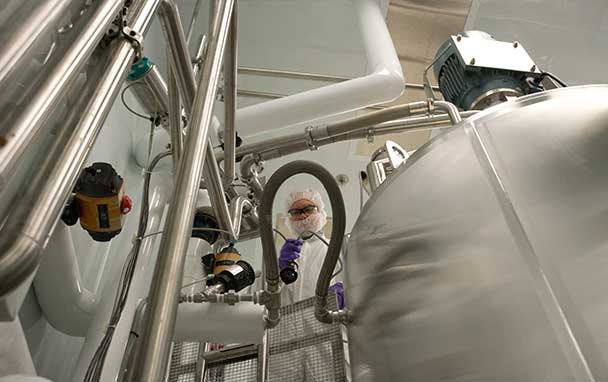
The customers therefore arrive in layers. Patients and consumers use the products. Doctors, dentists and aesthetics providers select or administer many of them. Hospitals, pharmacies and retail chains buy them. Wholesalers move enormous volumes in between. In 2025, Cencora, McKesson and Cardinal Health accounted for 18, 16 and 14 percent of consolidated revenue respectively. That is an efficient route to market, and a concentrated one.
“The real moat is not one pill. It is the permission, evidence and plumbing required to put that pill in the right hands.”YesPress analysis
02 / The bill arrives
What it cost, and what failed first
The expensive hinge in this story is Salix. In 2015, Valeant increased its offer and completed the acquisition at approximately $15.8 billion in enterprise value. The prize included Xifaxan, which generated $2.21 billion a decade later and represented roughly 85 percent of Salix revenue in 2025. The strategic intuition was legible: buy a focused GI franchise with a productive commercial channel. The financing and the broader acquisition tempo left far less margin for error.
What failed first was trust. In October 2015, Valeant disclosed its relationship with Philidor, a specialty pharmacy used to fill prescriptions. Questions about that relationship, revenue recognition and disclosure accelerated a share-price collapse. Valeant terminated the arrangement within weeks. In 2020, by then called Bausch Health, the company agreed to a $45 million SEC penalty to settle charges concerning improper revenue recognition and misleading disclosures from that period, without admitting or denying the findings.
Scale versus obligation / 2025, $ billions
Debt figure is aggregate contractual principal at December 31, 2025. Bars compare scale, not maturity timing or profit.A name change could not refinance a bond. The harder reset was behavioral: fewer giant takeovers, more debt repayment, asset separation and selective business development. Bausch + Lomb returned to public markets in 2022 through a $630 million gross IPO, with proceeds directed into transactions that repaid Bausch Health debt. In 2025, Bausch Health completed $9.6 billion of refinancing activity, reduced net debt by $376 million and ended the year with $20.23 billion of consolidated debt principal. Progress and burden can be true at once.
03 / The new playbook
Defend the cash engine, then buy options
The current playbook starts with brands that already work. Bausch spends on Xifaxan consumer advertising and sales capability, protects intellectual property, supports patient access and looks for adjacent indications or molecules. It uses existing specialist relationships to launch related products. In aesthetics, it bought longtime Chinese distributor Shibo in 2025, turning an indirect route into direct customer access. In Poland, it partnered with YUN to bring microbiome skincare through an established local organization.
Then it makes smaller pipeline bets. The 2025 acquisition of DURECT cost $84 million in total consideration, including $64 million cash, and added larsucosterol, an investigational treatment for alcohol-associated hepatitis. Additional sales milestones could reach $350 million. That is still risk capital, but it is a different species from a $15.8 billion platform acquisition.
Keep
Durable specialist brands, prescriber relationships and global manufacturing.
Deepen
Patient access, education, indications and direct distribution.
Reduce
Debt, refinancing cliffs and dependence on financial engineering.
Test
Late-stage assets where an existing clinical channel creates an advantage.
Clinical development is still allowed to say no. In January 2026, Bausch reported that both RED-C Phase 3 trials of rifaximin soluble solid dispersion were safe and well tolerated but failed to achieve their primary endpoint. That was the first thing to fail in the latest R&D chapter, and an important reminder that channel expertise cannot force biology to cooperate. The company continued planning the separate larsucosterol program rather than pretending the programs were interchangeable.
04 / Why it is different
Not pure biotech, not consumer health, not quite a conglomerate
Bausch Health occupies an odd middle of the market. A pure biotech may rise or fall on one experimental asset. A generic manufacturer competes mainly on cost and supply. A consumer-health company wins on retail distribution and brand. Bausch combines pieces of all three, plus devices and specialist sales forces. Its advantage is breadth within practical channels: a gastroenterology organization can educate patients and physicians around liver complications; a dental team understands the procedure in which Arestin is used; Solta can train providers while selling devices and treatment consumables.
The portfolio also creates complexity. Competitors change aisle by aisle: AbbVie and other specialty-pharma groups in prescription medicines; Alcon and CooperCompanies in eye care; InMode and aesthetics divisions in devices; Perrigo and consumer brands in OTC; countless regional and generic manufacturers everywhere else. Bausch wins when clinical familiarity, reimbursement, manufacturing reliability and a durable brand reinforce one another. It struggles when one of those supports disappears.
What you can steal
Build adjacencies around a trusted workflow, not around a fashionable category. A customer relationship should make the next product cheaper to explain, easier to deliver or safer to support. Buy a distributor only when direct access improves those economics. Most important, keep enough balance-sheet room to survive the launch that slips, the trial that misses and the patent that ends early.
05 / The conditions
When the medicine-cabinet strategy stops working
The most immediate risk is concentration. Xifaxan produced more than one-fifth of 2025 sales, faces a negotiated Medicare price beginning in 2027 and potential U.S. generic competition in 2028 under current settlements and expectations. A product can be excellent and still become less profitable because exclusivity, reimbursement or regulation changes. Three wholesalers representing 48 percent of revenue create a second concentration point.
Debt makes every other risk louder. At the end of 2025, contractual principal totaled $20.23 billion, with $4.24 billion scheduled in 2028. Refinancing moved deadlines and operating performance improved: second-quarter 2026 revenue reached $2.85 billion, up 13 percent, while management raised guidance. But refinancing is rented time. The strategy works if cash generation, selective growth and asset value improve faster than borrowing costs, patent erosion and regulated pricing narrow the window.
There is also a cultural condition. Healthcare companies sell evidence and reliability before they sell a brand. Bausch now describes its values as principled leadership, problem solving, creative thinking and result seeking. The first word carries the most weight. A company with this history cannot afford governance as wall art. Quality systems, adverse-event reporting, trial candor and clean channel incentives are operating features.
“Durable products can survive a broken strategy. The balance sheet remembers how the strategy broke.”The lesson from Bausch Health
So what changed management's mind? Reality did. Philidor showed the cost of opaque distribution. The share collapse showed the cost of lost credibility. Debt showed the cost of purchasing growth without slack. The Bausch Health era has been an extended attempt to replace velocity with optionality: keep the products patients and clinicians use, refinance what cannot yet be repaid, invest where commercial expertise offers an edge and disclose when a trial misses.
That approach is not dramatic enough for a founding myth. It is more useful than one. In pharmaceuticals, the business is a chain of permissions: permission from biology, regulators, prescribers, payers, patients and capital markets. Bausch Health once behaved as if money could shorten the chain. Its current task is to prove that disciplined operation can strengthen every link before the oldest obligations come due.