Michael G. DeGroote left school in grade nine. Decades later, a business school carried his name. Between those two facts sits a career involving tobacco fields, a surplus army truck, school buses, a football club and a retirement that proved remarkably poor at keeping him retired. The university honour makes a tidy ending. His life took a less tidy route.
Born in Belgium in 1933, DeGroote arrived in Canada with his family in 1948, aged 14. Work in southern Ontario's tobacco fields helped support the family. Further schooling gave way to the immediate business of earning a living. At 18, he bought a former army truck and hauled manure for tobacco farmers. His first business had a practical customer, a practical purpose and very little prospect of appearing in a glossy brochure.
DeGroote died on September 12, 2022, aged 89. The institutions associated with him include Laidlaw, CBIZ, McMaster University and Hillfield Strathallan College. They make an unusual collection: businesses that moved people and handled their daily needs, alongside schools where other people could prepare for careers of their own. Following those connections gives his story a shape that a list of titles cannot.
A truck before a transcript
The former army truck belongs near the beginning because it brings the scale of the later career back into view. Before acquisitions and public companies, there was an individual vehicle and a job someone needed done. Farming created a demand for hauling. DeGroote entered that gap. Nothing about the work required a glamorous explanation; it required a truck to arrive.
He expanded into gravel hauling and took part in the trucking demand surrounding northern Ontario's uranium business. Expansion also exposed him to a reversal. His early enterprise failed, and he went through bankruptcy in his twenties. That episode matters because the familiar shorthand, “self-made,” can make a career sound as though each successful decision followed naturally from the last. His did not.
In 1959, he purchased Laidlaw Transport, a small trucking operation in Hagersville, Ontario, and moved into the Hamilton area. Laidlaw already existed; Robert Laidlaw had founded the business in 1924. DeGroote's contribution was to change its scale and, eventually, the kinds of services it provided. Buying an existing operation would become a recurring method in his career.
There is a useful distinction between starting with nothing and starting with something small. Laidlaw had trucks, customers and a business to run. DeGroote could build from that base. The work involved finding another operator, agreeing a price and bringing an additional business into the fold. Growth could arrive through the purchase of someone else's accumulated effort.
- 1948Belgium → Canada
- 1959Purchases Laidlaw
- 1996Founds CBIZ
- 2017Honoured by DeGroote
The school run becomes a business
Laidlaw expanded beyond trucking into waste collection and school transportation. These were services tied to ordinary routines: children going to school, rubbish being collected, vehicles following a route. Their everyday appearance concealed the possibility of building a large enterprise from many smaller operators. A school bus has a reassuringly modest job description. A fleet changes the arithmetic.
Laidlaw went public in 1969. Its later acquisition history included expansion into American school transportation in the 1980s. Under DeGroote, the company became a major North American operator in both buses and waste management. His business career reached across the border even as Hamilton remained an important point of reference.
The attraction of these services is easy to understand: a customer needs the work performed repeatedly. The challenge is equally plain. Buying a business adds routes, vehicles and people, but also adds responsibility. Each acquisition enlarges the organisation that must make tomorrow's service happen. A contract cannot drive a bus; someone still has to turn up and do it.
In 1988, DeGroote sold his interest in Laidlaw to Canadian Pacific. The transaction marked an exit from the company he had spent decades building. By 1990, he had retired to Bermuda. After a career measured in purchases and expansion, an island offered a change of setting. It did not, as events would show, supply a convincing full stop.
Hamilton, with a football interlude
During the 1970s, DeGroote owned the Hamilton Tiger-Cats. A football team gave his business life a different public setting. Trucking customers might judge a company by a delivery. Football supporters have several additional methods of expressing an opinion, few of them discreet. Ownership brought him into a part of Hamilton life where the audience already had strong feelings.
He sold the club to Harold Ballard in 1978. The episode sits between the Laidlaw acquisition and the much later sale of his stake in that company. It also helps explain why a profile confined to financial services would miss part of his relationship with the city. Hamilton knew his name through sport before generations of students encountered it on a school.
A contemporary account described him as a private figure despite the growing size of his business interests. The same combination appears in his national honour. When he was appointed an Officer of the Order of Canada in 1990, the citation recognised his business record and his quiet support for arts, education and community projects in the Hamilton area. Public institutions could carry the evidence of his involvement even when he preferred a quieter personal presence.
Retirement gets another assignment
Bermuda became his home, but DeGroote returned to business through ventures including Republic Industries and AutoNation. His circle included Wayne Huizenga, whose career also moved through waste collection and the building of companies by acquisition. DeGroote's later work crossed industries rather than staying within the boundaries of the trucking business that had first made him known.
CBIZ dates its founding to 1996 and identifies DeGroote as its founder. He served as chief executive from 1996 to 2000 and as chairman from 1996 to 2002. Those dates place him at the beginning of a company conceived around a different recurring need: the professional services required to keep smaller businesses running.
Accounting, payroll, benefits and related services could be offered through a national organisation. The intended customers were small and middle market businesses. The proposition had a recognisable family resemblance to his earlier work: bring separate operators together, widen the services available and make a larger organisation from businesses whose expertise began locally.
For a growing firm, those services sit behind the visible work. A customer may see the shop, the factory or the finished assignment. Someone must also handle the books and payroll. DeGroote's new enterprise addressed that less conspicuous side of business. The vehicles had disappeared from the foreground; the interest in necessary, repeat work remained.
Buying is easier than bringing together
The early company, then called Century Business Services, expanded rapidly by acquiring local firms. Growth created an integration problem: putting businesses under common ownership did not automatically make their services work together. The company also faced questions about its accounting, falling shares and a difficult transition around 2000.
DeGroote stepped down as CEO that year. Steven L. Gerard became chief executive in October 2000 and later succeeded him as chairman in 2002. Gerard's work included restructuring operations and reducing debt. The change in leadership belongs in the story because founding a company and making its model endure are different undertakings, often performed by different people.
CBIZ's later memorial described DeGroote's original concept as central to its mission. That continuity does not erase the difficult opening years. It shows how an idea can survive changes in management and execution. For an acquisition-led business, the moment after the transaction deserves as much attention as the transaction itself. A signature can transfer ownership in an afternoon. A functioning organisation takes longer.
Three million dollars, then a school name
In 1987, before leaving Laidlaw, DeGroote began his relationship with McMaster's Faculty of Business through a $3 million gift. The money helped support a new building. In 1992, the faculty became the DeGroote School of Business, and McMaster awarded him an honorary doctorate. A donor who had left formal schooling early now had a lasting connection to university education.
His support formed part of McMaster's Centennial Campaign, launched in 1987 with a $25 million goal. By its conclusion in 1992, the campaign had raised $93 million. That wider effort helped change the campus through buildings and student support. DeGroote was a lead donor within a project involving other benefactors, families and institutions. The school bearing his name was also the product of a collective undertaking.
The physical result is worth dwelling on. A building gives a gift an address and a daily use. A classroom fills, empties and fills again. Students arrive with different ambitions and leave for different employers. The donor's original cheque becomes part of a setting in which other people make decisions. That is a quieter form of influence than chairing a board, and one with a much longer timetable.
A name that kept going back to class
His educational giving extended to Hillfield Strathallan College, where a $10.5 million gift was announced in 2009. The school made him an honorary member of that year's graduating class. Later family support helped the school's wider expansion. Its Michael G. DeGroote Senior School and athletic facilities gave the connection a visible place on the campus.
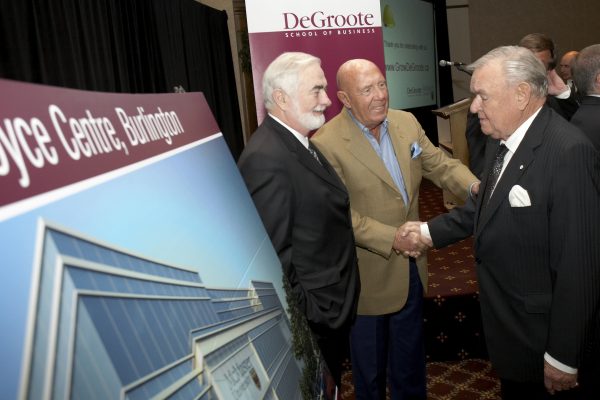
In a photograph from another 2009 occasion, DeGroote stands with McMaster leadership at the unveiling for the Ron Joyce Centre campus in Burlington. The picture brings several threads together: an older entrepreneur, an educational institution and a project intended for future use. The company-builder has joined a different kind of opening ceremony.
In 2017, the DeGroote School of Business presented him with the Wayne C. Fox Distinguished Alumni Award. The recognition came during the school's 25th anniversary celebrations. The former grade-nine student had become an honorary doctor, a school namesake and an honoured member of its wider community. Education had found several ways to welcome him back.
His biography should allow both sides of that connection to remain visible. He built companies, encountered reversals, left leadership roles and supported institutions beyond his own businesses. Students passing through a school bearing his name inherit neither his balance sheet nor his decisions. They receive something more practical: a place to learn, supported in part by the earnings of someone whose own classroom years ended early.
“support of the arts, education and charitable endeavours”
From his Order of Canada citation, 1990
Follow the connections
Explore the institutions and accounts connected with this life.
- CBIZ: founder memorial and leadership dates
- DeGroote School of Business: a remembrance
- McMaster: Michael G. DeGroote biography
- Order of Canada: official citation
- Laidlaw: company history
- Century Business Services: early company history
- McMaster: Centennial Campaign
- Royal Gazette: DeGroote in Bermuda
- Hillfield Strathallan: builders and patrons
- DeGroote: the 2017 anniversary and award
- CHCH: remembering Michael George DeGroote
- The CBIZ company profile