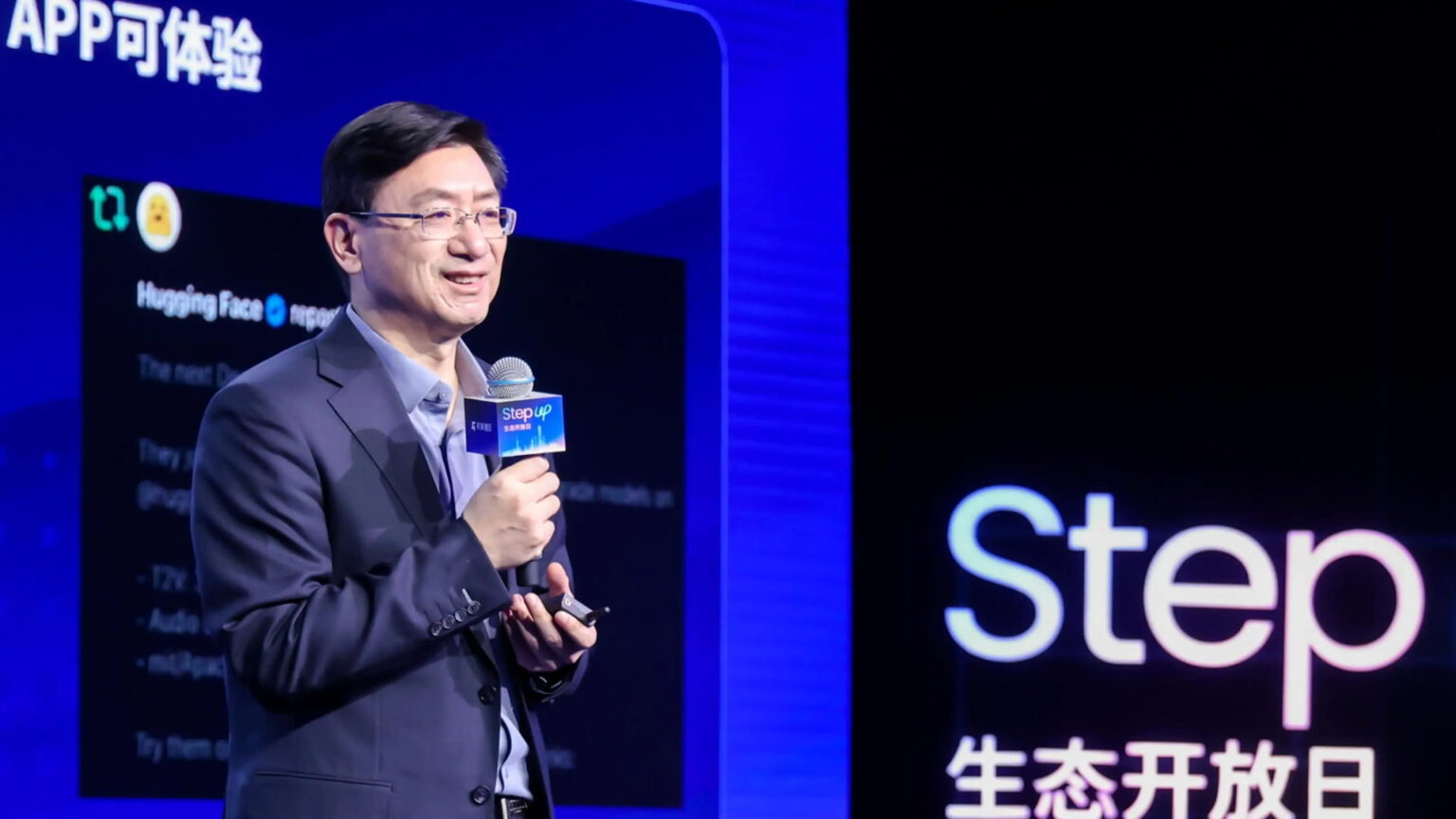
Consider the microwave. In a June 2025 conversation, StepFun founder Jiang Daxin imagined giving one a simple instruction: steam an egg. The interesting part was everything the person would no longer need to do. Find the manual. Decode the buttons. Translate a perfectly ordinary wish into a sequence the machine could understand.
That small example opens a door into StepFun, a Shanghai company whose research can otherwise sound forbiddingly large. There are billions of parameters, multiple model families, and ambitions involving artificial general intelligence. Yet the microwave supplies a useful test. Does all that intelligence make the machine easier to use?
- StepFun builds models that work with language, vision, speech, images, and video.
- Developers buy API access; manufacturers integrate its technology into devices.
- Its distinctive bet joins model research, efficient inference, and hardware distribution.
A model needs somewhere to go
Founded in 2023 by the former Microsoft executive, StepFun belongs to China’s crowded foundation-model market. DeepSeek, Alibaba’s Qwen, Moonshot’s Kimi, and other suppliers offer alternatives. Choosing between them means comparing capabilities, prices, deployment options, and the job at hand. A single leaderboard cannot settle all four.
StepFun’s answer has been breadth. Its public releases include speech systems, image editing, and video generation alongside language models. A developer can build an assistant that listens, interprets an image, or calls a tool. A creator can experiment with an edit expressed in ordinary words. Different models handle different parts of that work.
The company’s current website also lists Step Code and AI Studio. These give the underlying research a more familiar shape: a coding tool, a browser workspace, an API request. The consumer assistant historically known as Yuewen supplies another entrance. The same company sells building materials and makes things with them.
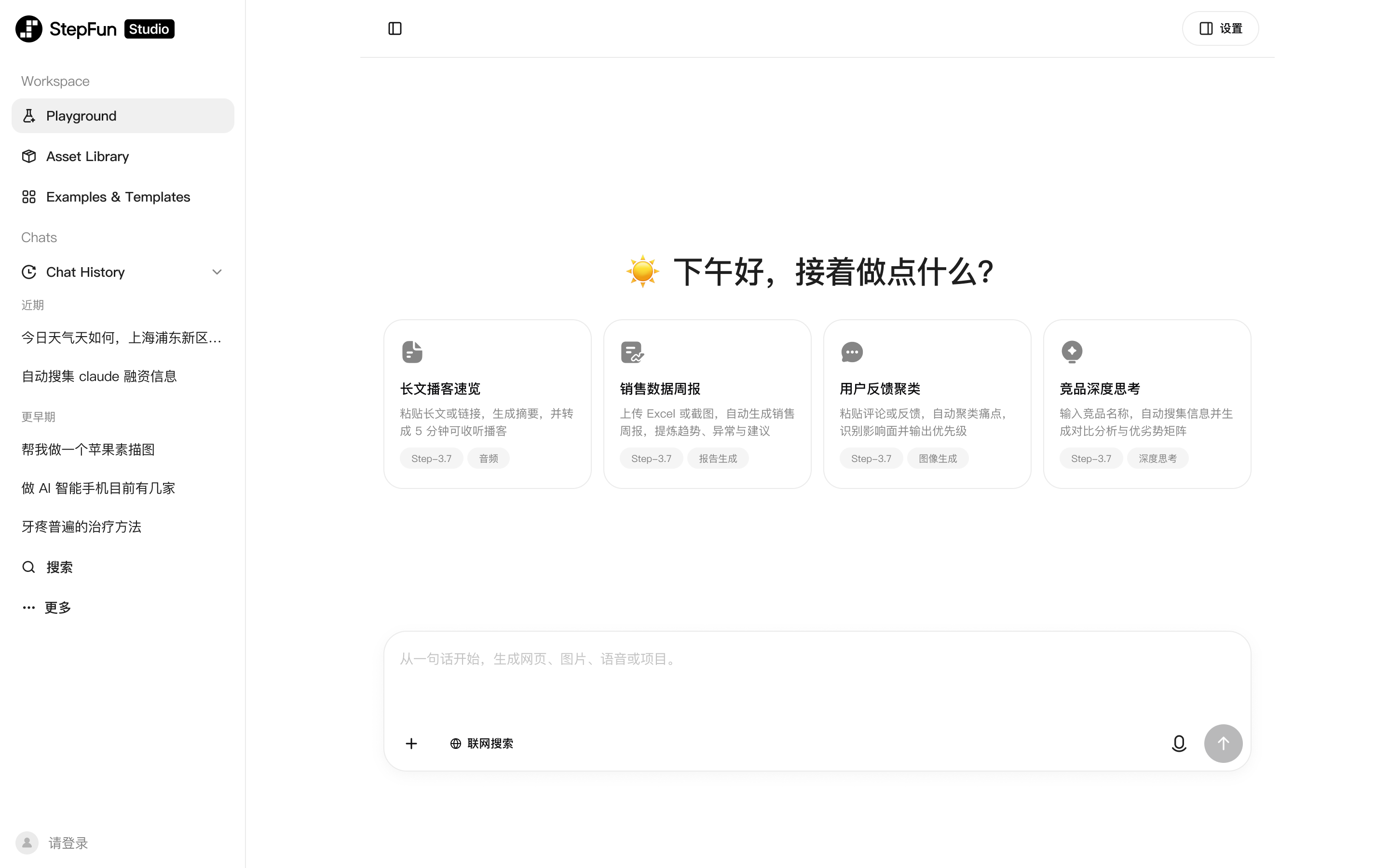
That arrangement asks the company to serve two audiences. Developers need predictable interfaces and documentation; manufacturers need systems that fit a product’s controls and constraints. A convincing demonstration helps open the conversation. Integration determines what reaches the customer. StepFun’s expertise sits across that boundary, between training a capable model and making it run inside a useful service.
The showroom is already in your pocket
Distribution makes this portfolio more interesting. StepFun names OPPO, Honor, and ZTE as smartphone partners. Its investor Qiming reported more than 42 million smartphone installations by the end of 2025. Treat that figure carefully: an installed model does not establish how many people use it regularly, or how much they pay.
Cars provide another route. StepFun’s website describes work with Geely and Afari on a full-vehicle intelligent agent, launched in the Zeekr 8X. For a model developer, the appeal is easy to see. A car already has microphones, screens, controls, and people who would appreciate fewer menus.
The business interpretation is that manufacturers can supply access to customers who might never seek out another chatbot. StepFun supplies technology the manufacturers can integrate. Success still depends on the finished experience: whether a request is understood, whether the right action follows, and whether the driver has to repeat it.
Big model. Smaller working crew.
There is a second problem inside the first. An assistant that handles many steps can consume a lot of computation. StepFun’s engineering therefore pays close attention to what happens each time a model produces its next token, a small unit of text.
Step 3.5 Flash illustrates the approach. It has 196 billion parameters but activates 11 billion per token through a mixture-of-experts architecture. Think of a large organization assigning a smaller working crew to each job. The unused capacity remains part of the organization; it simply does not all work on every token.
This ratio describes activation. It is not a measured reduction in cost or memory.
Step 5 Preview takes that idea into a larger system: 600 billion total parameters, 27 billion active, and support for up to a million tokens of context. Its published focus includes software engineering and professional work. The useful question for a buyer is whether that capacity improves a real assignment.
The meter keeps running while it thinks
StepFun charges for hosted model usage. On its global pricing page, Step 3.5 Flash costs $0.10 per million uncached input tokens and $0.30 per million output tokens. Step 5 Preview is $1.00 and $2.70 respectively, as checked on October 25, 2026. Cached input has separate, lower rates.
Those prices require a second calculation. Step 5 Preview’s billed output includes reasoning as well as the final answer. Step 3.5 Flash’s documentation acknowledges longer generation paths than Gemini 3.0 Pro for comparable quality. A low unit price can be consumed by extra thinking, retries, or an unsuccessful run.
The useful unit is a finished task.Editorial takeaway
The capital requirements are substantial, too. Qiming confirmed a January 2026 B+ financing exceeding RMB5 billion. May reporting described a further round of nearly US$2.5 billion as nearing completion. That prospective transaction should retain its label; a reported financing is different from money confirmed in the bank.
For customers, the sensible comparison is a small batch of actual work: a coding issue, a document review, a spoken request. Keep the acceptance criteria fixed. Record which model finishes, how long it takes, and where a person intervenes. Those results say more about a purchase than an impressive specification detached from its workload.
Where the engineering gets awkward
StepFun’s October training account supplies a concrete failure and response. As Step 5 Preview’s network grew deeper, the team observed numerical instability, including exploding values and gradient spikes. It changed the precision used for selected internal values and introduced more targeted gradient clamping. The account describes adjustments prompted by observed behavior.
Released models have their own friction. Step 3.5 Flash’s documentation flags repetitive reasoning, mixed-language answers, and reduced stability in unfamiliar settings or extended dialogue. Downloadable weights also require suitable hardware. Step 5 Preview uses a different license from the Apache-2.0 terms of Step 3.5 Flash; commercial users must read the relevant conditions.
For an enterprise team, downloadable weights offer another choice: operate the model under its applicable terms instead of sending every request to a hosted service. That choice shifts responsibility for serving, updates, monitoring, and capacity onto the buyer. Openness changes who can run the system; it does not remove the work of running it.
A builder can copy something practical here without financing a model lab: choose one recurring task, test representative inputs, and count latency, errors, and total cost through completion. Try the model in the environment where it must work. The microwave is still a good test. Eventually somebody wants the egg.