At fifteen, Stefanie Roumeliotes was already doing congressional internships. She would become her high school's student body president. But an earlier political education had taken place in her godfather's home, where she watched meetings about strategy and tactics. Before politics became her profession, it was something adults she knew sat down and did. The distance between a family gathering and public life was short enough for a curious girl to cross.
That is a useful place to begin with someone whose professional life involves helping other people get elected. The familiar political biography follows the candidate toward the microphone. Roumeliotes's story follows the people who help pay for the microphone, organize the support and keep an undertaking going after the initial excitement has worn off. There is considerable work between believing in someone and putting a functioning campaign behind them.
A political education in a living room
She grew up in the San Francisco Bay Area, with Holy Cross Greek Orthodox Church in Belmont anchoring her Greek heritage. Summers took her to relatives in Maine, New Hampshire and Massachusetts. Her grandfather, a Greek immigrant who graduated from Brown in the 1930s, taught her to connect education with opportunity. The women in her family, particularly her mother, supplied another example: careers, service and family obligations could occupy the same life.
UCLA followed. Then, in 2000, came the chance to learn fundraising on Dianne Feinstein's Senate reelection campaign. She later worked as deputy finance director for Phil Angelides's gubernatorial campaign. Those beginnings put her inside the financial workings of electoral politics. They also gave a young organizer a specific trade to practice, one with deadlines and consequences beyond a good conversation.
By 2004 she had founded SGR Consulting in San Francisco. The proposition was straightforward: campaigns needed fundraising help; she could make a business providing it. The firm would work with nonprofit organizations as well. A career in public life could therefore take the form of a private company, with clients, colleagues and the responsibility of keeping the enterprise useful.
- 2000Fundraising on Feinstein's reelection campaign
- 2004SGR Consulting is founded in San Francisco
- 2007-08Northwestern finance director for Hillary Clinton
- 2024National senior adviser on the Harris-Walz campaign
The candidate has a name. So does the finance director.
In the 2007-08 presidential cycle, Roumeliotes served as Hillary Clinton's Northwestern finance director. A campaign organization chart makes the assignment look almost modest: a region, a name, another line among many. Yet the chart captures something a campaign photograph cannot. A national political operation divides its work among people with specific responsibilities. The person at the lectern depends on a much larger cast.
There is a temptation to make fundraising sound like an unusually sociable evening out. A regional finance title suggests a more exacting occupation. Support has to become a working campaign. The geographical label matters, too: Roumeliotes's career was already extending beyond the city in which she had started her firm.

Roumeliotes has described a rule for donor conversations: she asks people to support candidates or efforts that match their interests and values. That makes listening part of the assignment. The relationship runs in both directions, with a responsibility to understand the supporter as well as the cause. It is an approach that gives the apparently simple act of asking for money a more demanding preliminary task: knowing why this person might care.
The years brought work with Joe Biden, Kamala Harris, Gavin Newsom, Alex Padilla and other Democratic figures. In 2024, Roumeliotes served as National Senior Advisor for Technology and Business Development on the Harris-Walz presidential campaign. The title joined two subjects often discussed separately: political support and the business community. Her assignment placed them together.
The wider professional arc is visible in SGR's present-day services, which include finance strategy, public affairs, nonprofit development, donor engagement, messaging and events. A founder who began in campaign fundraising now leads a firm offering several forms of practical support. That breadth gives the work continuity between election cycles, while keeping relationships and organizational purpose at its center.
SGR's reported cumulative client fundraising since 2004.
Company-reported total, accessed October 2026.SGR says it has helped clients raise more than $2 billion since its founding. The figure describes money raised for candidates, organizations and causes across many engagements. Its significance here is duration and accumulated work. Twenty-two years separate the firm's founding from this profile. A fundraising practice has to find reasons for people to participate through changing candidates, priorities and political seasons.
She once considered running for office herself. She decided her instincts and skills were better used helping other people seek it. The choice clarifies the shape of her ambition. Campaigns offered her a place to plan, solve problems and work alongside candidates without becoming one. Building SGR gave that preference a durable professional form, along with an organization she could shape herself.
San Francisco keeps appearing in the story
National assignments did not erase the local ones. On May 14, 2010, then-Mayor Gavin Newsom appointed Roumeliotes to the Golden Gate Park Concourse Authority board. Public service added a different kind of obligation to a career already entwined with electoral politics. A campaign seeks permission to govern; a public appointment puts someone inside the machinery of a city.
In 2017, Mayor Ed Lee appointed her chair of the San Francisco-Thessaloniki Sister City Association. The role connected her home region with her Greek heritage through municipal, business, educational and cultural exchange. For Roumeliotes, the two strands had long coexisted. Here they acquired an institutional address.
Her civic commitments have also included board service with Children of Shelters and TogetherSF. Put alongside the sister-city appointment, those roles show several scales of participation: children in one city, residents looking for ways to engage, and exchanges across an ocean. Her career repeatedly returns to organizations in which people have to agree to do something together.
That recurrence makes San Francisco more than the location on a business card. It is where political clients, civic appointments and community organizations overlap in her professional life. The city supplies a continuing setting even when the campaign is national.
One hour of pay, and the women coming next
Dress for Success named Roumeliotes a 2021 Success Honoree. Its account of her work emphasizes mentoring women entering politics, alongside helping elect women to offices where they had previously been absent. The achievement has a human scale as well as an electoral one: someone starting out needs people willing to explain the work and help her advance.
“I wouldn't be where I am today without them.”
Stefanie Roumeliotes, on the women behind her success
The sentiment is reciprocal. She credits women with making her own progress possible, then puts time into women beginning their careers. Mentoring belongs naturally in a profession so dependent on relationships. The first useful introduction, the first assignment and the first person willing to take a younger colleague seriously can all matter before a title arrives.
The recognition also connects two forms of advancement that can be separated too neatly. A woman seeking public office needs backing. A woman entering or returning to employment needs support as well. Roumeliotes's involvement with Dress for Success extends the concern with women's opportunity beyond the campaign. It brings a professional commitment into contact with the everyday business of earning a living.
In March 2022, she joined six other leaders in Dress for Success San Francisco's Bay Area Women in Power campaign. Participants pledged the equivalent of an hour's pay. The campaign set a $75,000 goal for the month, supporting services that help women achieve economic independence. An hour is an unusually comprehensible fundraising unit: a piece of one's own working life offered to help someone else's.
That month's Casino Royale gala at the Palace Hotel recognized Roumeliotes alongside Andrew Freeman and Dion Lim. Five hundred guests attended; the event raised more than $500,000 for workforce development and employment retention programs. The ballroom provided the occasion. Helping women establish and sustain working lives supplied the reason for assembling it.
The advice was to pay people well
Asked about advice that stayed with her, Roumeliotes recalled investor Ken Sawyer's counsel to hire people smarter than herself and pay them well, even more than she paid herself. Political strategist Kristin Bertolina offered another rule: stay loyal to colleagues and do not take their clients. Both pieces of advice concern the treatment of other people. Neither requires a particularly ornate management vocabulary.
Her reading recommendations give the portrait another register: Glennon Doyle's Untamed, Chanel Miller's Know My Name and Stephanie Artarit's Athens Riviera. Her preferred Northern California escape includes Tomales Bay, lunch at Hog Island Oyster Co. and a stay at Nick's Cove. A person can spend a working week raising money and still want lunch by the water. The oyster is under no obligation to discuss a campaign.
A fundraiser meets Astraea
In 2025, the Greek America Foundation honored Roumeliotes at its Gabby Awards in New York. Twenty women from the United States and Canada were recognized in an evening called “Goddesses in our Midst.” Each was paired with a figure from Greek antiquity. Roumeliotes was associated with Astraea, the goddess linked to justice and innocence.
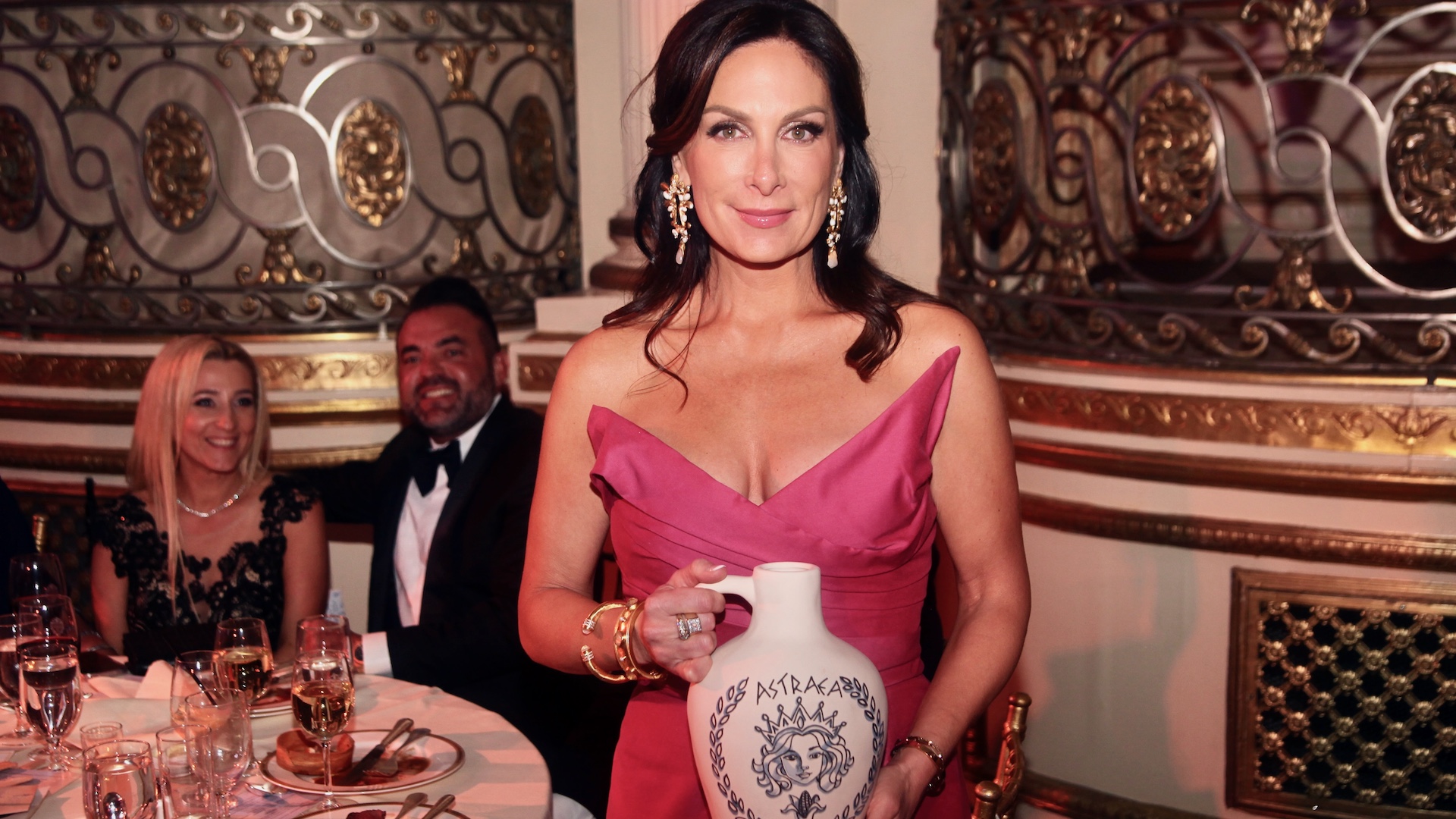
It was an elaborate cultural tribute to a career concerned with practical arrangements. The pairing also brought the story back to its beginning: Greek community life, public service and the belief that participation is something a person can learn. The teenager watching political meetings had built a profession helping other people act on their convictions.
The victory speech is the part everyone recognizes. Roumeliotes has spent her career on the work that comes earlier: building support, finding resources and helping people take a place in public life. Her name need not be on the ballot for that to be a political life.