Consider the modest vendor invoice. At an investment firm, paying it may be the easy part. The awkward question is which fund, management company or department should bear the expense. A bill arrives as one number. The organization receiving it may contain dozens of reasons to divide that number differently. Somewhere, somebody must remember the rules.
Stavtar Solutions has made that memory its business. Its flagship software, StavPay, brings vendors, contracts, invoices, allocations, approvals and payments into a connected workflow. The customer is usually a finance team at a hedge fund, private equity firm or family office. The attraction is wonderfully prosaic: less arithmetic by hand, more explanation on demand.
- The job: allocate complex business expenses and carry them through approval and payment.
- The buyer: finance and operations teams; Stavtar reports 140+ asset-manager clients.
- The wager: finance software becomes more useful when it preserves the reasoning behind the numbers.
A budget objection becomes a product
Steven Petersen and Avtar Batth knew each other from TPG-Axon, where finance and technology met over the practical business of building systems. Later, as CFO at Hudson Bay Capital, Petersen encountered a familiar absence: no single view of what running the enterprise actually cost.
He proposed software above the existing systems, gathering the relevant data and doing the allocation work. His boss liked the idea less at the proposed budget. Petersen called other CFOs. Their accounts of manual work suggested a market beyond one employer. With permission to pursue an outside business, he and Batth planned to fund the product themselves and recover their costs by selling it to other funds.
Stavtar was founded in 2017. StavPay was developed in 2018 and launched on January 1, 2019, with three funds, including Petersen’s own. He went full-time at Stavtar in May 2022. The name combines the founders’ names. They thought it sounded like a universe; the first territory was accounts payable.

An invoice needs a memory
StavPay’s distinction lies in configurable expense allocation across multiple layers. The rules can reflect attributes such as fund size, headcount or deal activity. It then connects the calculation to approval workflows and downstream financial systems. That sequence matters: a carefully divided expense still creates work if someone must retype it into the ledger.
The platform lists integrations with general ledgers, banks, wire platforms, fund administrators and other financial tools. It also offers modules for accruals, budgets, legal invoices, chargebacks, procurement, time tracking and 1099 work. A business process operations team supports clients. This is software accompanied by people who help operate the process, an important detail for a buyer comparing features alone.
- 01 Capture invoice
- 02 Apply allocation rules
- 03 Route for approval
- 04 Pay and pass to ledger
Simplified workflow illustration. Each client’s configuration differs.
The most useful customer evidence is specific. Axonic Capital CFO Amanda Favorite describes the old allocation process as an operational burden. Her account emphasizes documentation and reliability alongside automation. The benefit is easier to grasp when imagined from the reviewer’s chair: find the transaction, follow the reasoning, see the record.
“Before Stavtar, expense allocation was a constant operational strain.”Amanda Favorite · CFO, Axonic Capital
Stavtar’s current homepage reports more than $20 billion in processed expenses and 700,000 invoices. Those are company figures, without a stated measurement period. They describe the administrative work passing through the system. They also explain why the humble invoice deserves more attention than its stationery suggests.
The people and entities behind the expense
An expense is attached to a business structure. StavOrg maintains legal-entity records, ownership charts, authorized signatories and filing alerts, with banking visibility alongside the entity information. Its connection to StavPay makes sense: the entity receiving a charge should be identifiable without a hunt through another folder.
Employee compensation adds another clock to the problem. A bonus can be awarded, accrued, deferred and paid at different times. StavComp supports salary, bonuses, deferrals, phantom equity, clawbacks and benefits. It produces accrual schedules, cash-flow forecasts and reconciliation reporting, and connects compensation data to StavPay’s expense workflows.
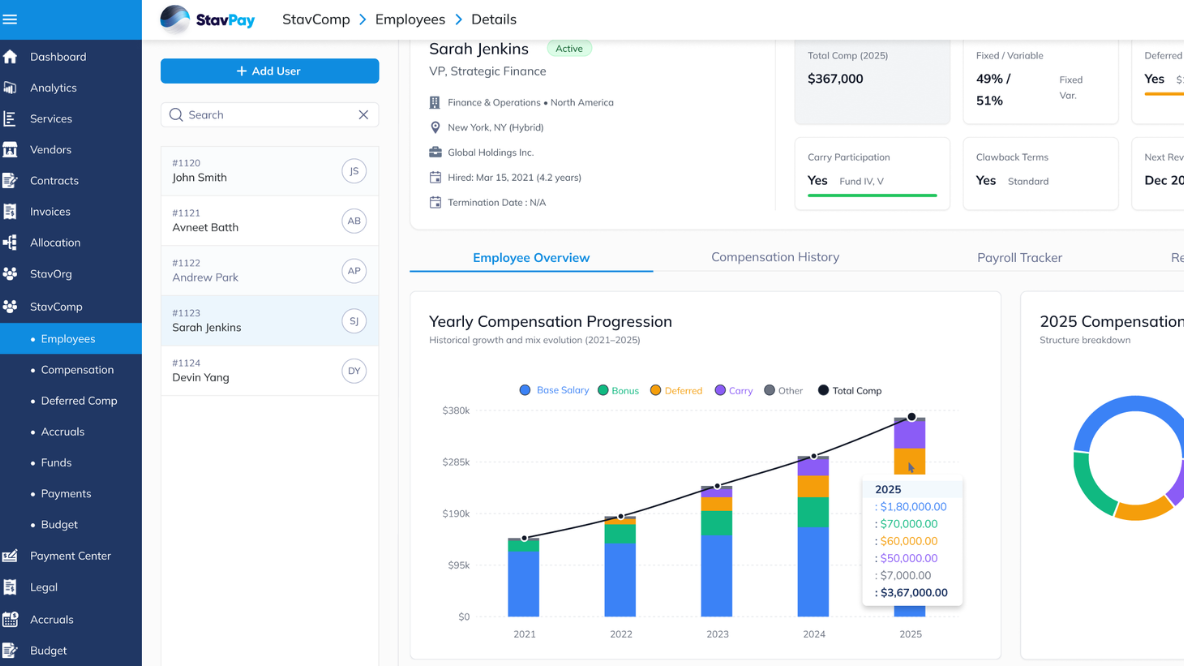
Together, these products give the company a coherent expansion route. The invoice, employee and legal entity are related records. Connecting them can spare a finance team the recurring task of proving, across separate systems, that they all describe the same business.
A shop inside the accounts payable system
In July 2025, Stavtar launched StavMarket, embedding vendor discovery inside StavPay. Vendors can present searchable profiles, collateral and videos; clients can make contact. Discount codes help measure engagement. The commercial intuition is appealing: a place already handling supplier relationships may be a useful place to discover suppliers.
AgentSmyth joined that month, bringing its trading-intelligence offering into the marketplace. In February 2026, Stavtar appointed Michael Basen to lead StavMarket. The current product description emphasizes warm introductions and events as well as searchable listings. Relationships remain part of the machinery.

The broader business is B2B SaaS, supported by implementation and operations services. Linedata announced a StavPay-powered expense-management service in 2021. Elephant’s $55 million minority Series A investment, announced in August 2025, backed further product development, payments and hiring. It financed expansion after years of product use.
Investment in Stavtar. Separate from the assets its customers manage.
Four weeks, with a defined scope
The practical starting point is Stavtar’s standard four-week configuration offer, advertised at no additional cost for StavPay clients. It covers invoice ingestion, pre-built allocations, approval workflows and ACH payments. Onboarding data comes first; testing and client sign-off follow. Custom integrations and specialized workflows sit beyond that standard scope.
For a prospective buyer, the useful exercise is to trace one invoice: arrival, allocation rule, approver, paying entity and accounting destination. Find where the process needs someone’s private knowledge. Software becomes useful when that knowledge can be expressed clearly and checked.
A small business with straightforward bills may need less machinery. A complex manager still needs sound policies, usable data and people willing to settle exceptions. Stavtar’s proposition is most persuasive where those decisions already exist but live in scattered spreadsheets. The invoice arrives with a number. Finance should be able to send it onward with an explanation.