A startup conference has an obvious centre of gravity: the stage. Someone has a microphone. Someone has built a billion-dollar business. Everyone else has a lanyard. Yet one of the more revealing details about Gujarat’s Startup Conclave sits in a university annual report. Navrachana University says eight startups from its innovation foundation attended the 2023 gathering. Three gained clients. There, in miniature, is a reason to leave the office.
- Exhibit a product, pitch investors and meet industry contacts.
- Gujarat’s government brings national innovation agencies into the room.
- The 2025 closing report put startup investment at ₹232 crore.
- A good introduction still needs a second meeting.
Startup Conclave is a government-led entrepreneurship platform whose public face is an event: exhibitions, investor conversations, panels and roundtables. The Education Department of Gujarat organizes it with collaborators including i-Hub Gujarat. Founders are one audience. Investors, industrialists, students, incubators and policymakers are others. Its practical proposition is unusually easy to understand. People who need one another can spend two days in the same place.
A customer is a useful souvenir
The Navrachana example matters because conference success is often counted in people. A crowded hall makes an excellent photograph. A new customer is harder to photograph, but easier for a founder to explain to an accountant. The university’s account supplies a modest, concrete outcome. It also suggests how an exhibition can serve a young business: as a place to discover whether strangers see a reason to buy.
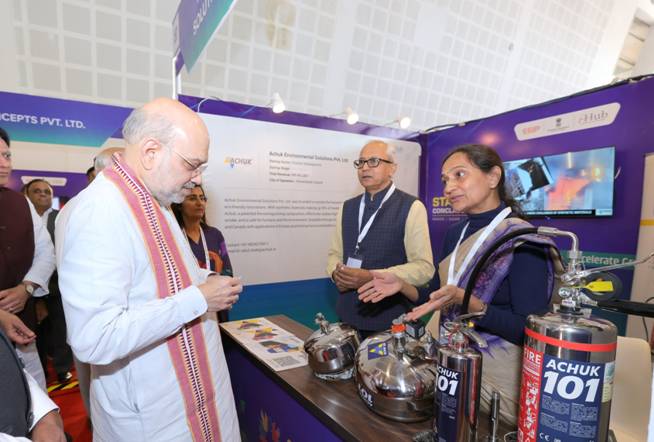
A founder can demonstrate a product, hear objections and arrange a follow-up. An industrial visitor can inspect something that would be difficult to understand from a pitch deck. Students can encounter entrepreneurship as a working activity, with equipment and sales conversations attached. The exhibition is the place where an abstract promise has to survive a question from someone standing three feet away.
The guest list is the mechanism
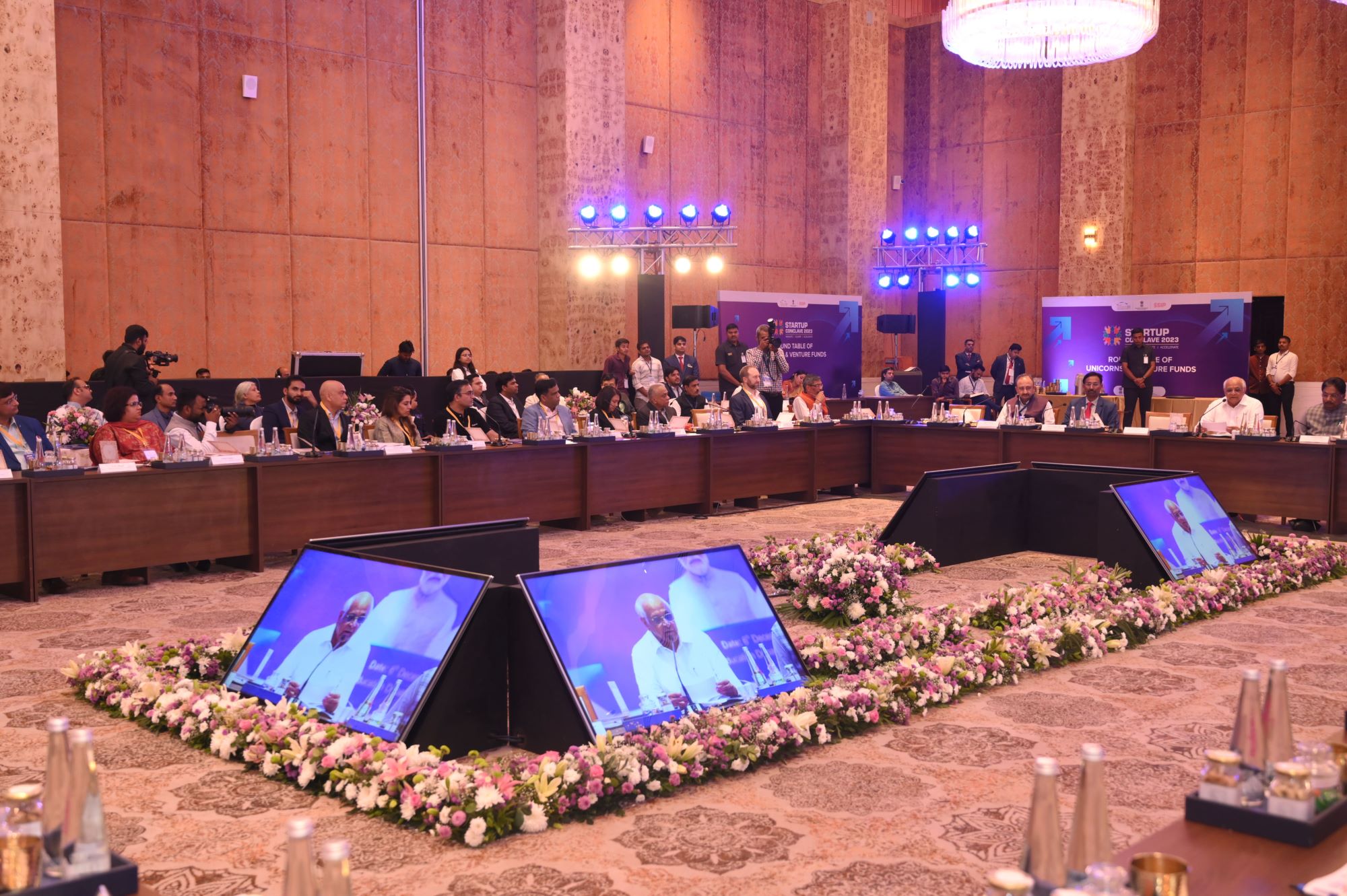
In December 2023, the conclave formed part of the run-up to Vibrant Gujarat 2024. A government account describes a roundtable bringing together venture capitalists, unicorn founders, investors, accelerators and industrialists. That combination explains its position in the market. An incubator demo day can offer concentrated investor attention. A trade exhibition can offer buyers. Here, government and policy discussions share the programme with both.
The September 23-24, 2025 edition at Mahatma Mandir in Gandhinagar extended that arrangement. Collaborators included Startup India and DPIIT, MeitY Startup Hub and iDEX Defence Innovation Organization. For technology businesses, these are different institutional entry points: entrepreneurship policy, electronics and digital innovation, and defence innovation. Putting them on one programme gives founders several kinds of conversation to pursue.
The programme also made room for women founders and investors through “SheLeads”, alongside sessions on emerging sectors, investment and India’s unicorn companies. A session title cannot prove an investment outcome. It does, however, show how the organizers divided attention. The agenda treated entrepreneurship as a collection of distinct problems, with different people needed to answer them.
First, get everyone through the door
There is a pleasingly ordinary detail beneath this institutional machinery. Hashtechy, the technology vendor behind the 2023 registration project, describes the client’s challenge as managing the influx of attendees. Its answer was a straightforward registration system that issued personalized QR codes. The case study reports more than 350 startup registrations and more than 85 investor registrations.
This was an operational problem with an operational answer. It offers something other organizers can copy: make participation simple before making the programme elaborate. Registration, entry and mobile access consume time that visitors could otherwise spend meeting people. The vendor’s account identifies a design challenge and a delivered system; it does not establish that an earlier system crashed or that queues disappeared.
“mind to market”
A phrase used in the government’s account of Amit Shah’s 2025 address
Read the cheque carefully
The 2025 closing report supplied the big number: ₹232 crore in investment for startups, alongside 84 memoranda of understanding. The Indian Express reported those figures, citing the event’s closing proceedings. The distinction matters. This is money reported for participating ventures. It is not the conclave’s revenue, valuation or fundraising round. Nor does an aggregate announcement show how much each founder ultimately received.
Closing-session figures, September 2025. These measure different activities and should not be added together.
There are smaller, more tangible traces of the investment activity. i-Hub reported cheques presented by Finvolve to BU4 AUTO and Ammunic Systems, and by Indicorn Angels to SetMyCart and Kraya India. Separately, its account of an agreement with Indian Angel Network describes a pipeline for mentoring, capacity building and investor connections. These examples show the machinery behind the ceremony: organizations agreeing to keep working together.
The economic model visible here is public-sector convening with institutional collaboration. Its value travels through access, introductions and startup development. The ₹232 crore figure cannot tell an attendee what participation costs. A founder considering the trip should establish current entry or exhibition terms and budget travel, accommodation, preparation and time away from the business. Those are individual planning decisions, rather than a price implied by the investment headline.
Bring a question worth answering
For founders, the useful preparation is specific. Decide whether the next bottleneck is capital, a customer, technical feedback or an institutional introduction. Bring a demonstration suited to that conversation. Ask for a defined next step. For organizers elsewhere, the transferable idea is to connect several kinds of help, then make the route between them easy to navigate.
This approach depends on fit. A venture seeking customers needs relevant buyers; a company seeking equity needs investors whose interests and cheque sizes match. Attendance cannot substitute for product readiness or evidence of demand. The current Startup RISE application advertises sector-agnostic private-investment opportunities between ₹50 lakh and ₹10 crore. That describes a fundraising route. A founder still has to make a case that survives the meeting.
The most persuasive version of Startup Conclave is therefore a very practical one. Arrive with something to show and a question someone else can answer. Leave with a name, a reason to speak again and a date in the calendar.