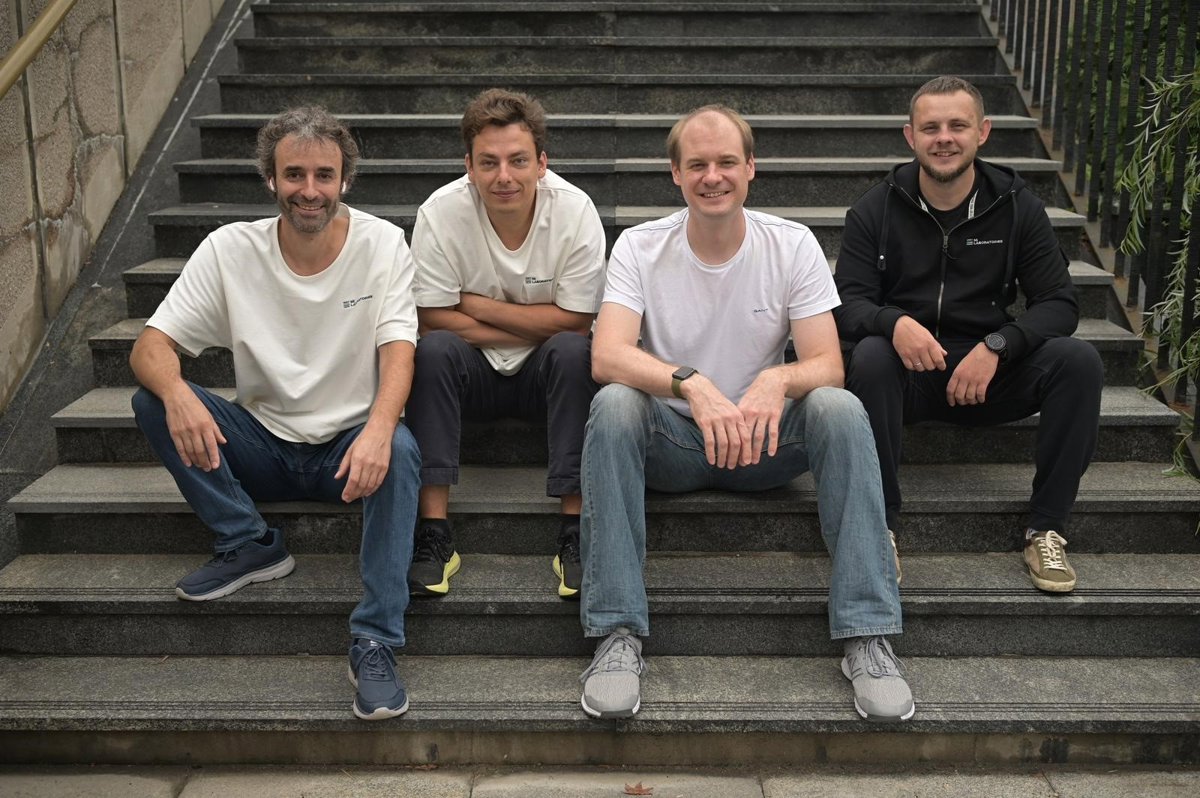
The T-shirts were an accident. When Stanislav Poslavsky joined Sander Wuyts for an episode of The Repertoire Room in September 2025, the two had arrived dressed alike. Poslavsky later joked that the coincidence might be a sign of a good partnership. For a conversation about the awkward distance between people who make scientific software and people who need to use it, matching clothes offered an unusually economical introduction.
His subject was a mismatch rather less easily resolved. Biologists had questions about their data. Bioinformaticians had tools for answering them. Between the two lay computing resources, programming languages and the practical business of getting an analysis to run. Poslavsky, co-founder and CEO of MiLaboratories, had come to describe that distance as a problem worth building a company around.
There is something pleasingly improbable about the messenger. Before making software more approachable for laboratory scientists, he worked on theoretical particle physics and programs for manipulating mathematical expressions. His professional vocabulary includes tensor indices, polynomial rings and Gröbner bases. A person could assemble quite a formidable barrier to entry from the nouns alone.
The physicist and the paperwork of the universe
Poslavsky studied at Lomonosov Moscow State University between 2005 and 2014, completing a doctorate in elementary particle physics. His research career included the Institute for High Energy Physics in Protvino. The problems were exacting: calculations involving particles, interactions and mathematical expressions whose bookkeeping could become an undertaking in its own right.
One response was Redberry, an open-source computer algebra system he developed with Dmitriy Bolotin. Their introductory paper was submitted in February 2013. It described software that understood tensor expressions, including the indices attached to mathematical objects and the symmetries governing their manipulation. Redberry accepted familiar LaTeX-style notation, allowing users to enter expressions in a form close to the one they already wrote.
That last detail deserves a pause. Even here, in software intended for people who willingly calculate particle interactions, there was attention to the language of the user. A scientist should be able to express a problem without first inventing a new relationship with the keyboard. Mathematical sophistication and considerate software design could occupy the same room.
In January 2016, Poslavsky presented Redberry at the ACAT computing workshop in Valparaíso, Chile. His talk covered applications in particle physics and gravity, including deriving Feynman rules and distributing calculations across machines. The abstract identified a familiar nuisance: as physics problems became more complicated, the computer algebra system itself could become the bottleneck. His later career would give that word a different setting.
An algebra library with a front door
Rings, another of Poslavsky’s projects, moved through a related mathematical landscape. He submitted its paper in December 2017; the journal article appeared in the 2019 volume of Computer Physics Communications. Written for Java and Scala, the library handles polynomial arithmetic, factorization and other operations in computational algebra. It is the sort of machinery most people are happy to know somebody else has built.
The documentation supplies both an application programming interface and an interactive shell. A programmer can embed the library inside another application; someone exploring a calculation can work with it directly. Its Scala interface offers a compact way to express mathematical operations while retaining information about the kinds of objects being manipulated.
Consider the difference between a mathematical method and a library somebody can actually adopt. The method must be correct. The library also needs sensible interfaces, examples and a way into the work. Rings has a quick tour, a user guide and benchmarks. Those are modest-looking components of a research project, but they determine whether another person gets past the first afternoon.
Read alongside Redberry, Rings suggests a recurring concern in Poslavsky’s work: turning specialized computational knowledge into something another researcher can operate. This is an interpretation of the projects, rather than a claim about his private motivations. The practical continuity is visible in their design. Both provide ways to express difficult work without manually managing every underlying operation.
A change of subject, a continuing collaboration
Bolotin’s name connects the early algebra work to MiLaboratories. He and Poslavsky collaborated on Redberry before becoming co-founders of the company. The wider founding group includes scientist Dmitriy Chudakov and Alexey Nechaev. In its 2024 investment account, TEN13 described the three technical founders as collaborators who had known and worked with one another for more than a decade.
The company grew around scientific software the team had developed in academia. MiXCR became an established part of that work, with Poslavsky among the authors of its 2015 Nature Methods paper. By the time the business was attracting venture investment, there was already a history of writing, publishing and supporting computational methods behind it.
Poslavsky had also been CEO and co-founder of REDBERRY, described in his career history as a platform for industrial data science. That executive chapter began in 2018. The sequence complicates the familiar picture of a researcher abruptly exchanging a laboratory for a startup. Software development, scientific work and company building overlap in his record.
Today his public professional profiles place him in Bilbao, Spain. MiLaboratories describes a team distributed between Bilbao and San Francisco. The geography suits a company whose work crosses several professional languages as well as national borders: physics, programming, experimental science and the operational concerns of a research organization.
“We believe that opening our platform to the developer community will accelerate the adoption of modern computational tools”
Stan Poslavsky, October 2024
The next user may never open a terminal
Platforma changes the intended audience. Its premise is that scientists should be able to work directly with their data through a visual interface, while computational specialists build and extend the methods underneath. In his podcast conversation, Poslavsky described the difficulty of asking biologists to navigate tools that assume programming skills and computing expertise.
A useful way to understand this is to imagine two people looking at the same dataset. One knows which scientific question matters. The other knows how to run the necessary software. Each change to the question may require another handoff. That is an illustration of the coordination problem Platforma addresses, rather than a scene from Poslavsky’s office.
The design gives developers a way to package existing command-line pipelines into interactive blocks. Its SDK separates execution logic, a structured data model and the user interface. Scientists encounter the controls and results; developers retain a framework for describing the computation. Existing scripts can become part of the application without being rewritten from the beginning.
There is a quiet change in the definition of a finished tool here. A program can run perfectly and still be inconvenient for the intended user. A workflow can produce a result and still require another specialist each time a parameter changes. Poslavsky’s present business concerns that additional distance between a functioning calculation and a useful working instrument.
Opening the machinery
In October 2024, MiLaboratories announced its Platforma SDK alongside a Series A financing led by Kfund. The company’s release described total funding reaching $10 million. The SDK was offered free to academic scientists, giving them a way to develop custom analytical tools and applications. The announcement connected the business’s next stage to participation by other developers.
Poslavsky’s comment on opening the platform is particularly revealing beside his earlier projects. Redberry and Rings invited people to use and inspect scientific software. Platforma carries that impulse into a shared application environment. The company describes its SDK and built-in blocks as open source, with workflows and transformations available for inspection and versioning.
Openness also has a practical implication for the relationship with a user. A convenient interface can conceal the steps that created a result. Inspectable computational blocks offer a route back to those steps. For researchers, the ability to examine a method and repeat an analysis belongs alongside the convenience of clicking through it.
The technical and commercial questions meet here. The same company has to serve people who want a straightforward workspace and people who need to examine, adapt or deploy the underlying machinery. Its current offering includes private-cloud and high-performance computing deployment options. A friendly screen still needs somewhere dependable to do the work.
A matching shirt is the easy part
On the podcast, Poslavsky discussed ambitions to extend Platforma into additional kinds of biological analysis, including single-cell, multi-omics and microbiome work. Those were plans he described in September 2025. The larger direction was consistent: bring more scientific questions into a setting where the researcher can follow the analysis personally.
His public role now includes explaining and demonstrating that setting. The physicist who once presented automated algebra to a specialist computing workshop also appears in software demonstrations and conversations with scientific users. The audience changes; the need to show how a tool works remains. A demonstration has an agreeable way of making abstract promises answer to a mouse click.
The matching T-shirts make a good opening because they offer an easy version of alignment. Poslavsky’s work deals with the more demanding version: getting a method, a computer and a person with a question to cooperate. His career can be read through the interfaces he has helped build. First, expressions a physicist could enter. Then, algebra a programmer could embed. Now, analyses a researcher can explore. The steps between people are becoming part of the calculation.