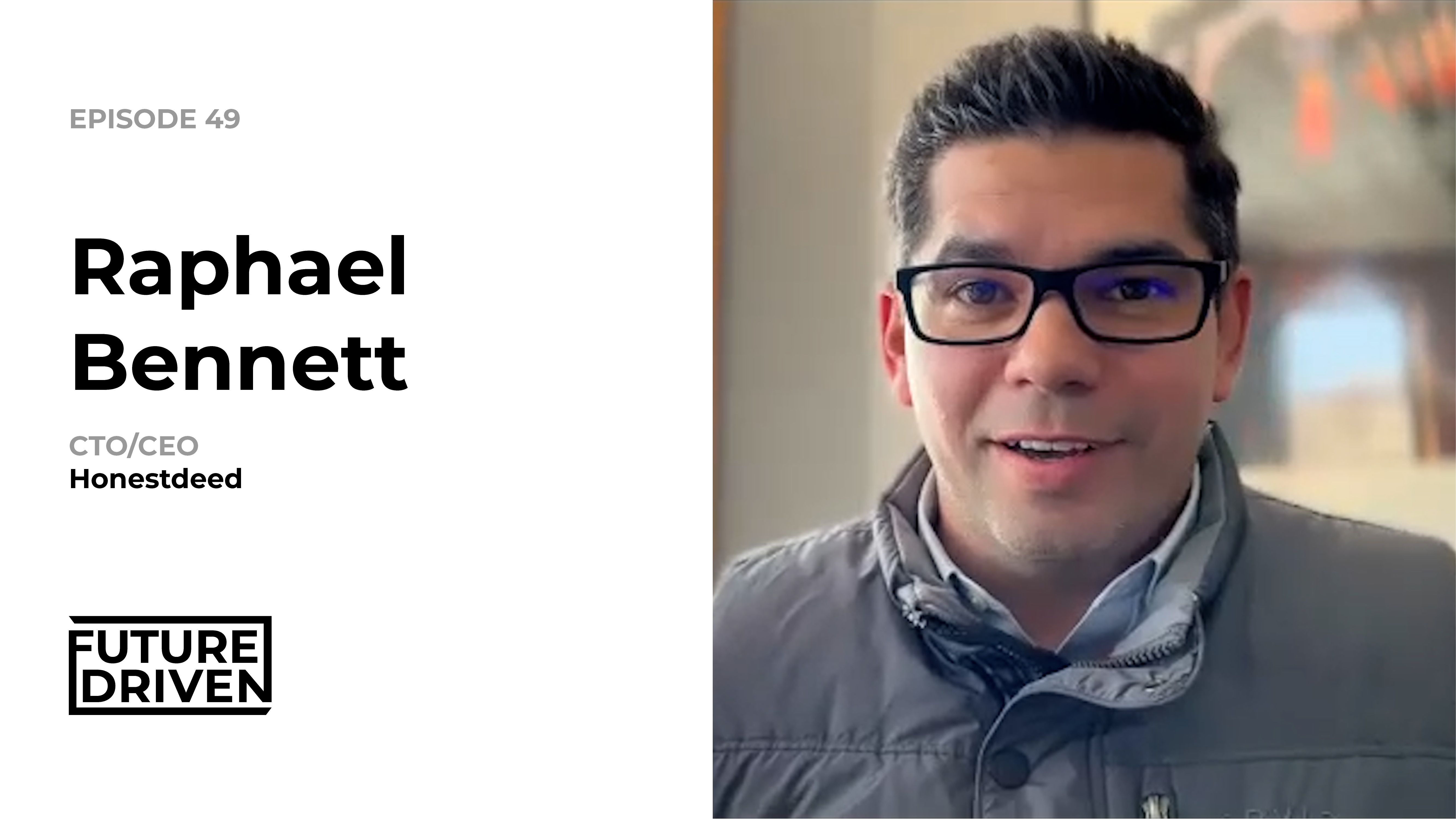
Raphael Bennett has a message for the chief financial officer, and it begins with the software bill. “Un-SAAS your company.” The instruction is abrupt enough to interrupt a polite meeting. Software subscriptions have a way of becoming furniture: familiar, expensive, occasionally awkward, and rarely questioned until someone has to move.
Bennett wants the question asked sooner. His argument is that companies should understand their own data and consider taking ownership of more of the infrastructure that handles it. The invitation comes with an offer to talk through the difficulty. There is something pleasingly unfashionable about an AI executive asking who understands the plumbing.
At REV Global, Bennett is co-founder, co-CEO and chief AI officer. Those titles put him at the meeting point of buying businesses and changing how they operate. Read his career through that lens and its apparently different chapters begin to connect. Virtual tours, hospitality software, financing and acquired companies all involve a system someone has decided to accept. Bennett keeps finding reasons to open it up.
Before the boardroom, a room on a screen
His early product work involved web-based virtual reality for indoor spaces. The setting feels apt: a software engineer building a way to move through a place without physically being there. In a later interview with Adam Lejeunekopp, Bennett described the difficulty of finding a job after college as a push toward entrepreneurship. Building his own work became a practical response to the absence of someone else’s offer.
By 2005, the Northern Michigan University graduate was in Chicago, developing virtual-tour technology called VR4. He had completed his BS in 2003. This was well before the current enthusiasm for AI officers and autonomous workflows. The underlying ambition was recognizable, though: take something awkward to experience at a distance and make it accessible through software.
The distance between that project and his present work is considerable. Still, the continuity is worth considering. A virtual tour has to help a visitor understand a space. A business system has to help an operator understand what is happening. Both can become elaborate demonstrations that leave the user confused. Bennett’s subsequent interest in user experience makes sense against that early assignment.
By 2018, he was appearing on a Northern Michigan career panel as a representative of Neustep. The event brought business owners from the Iron Mountain area together with students. It is a small career detail, but a useful one: alongside the products and executive titles sits the ordinary work of explaining a business to people deciding where they might fit.
The business underneath the booking
Bennett later served as chief technology officer of BCV Social. Hospitality technology presents a particularly direct test of whether software connects to an operating business. A guest sees a photograph, asks a question, makes a booking or complains. Behind those simple actions are systems that have to turn scattered interactions into something a hotel can handle.
RateGain announced its acquisition of BCV in June 2019. Its description of the combination brought together social listening, analytics, creative work and guest engagement with revenue management and distribution. The transaction illustrates a kind of business logic that now sits close to Bennett’s work: software capabilities can matter both as operating tools and as reasons for an acquisition.
BCV’s work included monitoring and engaging with social media around the clock. That detail matters in hospitality: a guest’s question does not wait for the next office opening. The technology sits alongside a service obligation with inconvenient hours.
There is a useful difference between writing a feature and understanding why another company would want to own it. The second question requires a wider view. How does it fit with the buyer’s existing work? Who uses the information? Where does the value appear? An engineer moving into company ownership has to become interested in the answers beyond the code.
A clever mechanism needs a willing customer
HonestDeed brought Bennett into another system with established habits: asset financing. Techstars named him among the company’s founders in its summer 2022 Boulder class, the accelerator’s first cohort focused on fintech. At the time, the proposition centered on seller financing for home buyers and sellers. The engineering problem extended into a transaction people already knew how to approach in a particular way.
That history acquired a revealing turn. By March 2026, the HonestDeed team described shifting toward business customers and familiar amortization methods after encountering resistance to an unfamiliar consumer structure. It is a modest, consequential lesson: a mechanism can look attractive to its designer and still ask too much of its customer.
Bennett’s Michigan Ross MBA belongs in this part of the story. He connected the venture’s development to the school’s entrepreneurial network and the REV club that evolved into REV Global. The relationship between the financing venture and the investment platform is unusually close. Ideas, professional contacts and capital were developing around the same network.
Consider the tension in that combination. The engineer can see a better arrangement. The buyer has to understand it, trust it and explain it to someone else. A product has several audiences before it has a customer. Each can stop the transaction. Elegance is welcome; familiarity often gets the paperwork signed.
Three tools, one ownership question
In his current work, Bennett has made his preferred starting equipment public. He describes acting as a fractional CTO for companies REV has acquired or partnered with. His recommended trio is Twenty for customer relationship management, Mautic for email marketing, and n8n for automation and orchestration. He specifies self-hosted, open-source software.
Open source · Self-hosted · Company-controlled infrastructure
The specificity is helpful. Readers can examine actual products instead of decoding a promise about transformation. The list also shows where his attention goes first: relationships, communication and the connections between tasks. These are practical places to look when deciding whether an AI project has anything useful to do.
His stated aim is to create a foundation for AI workflows while keeping private company data under the company’s control. That makes ownership part of the design discussion from the beginning. There are still decisions to make about maintenance, access and responsibility. Owning machinery includes the less photogenic privilege of having to look after it.
The appeal of his argument rests partly in its choice of audience. He addresses CFOs alongside founders and technology leaders. An infrastructure decision reaches the accounts, the operating team and whoever has to fix the connection when it fails. The conversation improves when those people are thinking about the same workflow.
“Un-SAAS your company. Start planning for it now.”
Raphael Bennett, on infrastructure ownership
Good systems still need other people
At REV, Bennett shares leadership with Lynn Fernando, whose background includes commercial and marketing roles at Amazon, Disney and Nestlé. Her chief revenue officer role sits alongside his AI remit. Their pairing puts two sets of questions close together: can the business win customers, and can its operations support the work?
They have also hosted conversations about the ownership transition itself. In a REV Roundtable discussion with M&A lawyer Armen Martin, Bennett and Fernando explored succession planning and preparing a company for an acquisition. Such preparation gives the technology work a longer horizon. A workflow has to make sense after a founder hands over the keys.
His professional interests have appeared in less predictable combinations, too. After a University of Michigan reception, Bennett wrote enthusiastically about discussions ranging from AI and private equity to manufacturing, civil discourse and Michigan sports. “Go Blue!” was his sign-off. The detail gives the executive vocabulary a little air: even a conversation about capital formation can make room for the team.
His views on remote engineering are similarly attentive to people. He supports opening the talent pool through remote-first work, while acknowledging the frustration of poor management. A distributed team can widen the search for ability. It also makes clarity an everyday obligation. Software offers plenty of places to hide a misunderstanding until it becomes expensive.
For Bennett, the design choices start before anyone writes the application. He favors event modeling, a way of working through what happens in a system, and names the programming language Clojure among his preferred building tools. The sequence matters: agree on what the business needs to do, then decide how to express it in software. It is easy to imagine the temptation to reverse that order when a new tool arrives. His stated preferences give the conversation a more concrete starting point than enthusiasm alone.
What survives the company
One of Bennett’s less glamorous specialties concerns technology left behind when a venture fails. His advisory work includes examining software assets, assessing their value and helping find another owner. It is a revealing assignment for someone whose career is associated with building. Sometimes the useful thing already exists, stranded inside a business that could not continue.
That work requires distinguishing an organization’s fate from the possible uses of what it made. The questions become concrete. What can still function? Who understands it? Where could it earn its keep? The familiar startup ending leaves those questions open. A closing company may have completed something another operator needs.
Seen this way, Bennett’s ownership argument has a longer history than its AI vocabulary suggests. He has worked on making spaces navigable, financing understandable and operating tools available to the people running a company. The recurring interest is in the arrangement underneath the experience. For an executive with three titles, it is an appealingly ordinary place to begin: find out how the thing works, and who can change it.