The chairs were moving again. At Quanta, an engineer would roll over to an accountant to ask how a decision had been made. An accountant would roll back toward engineering to see how that decision was becoming code. The office had developed its own transport system, powered by questions.
Helen Hastings noticed. The founder and CEO changed the seating arrangement so engineers and accountants sat together by workstream, alternating along the same row. The room caught up with the work. For a company building accounting automation, it was a modest intervention with a useful implication: the person writing the software ought to be within conversational distance of the person who understands the transaction.
“Sometimes progress looks like a roadmap. Sometimes it looks like moving a chair,” she wrote. There are more expensive ways to describe collaboration. Hastings had found one with wheels.
An unsolved problem, before Quanta
Years before Quanta, Hastings was studying computer science at Stanford. In a June 2016 spotlight, she described technology as something she could tinker with, combine, and improve. Her questions concerned the next step: what an application, a website, or a company could become if someone examined the way it worked.
“To me, technology is an unsolved problem.”
Helen Hastings, 2016
It is an expansive way to describe an engineering education. A system can function exactly as intended and still leave a better arrangement undiscovered. You can learn its rules, then ask why those particular rules exist. That curiosity would eventually take her into a field where the rules arrive with rather more paperwork.
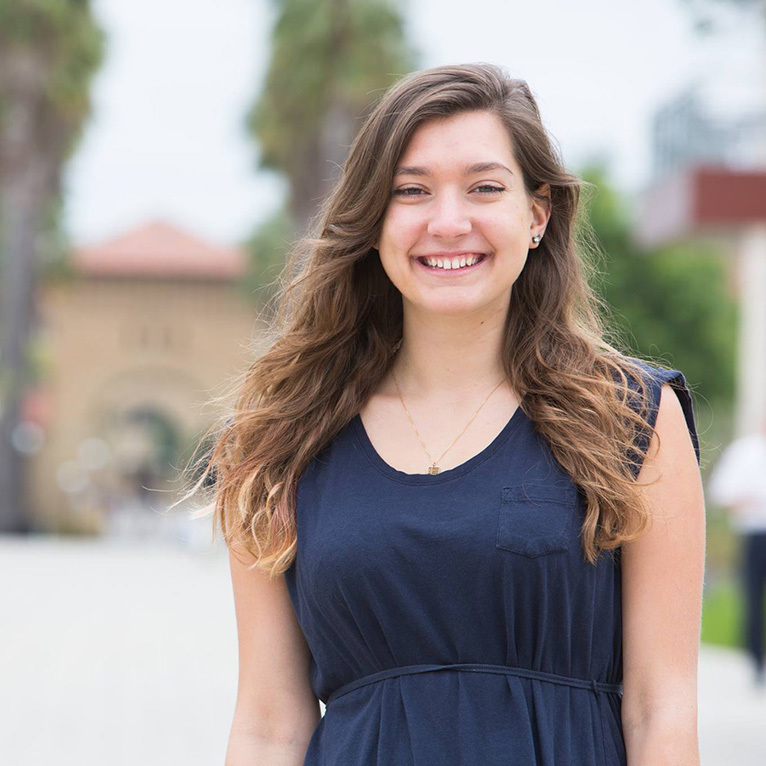
Her Stanford years also included she++, the organization encouraging women to pursue technology. She appeared among the initial interview subjects in its video library, identified as the group’s director of finance and a developer at Stanford’s Virtual Human Interaction Laboratory. The series put different computing careers in front of students who might otherwise never picture themselves in them.
Hastings was participating in that effort while still making her own way through the subject. The work placed a human face on an abstract career choice. A student could see a person doing the job and ask how she had arrived there. Years later, understanding another person’s work would become central to Hastings’s company.
The ledger apprenticeship
At Affirm, Hastings spent nearly six years building financial systems. She joined when the company had roughly 100 people and stayed as it grew beyond 2,000 and went through its IPO. Her work included the first iteration of its in-house accounting ledger.
She learned to build ledgers before she understood much accounting. From an engineer’s perspective, they made sense: money moves, balances change, and the system needs a durable account of what happened. A financial record has to survive questions from people who were nowhere near the original transaction.
Working with the accounting and finance team exposed the distance between recording activity and making it understandable. Hastings saw limitations in the existing systems and wondered whether these belonged to Affirm’s particular complexity. A lender can give an accounting system plenty to think about.
The question followed her beyond the company. If the difficulty came from the underlying machinery, other businesses might be struggling with a simpler version of the same problem. A founder should be able to ask what customers owe or how the business is performing without commissioning an archaeological expedition.
A long season of questions
Hastings began researching full time in 2022, before Quanta started in 2023. She sought out controllers, accounting managers, and finance leaders, often through cold LinkedIn messages. It was an engineer’s deliberately slow route toward building something: ask, listen, repeat.
The important distinction was between understanding a system and understanding someone’s working day. A technically plausible product can still miss the moment when an accountant needs an explanation, a founder needs an answer, or a team needs somebody to take responsibility for the books.
Those early conversations also created relationships that outlasted the research. Yehuda Tenenbaum helped Hastings investigate the field before Quanta got going. In January 2026, she joined his podcast, The People Behind the Books, to talk about the company. The person who once helped her ask questions was now interviewing her about what she had built.
Another connection ran through engineering leader Sarah Ericson, who introduced Hastings to Accel’s Amit Kumar. When Kumar later explained the firm’s investment, he emphasized her technical background and familiarity with the work. The financing had a history of people getting to know one another, as well as a theory about a market.
- 2022Full-time customer research
- 2023Quanta begins; Accel seed investment
- Feb 2025Public launch and seed announcement
- Dec 2025Series A announcement and Prism
The engineers did the books
Quanta’s early approach included having engineers perform bookkeeping themselves. Hastings has called it “engineers as bookkeepers.” Before a process could be automated, the people building the automation had to encounter its details.
Consider the apparently ordinary task of interpreting an expense. A vendor name alone may tell you surprisingly little. Human-written memos and the circumstances of a purchase can carry the meaning. Hastings’s attention went to that language, the material a bookkeeper reads before deciding where an item belongs.
That observation helps explain the combination she chose: accounting expertise alongside software, with a general ledger built inside Quanta. The company’s launch described automated routine entries, native accrual schedules, and integrations such as Stripe, while making experts available to customers through Slack.
Hastings’s stated ambition was to automate non-creative accounting work while leaving room for people to make strategic decisions. The ambition requires a fairly intimate acquaintance with the supposedly routine parts. Someone has to notice which cases are ordinary, which merely resemble ordinary cases, and which need another question.
Seen that way, the rolling chairs were doing useful work long before the seating plan changed. Each trip represented a piece of knowledge that had yet to cross from one profession into another. Putting the desks together shortened the journey.
The customer who makes you nervous
Listening becomes less comfortable once a customer is paying. Hastings has spoken about the impulse to avoid opening messages from customers who repeatedly point out problems. Her advice is to move toward those conversations. They care enough to explain what needs attention.
“Your scariest customers are actually the best ones,” she said. It is an unusually candid formulation for a founder. The difficulty is recognizable: a message can be valuable and still make its recipient wish, briefly, to become unavailable.
For Hastings, the practical response is to investigate the pain behind the complaint. A demanding customer gives the team something specific to understand. Silence offers fewer clues. The habit that began with cold research calls has to survive contact with the less flattering parts of running a business.
Keeping the explanation attached
By March 2026, Quanta was describing its service and software as one system: a team maintaining the books, with the decisions behind the numbers connected to the record. The aim is to let a finance leader investigate a change without rebuilding its history from scattered spreadsheets and conversations.
A customer example makes the ambition concrete. Lightning AI’s Vasanth Thiruvadi had inherited a finance operation where month-end closes could take 20 to 30 days. Quanta’s account of the work describes continuously maintained books and a process in which he supplied a short document about unusual items near month-end.
It is one customer’s experience, and the value lies in the changed routine. Attention moves toward exceptions and business decisions. The accounting work is still happening; its timing and visibility change. That is the sort of operational detail Hastings spent her research period trying to understand.
Her May 2026 essay took the argument further. It described a familiar compression: a detailed revenue spreadsheet becomes a summarized journal entry, while the explanations remain outside the financial system. Her objection concerns what gets lost along the way. A total can be correct and still leave its reader unable to answer the next question.
That concern connects the engineer’s ledger to the founder’s product. Preserve the transaction, preserve the reasoning, and give the next person a way to examine both. Accounting carries a business’s history. Hastings wants the footnotes to travel with it.
A little more room to build
In December 2025, Quanta announced a $15 million Series A led by Accel and introduced Prism, its reporting layer for exploring reconciled financial data. Participants included Operator Collective, Designer Fund, Basecase, Naval Ravikant, and operators from companies including Notion, Stripe, and Affirm.
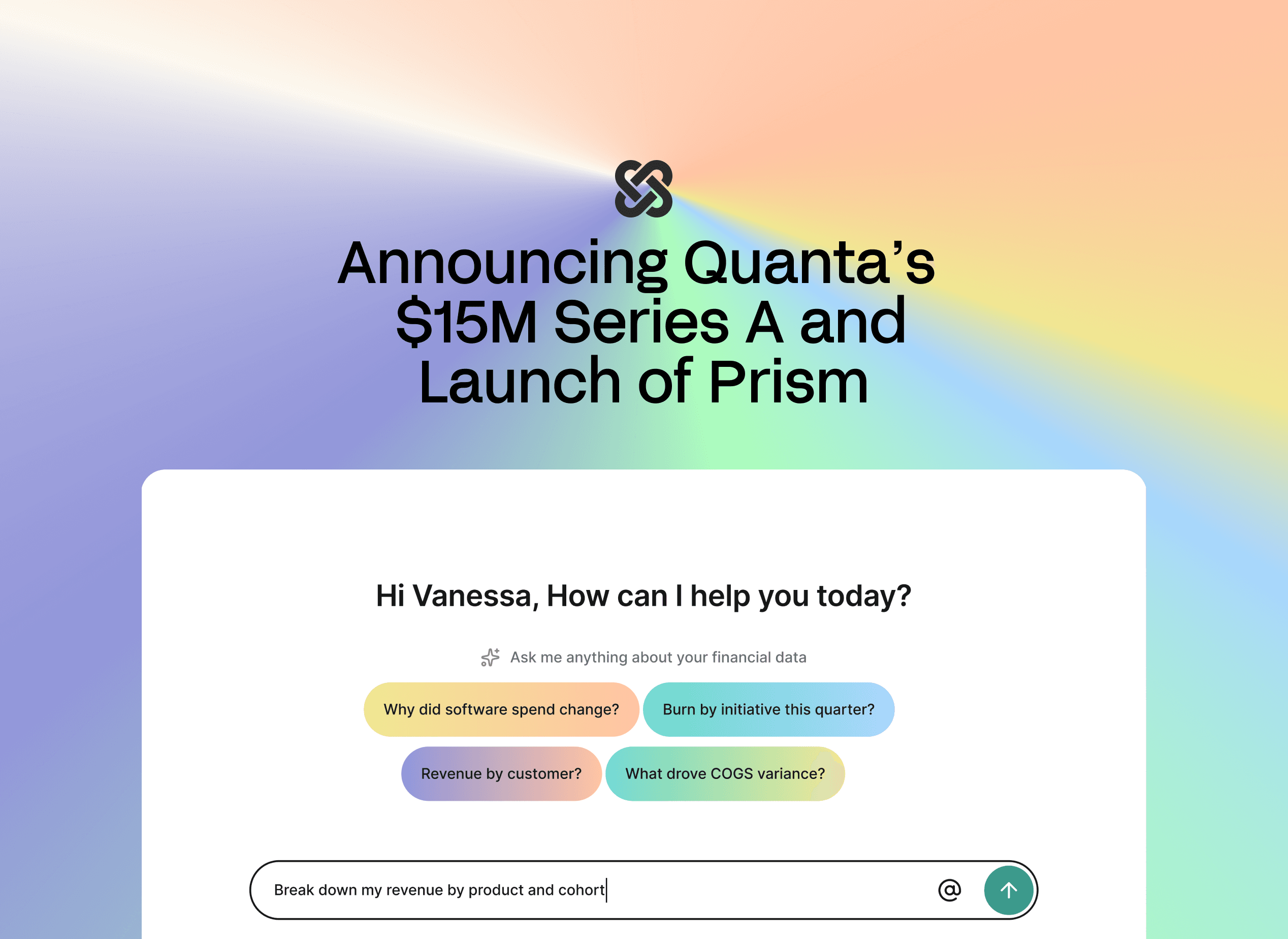
Hastings’s goal is to make financial information dependable and current enough to use while decisions are being made. Prism puts a conversational reporting layer above that work. The usefulness of the conversation depends on the records beneath it, a dependency her career has given her plenty of reason to respect.
In 2026, her public conversations have ranged from continuous close to the economics of AI-enabled services. The subject keeps returning to the relationship between people, software, and the work a customer needs completed. A new interface is only one part of that relationship.
The most revealing picture of Hastings’s approach may still be the office in motion: an engineer asking how a judgment works, an accountant checking how the code represents it, a founder noticing the traffic. She had spent months going out to find those conversations. Once they were happening inside her own company, she made room for them.