A spreadsheet can look perfectly respectable while concealing a small administrative nightmare. Someone has written a macro. Someone has hidden a cell. Someone has left the company. The numbers still arrive, neatly aligned, but the person responsible for explaining them has a problem. Bill Stone has been thinking about that problem for a very long time.
“I’m an old auditor,” he says. It is an unusually useful introduction to the founder of SS&C Technologies. Before the acquisitions, the stock exchange appearances and the four decades in charge, there was a professional habit: ask how a number was produced, who changed it and whether anyone could reconstruct what happened. A tidy answer mattered more than a tidy worksheet.
Stone started SS&C in 1986. The premise was practical. Financial institutions were handling increasingly complicated investments, and personal computers were becoming capable enough to help. He understood the accounts and the machinery. Putting them together became his business. The spreadsheets were merely the opening argument.
A football captain learns the books
William Charles Stone grew up in Evansville, Indiana. At Reitz Memorial High School, he captained the football team and graduated in 1973. Mary O’Daniel, whom he married, belonged to the same graduating class. He went on to Marquette University, earning a business administration degree in 1977. The early geography runs from southern Indiana to Milwaukee, then into the less photogenic corners of finance.
He began at KPMG as an auditor in St. Louis. Later, he directed its financial services consulting practice in Hartford, Connecticut. At Advest, he served as vice president of administration and special investment services. These were jobs with consequences attached to the details: operations, securities processing, reporting and the computers that made the work possible.
His dealings with the New York Stock Exchange and the Commodity Futures Trading Commission required preparation. A founder could hardly ask for a more pointed rehearsal. Before he had software to sell, Stone had seen the work it would have to survive. The attraction of technology was grounded in the inconvenience of doing things the old way.
Four people, $20,000 and a basement
At 30, Stone launched Securities Software & Consulting from his home in Windsor, Connecticut. He used about $20,000 of savings and began with four employees. The basement has become part of the company’s history, but the money is the more revealing detail. It was small enough that collecting from customers mattered immediately.
The early business grew through those customers. Revenue paid for more people. Outside investment arrived in 1990, when General American Life and Conning put in about $4 million. Stone’s recent recollection makes the sequence sound plain: sell something useful, collect the money, hire. Each step depended on the previous one working.

Then the market changed. The October 1987 crash damaged demand for brokerage systems. SS&C turned toward asset managers and insurers, customers with different needs and investments to account for. The move required a new product direction while the business was still young enough for a bad year to be personal.
In 1989, SS&C released CAMRA, an investment accounting system for the insurance and asset management industries. By 1995, annual revenue had reached $18 million. The following year, Stone took the company public. A basement business had acquired the very public obligation to explain its numbers to shareholders.
- 1986Starts SS&C at home
- 1989CAMRA reaches investment accountants
- 1996First public listing
- 2005Goes private with Carlyle
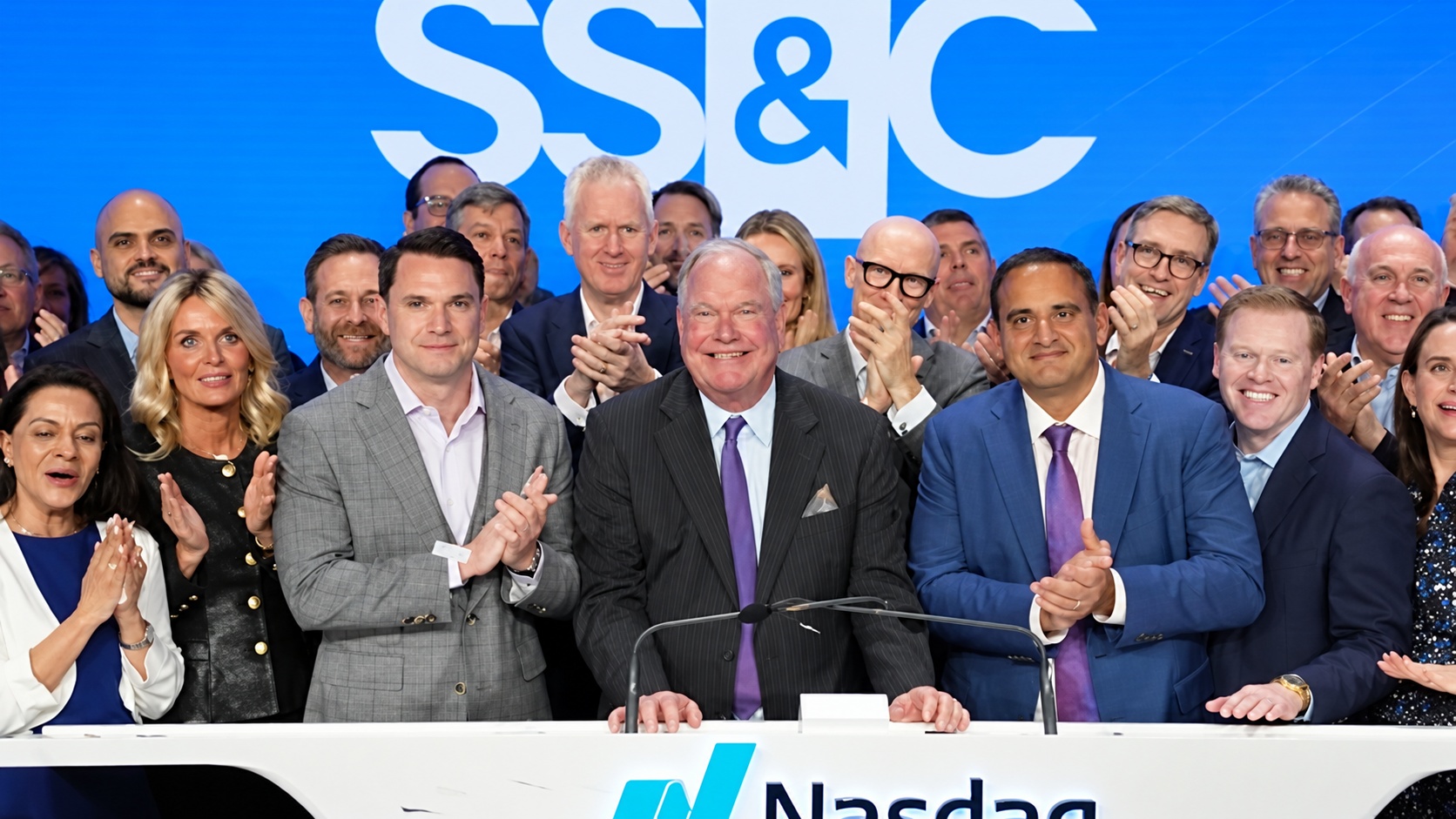
- 2010Returns to Nasdaq
- 2022Buys Blue Prism
The company that had to start again
The public listing did not settle the question of survival. By 2000, SS&C had annual sales of about $60 million. Then the technology bubble burst. Stone later described a workforce that shrank from 610 in June 1999 to 250 by December 2001. Those numbers make an uncomfortable interruption to any smooth account of entrepreneurial progress.
“I was passionate about getting rich,” he said in 2016. There is something bracing about the admission. It leaves the financial motive where everyone can see it. The harder part of the story is what followed when the business contracted: he expanded beyond licensed software into services, including data centers and programs other firms could offer under their own names.
In 2005, SS&C went private with the Carlyle Group. It returned to the public market in 2010. Stone remained chairman and chief executive through both transitions. The ownership structure changed around a leader who continued to run the operation. His biography contains two IPOs, which is one way of making a supposedly once-in-a-lifetime occasion less exclusive.
Why sell only the software?
A second question changed the business. SS&C supplied systems to hedge funds, and Stone could see what happened after the software was installed. There was an ongoing accounting and reporting operation around it. In 2002, he began pursuing fund administration: doing more of that work for customers with the systems his company already understood.
The commercial logic was direct. A software contract captured part of the spending around a fund’s operations. Providing the service opened a larger relationship. Expertise in accounting made the move plausible; owning the technology gave SS&C something to work with. Stone was extending an existing competence into an adjacent bill.
Acquisitions accelerated the expansion. GlobeOp arrived in 2012, Advent Software in 2015, and DST Systems, Eze Software and Intralinks in 2018. These businesses added different systems, customers and kinds of work. The resulting company is easier to understand as a collection of financial operations than as a single application with a widening menu.
Stone’s approach also depends on price. He has described comparing the cost of buying a capability with the cost of building it. A desirable product can still be an unattractive purchase. That distinction matters when acquisition announcements begin to look like a scorecard. A deal has to earn its place after the announcement is over.
By 2014, the economics of delivering those systems had changed again. Stone described internet connections that let smaller companies do work once burdened by expensive telecommunications. Storage and processing had become cheaper too. Earlier software had needed to conserve space; newer systems could concentrate on giving users information they could act on without overwhelming them. SS&C had offered services of this kind since 1994, though they remained a small business until the move into fund administration. Behind the expansion was a change in what a customer could afford to have delivered.
The popcorn theory of acquisitions
Asked in 2014 about the pace of dealmaking, Stone reached for a kitchen appliance: “We’re constantly cooking the popcorn.” Opportunities did not arrive at evenly spaced intervals. He wanted talent that brought different ways of thinking, along with technology, customers and access to new places. Sometimes several possibilities became actionable together.
The metaphor is more cheerful than the work. Integration involves people with expectations, customers who dislike disruption and products that may already have names worth preserving. Stone has explained why SS&C keeps familiar product brands when they retain value. An acquisition does not oblige a customer to enjoy learning a new vocabulary.
He is candid about the demands on managers. He wants to know whether people understand their businesses, and he recommends joining sales calls to find out. The emphasis is on observation. A presentation can describe competence; a conversation with a customer puts it to work. His impatience is directed at the distance between discussing something and delivering it.
“We’re constantly cooking the popcorn.”
Bill Stone, on looking for acquisitions, 2014
There is a corresponding limit to central control. A company operating around the world cannot depend on its chief executive watching every task. Stone describes trusting capable people and relying on internal controls. The old auditor remains present, even when the subject is delegation. Authority needs room to operate and a way to account for the result.
Windsor did not erase Evansville
Stone also brought work back to the city where he grew up. SS&C opened an Evansville office in 2011. By April 2012, it had 40 local employees at Innovation Pointe downtown, with plans for further growth. Those were specific jobs in a specific building, a more tangible hometown connection than a ceremonial appearance.
That same month, Marquette recognized him with its Entrepreneurial Award. The university’s accounting publication identified him as a 1977 business graduate and recorded the company’s acquisitions and international workforce. His career had expanded considerably from its Midwestern beginnings, but the institutions that knew him before SS&C still had reason to put his name in print.
The audit trail follows him into AI
In 2022, SS&C bought Blue Prism. The acquisition brought roughly 1,400 specialists in artificial intelligence, robotic process automation and natural language processing. The company has since described using its own operations to test automation before offering capabilities to clients. It has plenty of daily work on which a promising tool can prove useful or fall short.
By October 2026, Stone was talking about AI with the same concern that animated his discussion of spreadsheets: accountability. He described SS&C AI Gateway as a way to govern activity and preserve an audit trail. He wanted to prevent autonomous agents from wandering through systems without adequate oversight. Greater speed did not remove the need to know what had happened.
His ambitions still concern the machinery behind finance: faster processing, less settlement risk, systems that can handle the work customers bring them. After 40 years, the technology has changed repeatedly. Stone continues to ask questions a person responsible for the books would recognize. Who did the work? Can we trace it? Does the answer hold up when someone looks again?
Read, watch, follow
More of Stone’s career and thinking, in his own words and in conversation.
SS&C Technologies Website ↗Bill Stone on LinkedIn Profile ↗Accounting, systems and the fund business 2022 interview ↗How SS&C conducts acquisitions Podcast & transcript ↗Bill Stone on acquisitions and founder control YouTube ↗Forty years of SS&C 2026 video ↗Stone on AI and its limits October 2026 Q&A ↗From $20,000 to 29,000 people 2026 interview ↗