Srini Ramaswamy has spent more than three decades helping companies work out what their data means. Ask what he is proudest of, though, and the answer moves away from machines. He points to the people he has mentored, including those who have gone on to lead inside Systech and elsewhere. For someone whose career includes the titles chief technology officer and chief architect, it is a revealing choice of measurement.
Technology businesses have plenty of ways to count themselves: installations, customers, certifications, the number of letters now required to describe a database. A former colleague becoming a leader is harder to put on a dashboard. It also survives a software upgrade. That distinction offers a way into Ramaswamy's working life, which has unfolded through successive generations of enterprise computing without requiring a succession of new companies.
He co-founded Systech with his longtime friend Arun Gollapudi in 1993. Both remain in leadership. Ramaswamy now serves as co-founder and CEO, International, with responsibility spanning India, the UAE and the wider MENA region. Between the beginning and the present lies a career of changing responsibilities inside the same enterprise. The interesting question is what has carried across those changes.
Arun Gollapudi and Srini Ramaswamy co-founded Systech. Both still lead it.
Before the cloud had a name on the invoice
Ramaswamy studied at the Indian Institute of Technology Madras. Before Systech, he worked on Nestlé's technology staff. His route into entrepreneurship therefore included the inside of a large operating business, where information has to serve actual decisions. A system's elegance is of limited comfort to the person still waiting for the answer.
The young Systech worked in enterprise data warehousing, integration and business intelligence. Those descriptions sound less fashionable than today's AI vocabulary, but they name durable tasks: bringing records together, moving them between systems, and making the results intelligible. The company began in Los Angeles and built practices serving large enterprises. Ramaswamy's technical background became part of a business whose daily work depended on connecting information to use.
His friendship with Gollapudi became a business partnership long enough to encompass changes in how software was bought, hosted and built. Continuity is useful here because a customer's older systems do not politely disappear when a new platform arrives. Someone has to understand the inheritance. In enterprise technology, yesterday has an unusually persistent login.
Four titles, one continuing problem
Over his Systech career, Ramaswamy has been COO, CTO and chief architect before taking his international CEO responsibilities. The titles describe different distances from the work: how an operation runs, where its technology goes, how its systems fit together, and where the business grows. His career has crossed those boundaries inside a company he helped establish.
There is a practical tension in that combination. An architect has to consider the design; an operator has to consider whether people can deliver it. A regional chief executive has to consider whether a customer will buy it and whether the relationship can last. Ramaswamy's sequence of roles provides a useful way to read Systech's evolution through those overlapping questions.
The company's path widened from data management into analytics, then managed services and industry solutions. Dopplr, its analytics platform, arrived in 2017. Today its portfolio also includes tools for AI agents, pipeline engineering and database migration. The vocabulary has grown more exotic. The commercial test remains rather plain: can a business get useful work done with the information it already has?
A return connection to IIT Madras
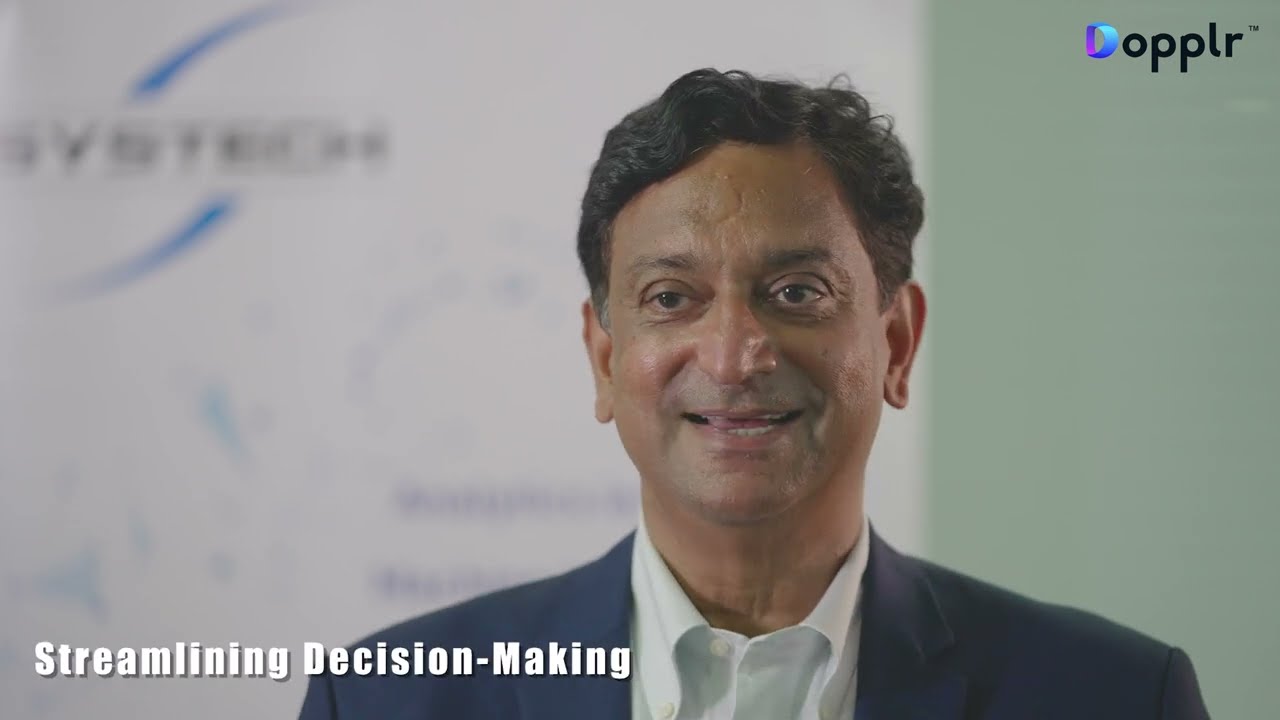
In July 2023, Ramaswamy's educational history intersected with Systech's commercial work. The company announced a partnership with IIT Madras, placing Dopplr at the center of a collaboration on applied AI and analytics. An alumnus was now speaking for a company working with the institution where he had studied. The connection had acquired a second purpose.
The partnership included Project Kaatru, an initiative using connected devices, remotely sensed information and models to assemble real-time air quality data. Its subject was the environment; its technical challenge involved gathering different kinds of information into something people could examine and use.
That is a helpful example of what his field contains. Analytics is often illustrated by a chart, as though the difficult part were choosing its color. The work begins earlier, with collection, consistency and the route between an observation and a decision. Bringing a university's research together with an enterprise platform puts those less photogenic questions near the center of the project.
“Our collaboration with IIT Madras marks a defining moment for Systech Solutions.”
Srini Ramaswamy · July 2023
The factory has a question
A year later, another collaboration made the practical aim more concrete. On July 18, 2024, Systech and Gyan Data announced OptiBlend, a tool for manufacturing processes that blend raw materials. Gyan Data is an IIT Madras-incubated company with expertise in process modeling and optimization. Systech supplied its analytics capabilities and the Dopplr platform beneath the solution.
The product brings together model selection, process configuration and optimization under constraints. Put more simply, it addresses the business of finding a workable mixture while attending to quality, resources and cost. The manufacturer supplies a problem with rules. The software has to respect them. An impressive answer that violates the production requirements would be an expensive suggestion.
Ramaswamy spoke for Systech at the announcement. The partnership illustrates the kind of connection his business makes: a platform team works with specialists who understand a particular industrial process. Neither a general-purpose tool nor domain knowledge alone describes the whole proposition. The useful result depends on fitting them together, a familiar problem for someone who has served as chief architect.
Data analytics
Optimization
What a mentor leaves running
Ramaswamy's preference for measuring achievement through people has a counterpart in how Systech approaches training. The company has used bootcamps to develop business intelligence and data integration specialists. Its training model also includes certifications and continuing technical development. In a business that sells expertise, learning has a direct connection to what can be promised to a customer.
Systech credits its bootcamp with graduating more than 1,100 business intelligence and data integration specialists. A program of that kind gives mentoring an organizational setting: a newcomer can acquire a common technical foundation before moving deeper into particular projects. For a founder looking at successive cohorts, the accumulated result is visible in people taking on larger responsibilities. The training belongs to the company; the acquired knowledge belongs to each participant.
In February 2024, Systech announced Great Place to Work certification in India for the period from February 2024 to February 2025. Ramaswamy described his reaction in the language of trust and shared effort. One line was especially apt for a data executive: “I am heartened to see our commitment to trust, innovation, and collective well-being quantified.” Even workplace culture, it seems, can find its way into a measurement.
A former employee offered a more individual view. In a July 2025 farewell post, Sabharam M thanked Ramaswamy for his guidance, clarity, high standards and trust during nearly four years at Systech. A farewell is a modest sort of testimony, but an informative one. It comes from someone looking back on everyday work, where a leader's expectations are experienced at close range.
The combination matters. Technical standards ask people to become better at the work; trust gives them room to take responsibility for it. A mentoring relationship can carry both. Ramaswamy's stated pride in former colleagues who become leaders gives that process a horizon beyond the next delivery date, and beyond the employer that first invested in them.
The next territory still needs the fundamentals
His present remit takes Systech into markets across India, the UAE and MENA. He lives in the UAE with his family. International expansion adds another kind of translation to the technical one: understanding how an established body of expertise fits customers and partners in different places. A platform can travel quickly. A working relationship takes people.
The company continues to deepen its technology partnerships. On November 3, 2025, Systech announced Microsoft's AI Platform on Azure advanced specialization, a designation involving an external audit and evidence of enterprise delivery. Ramaswamy connected the milestone to the team's technical experience and its longstanding Microsoft relationship. The announcement placed emphasis on implementing and operating AI, where the practical obligations continue after a demonstration ends.
The earlier expansion of Systech's Azure partnership had also linked technology investment to workforce development. Alongside data, AI and application work, the company emphasized training its architects and developing certifications. That detail helps explain the relationship between Ramaswamy's technical and mentoring responsibilities. A partnership creates access to a platform; people still need the knowledge to use it. Training connects the announcement to the work a customer eventually receives.
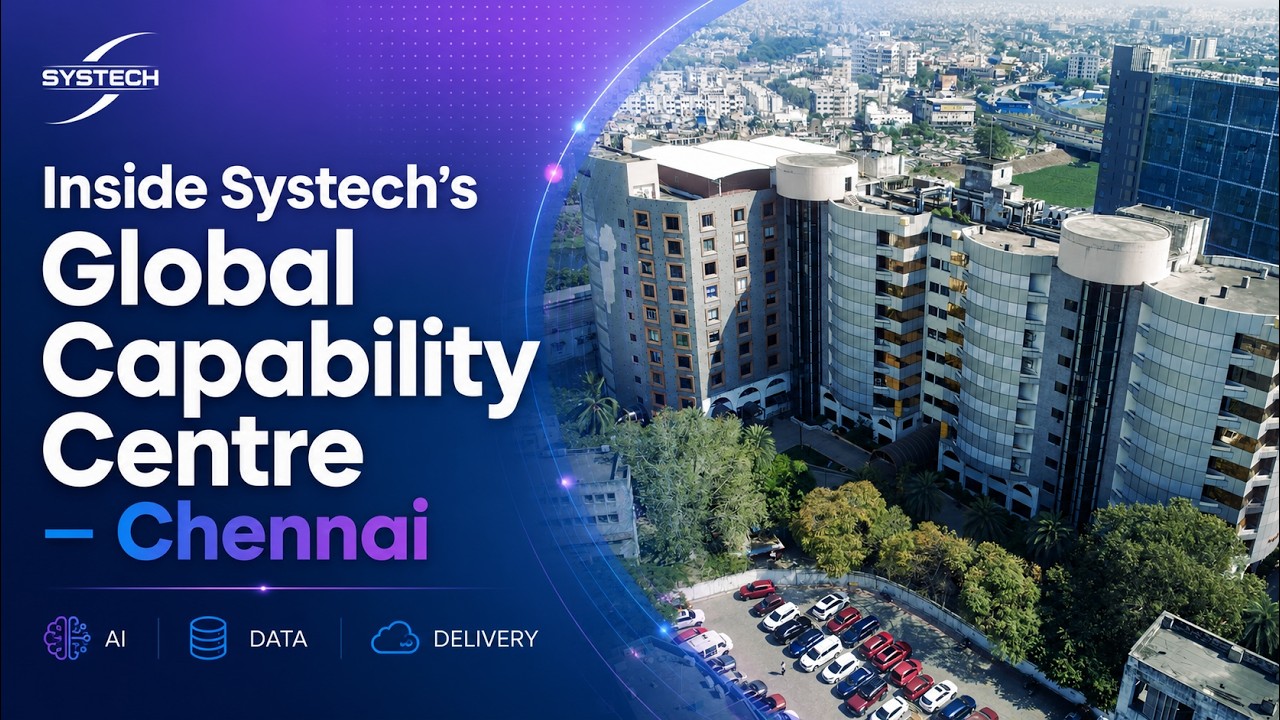
That emphasis also appears in the founders' discussion of the Chennai delivery center. They present it as a place accountable for the customer's work, with architecture, governance and delivery considered together. The center connects a global business to the engineers who make it function. Ramaswamy and Gollapudi appear together in the film, still explaining what they expect of the institution they began.
There is a certain discipline in staying with a problem while its tools keep changing. Ramaswamy has moved through operations, architecture, technology leadership and international growth while Systech's work has progressed from warehouses to AI. His own preferred achievement supplies the human scale for that long technical history: people who learned the work, took responsibility, and eventually led others. A company can replace a platform. The habits those people carry into their next role have a longer itinerary.
Follow the work
Conversations, collaborations and places to keep reading.