On a remote Utah trail, a digital identity system encounters a rather good critic: the absence of a phone signal. A ranger checking an off-highway vehicle education certificate cannot assume the internet will oblige. The credential must carry something useful with it. SpruceID helped Utah make that possible, with certificates stored in phone wallets and checked offline through the Verify Utah app.
- The job: issue, carry, and verify digital credentials.
- The distinction: disclose less, with proof that can move across systems.
- The catch: a wallet needs an accepting reader, sound rules, and a fallback.
A trail is a demanding test lab
Paper certificates once did this job. Utah’s digital version lets a verifier check the issuing authority’s cryptographic signature. A copied design or impressive-looking screenshot is insufficient. The software checks evidence of origin, rather than asking the ranger to become a connoisseur of official stationery.
The quieter consequence is privacy. In this implementation, checking the certificate does not require a message back to a central server. The issuer need not receive a fresh report whenever the holder presents it. The same choice that helps in a cellular dead zone also limits a new avenue for surveillance. Geography turns out to be an unexpectedly useful privacy consultant.
- 01Authority issuesA signed credential
- 02Resident holdsProof in a wallet
- 03Ranger verifiesOffline signature check
A login company meets the DMV
SpruceID began in 2020 with Wayne Chang and Gregory Rocco. Its early public language concerned user-controlled data and the web. Rocco’s biography supplies an appealing complication: a Joycean and musician who moved through media and identity work. A company devoted to proving facts had a founder trained to notice what language conceals.
The company’s Y Combinator profile puts its ambition neatly: “Instead of people signing into platforms, we imagine platforms should sign into people’s data vaults.” That reverses the usual arrangement, in which a service collects information and the person hopes it behaves.
Capital arrived in two substantial installments: a $7.5 million seed round announced in November 2021, led by Ethereal Ventures and Electric Capital, followed by a $34 million Series A in April 2022, led by Andreessen Horowitz. The combined $41.5 million financed a business pursuing identity infrastructure, not simply a nicer picture of a license.
California provided a consequential test. Its mobile driver’s license pilot launched in August 2023. SpruceID developed the state-branded wallet and issuance machinery, connecting credential technology to existing DMV systems. The company’s case study reports more than four million mDLs issued by August 2026. That measures program issuance, not SpruceID’s paying customer count.
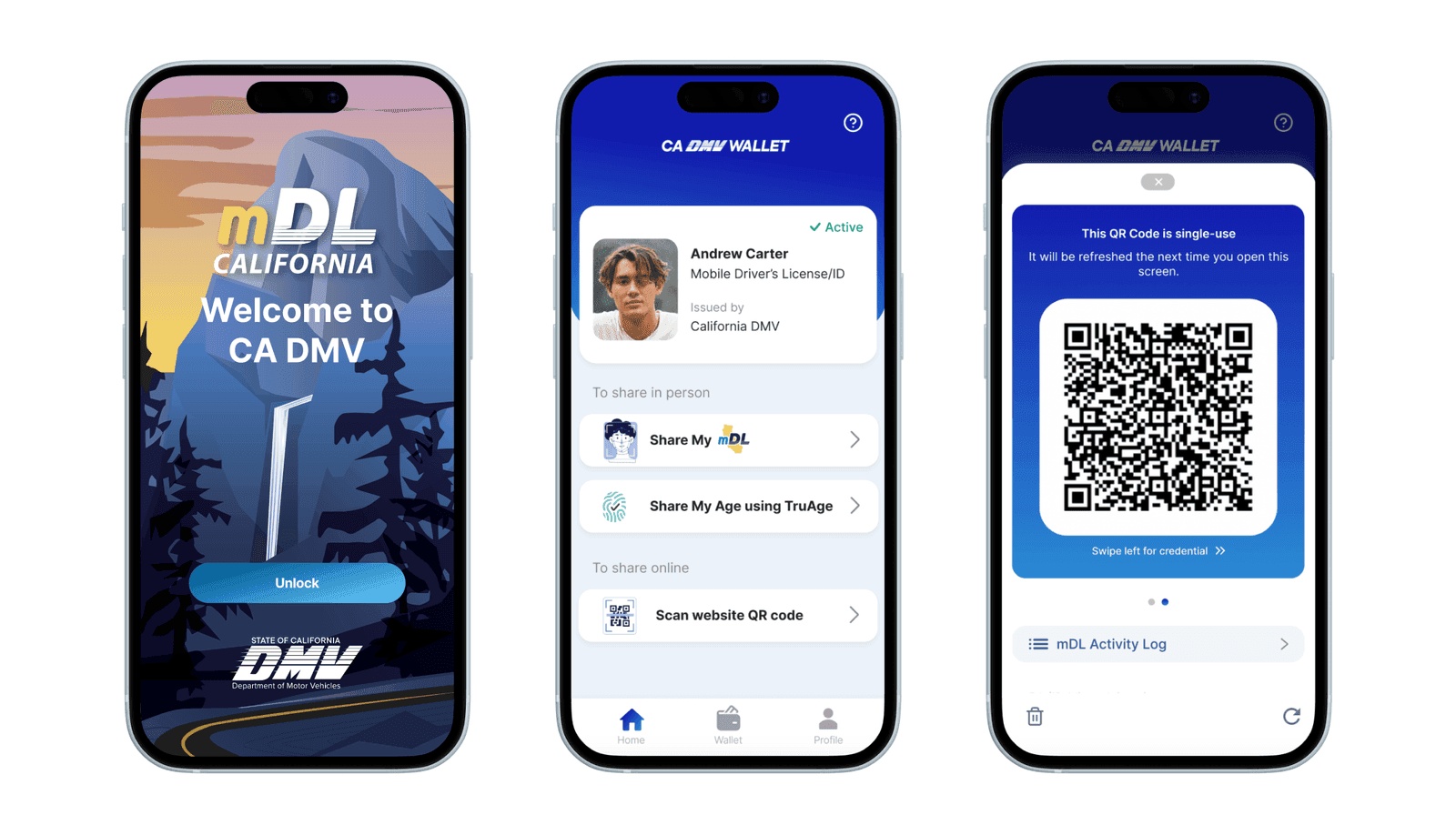
The privacy proposition is easy to understand at a bar. Proving you are over 21 need not expose your address. Selective disclosure lets a credential supply relevant attributes while withholding others. Ajay Gupta of the California DMV praised the partnership’s approach to “working with industry standards rather than proprietary”. The implementation won a 2023 Gartner Eye on Innovation Award for Government.
The machinery behind the pocket
The wallet is the visible object. Behind it are several separate jobs: determining who may receive a credential, issuing it, storing it, presenting it, verifying it, and handling changes later. A permit that cannot be renewed or revoked is an unfinished administrative system, however handsome its screen.
Credible manages that credential lifecycle. SpruceKit supplies open-source libraries and mobile tools for builders. SpruceID Verify is a hosted verification service with an SDK for web applications. It handles wallet communication and cryptographic checks, then returns structured identity results to the application’s backend. Its documentation distinguishes this online service from separate in-person integration paths.
This is a government and enterprise infrastructure business with software, hosted services, and integration work. Residents are users of customer programs. California’s pilot is free to residents. The state’s initial $10 million mDL budget allocation described in Senate material is a program budget, not a disclosed SpruceID contract price. Funding, procurement, and the price of an app answer different questions.
Its expertise lies where cryptography meets standards and existing systems. MATTR also offers standards-based credential infrastructure; IDEMIA is another mobile identity alternative. Openness is therefore a meaningful purchasing criterion, rather than an exclusive invention. SpruceID’s distinguishing evidence is its combination of reusable code and concrete public-sector deployments.
A wallet needs somewhere to go.
The practical problem after issuance
The wallet needs somewhere to go
A digital credential becomes useful when someone accepts it. California’s DMV lists more than 800 acceptance locations and distinguishes support across wallet types and services. Issuing credentials and building acceptance are related projects, with different participants. Four million credentials cannot teach an unfamiliar clerk how to read one.
The limits remain quite physical. California tells participants to carry their plastic license or ID, and to show the physical card to law enforcement. A phone can lose power. A verifier needs compatible software and trusted issuer information. An offline signature check establishes origin; it does not magically provide every subsequent change in credential status. Sound lifecycle policies still matter.
The marriage certificate has places to be
By May 2026, SpruceID was applying this thinking to a proposed shared-service model for Utah marriage licensing. The presentation addressed 29 counties with differing processes. A marriage certificate subsequently travels into name changes, banking, insurance, and other systems. Each stop can become another exercise in persuading someone that the paperwork is real.
The proposal would combine shared, versioned rules with local execution, and give clerks an auditable workflow. It remains a proposal. Its interest is the shift in emphasis: the credential becomes part of the public service surrounding it, including the decision and the evidence behind that decision.
There is a practical lesson here for builders. Choose one fact people repeatedly need to prove. Find out who accepts it, what they actually need to see, and where the check happens. Build the whole exchange around those conditions. Utah’s trail is a fine reminder that the world has no obligation to resemble a demonstration room.
Follow the proof
Explore the company, try its tools, and watch its video channel.