Before there was a publishing platform, there was a manuscript in a drawer. Yehuda Niv’s account of his first book gives it nearly four years there, before publication in 2012. He had written at night while working as an electronics engineer. Finishing the sentences had turned out to be only part of the assignment. Getting the thing into the world was another occupation altogether.
Spines is built around that awkward discovery. An author reaches the end of a manuscript and becomes, without applying for the position, a production manager. There are covers to commission, files to format, retailers to satisfy. The company’s proposition is straightforward: pay us to put those jobs together.
- The customer is the author. Production packages fund the service.
- Software meets a support team. Automation and human services share the workflow.
- Publication buys availability. Reader demand remains a separate challenge.
01 The manuscript that waited
Niv’s first response was to build Niv Publishing. His later response was Spines, founded in 2021 with Lev David, Nir Kenner and Niv Ovdat. The distinction matters. This venture came from somebody already familiar with the repetitive work of producing books. The opportunity was sitting between a writer’s finished document and a retailer’s requirements.
Investors paid attention. An April 2024 seed round brought $6.5 million, led by Aleph. A $16 million Series A followed that November, led by Zeev Ventures with existing investors participating. That is $22.5 million backing a bet on authors who want help shipping their work.

02 One upload, several professions
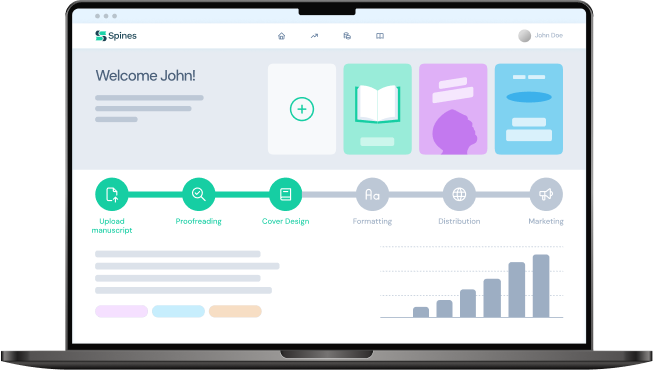
The practical offer begins with a manuscript. Spines brings proofreading tools, cover design, formatting, print, ebook and audiobook production into a dashboard. Human editing, illustration and translation can enter the project too. Its service menu extends upstream to coaching and ghostwriting, and downstream to marketing and distribution.
This makes the likely customer easier to picture: a first-time novelist, a children’s writer, a professional with a nonfiction manuscript. Such authors may be perfectly capable of making creative decisions while having little desire to learn file specifications. Spines sells coordination alongside production. For a writer with limited time, having someone responsible for the next step can be the attraction.
Buying cover design, formatting and distribution separately also means coordinating their handoffs. A single platform gives the author somewhere to see the sequence, approve decisions and ask what is holding up the next stage.
03 The bill has more than one line
Convenience has a price, and the old price is a poor shopping guide. Publishers Weekly reported in December 2025 that packages ranged from a few thousand dollars to more than $15,000. The current pricing page varies the offer by manuscript and services; its listed packages include three years of membership. A writer should price the actual book, including the editing it needs.
Then there is the money after publication. The standard terms give authors 70% of net sales royalties received by Spines, with some first-year promotions offering up to 100%. That percentage applies to receipts reaching the platform, rather than the cover price. Distribution depends on membership. Production fees, continuing service costs and royalty shares deserve separate lines in the budget.
For each $100 in net sales royalties received by Spines. Retail price is a different starting point. Promotions can change this split.
That changes the comparison. A managed service competes with an author assembling separate suppliers as well as other publishing packages. Paying more can buy back time. It cannot, by itself, establish that enough readers will arrive to recover the expense.
How many copies cover production?
At a 70% author share. Hypothetical inputs, not a Spines quote or sales forecast. Excludes advertising, membership, taxes and other expenses.
04 The humans inside the machine
The revealing detail in the audiobook offer is how little recording it needs. In December 2025, Publishers Weekly described voice cloning from roughly three minutes of an author’s speech. It also reported more than 300 artificial voice options and translation with human review. Suddenly, another format becomes a production decision an independent author can contemplate.
Yet the company’s current editing offer distinguishes developmental work from line editing. A grammar correction and a repaired plot are different purchases. Its careers page advertises production editors, designers and illustrators, alongside support roles. The human labor remains visible inside the technology business.
“The hardest part of writing a book shouldn’t be getting it published.”
Yehuda Niv / official founder biography
Even speed needs a definition. The homepage FAQ says publication typically takes around 30 days. The guide updated in August 2026 describes 90 days. Those are different expectations. A sensible buyer asks for a schedule tied to editing, approvals and formats, rather than treating the shortest advertised interval as a promise for every manuscript.
Niv’s advice to entrepreneurs in his Midstage interview offers a clue to the operating philosophy: “Start selling. Meet the market, see what the users say about the product!” It favors learning from customers early. An author’s corresponding question: who reviews my book, and which decisions need my approval?
05 A shelf is not an audience
Spines’ place in the market is clearest here: managed production for authors willing to fund it. Alternatives include BookBaby, or arranging editors and designers around tools such as Amazon KDP and IngramSpark. Traditional publishing offers another bargain, with a publisher selecting projects and taking the financial risk. Each route assigns the work differently.
Copyright ownership belongs in that comparison too. Spines says authors keep their book rights. Retaining those rights and keeping every dollar from a sale are separate arrangements. Confusing the two makes a publishing offer look simpler than the agreement underneath it.
Spines also offers a marketing tool for social campaigns, targeting and budget allocation. Useful machinery, provided the author understands its job. A distribution channel makes a book available; an advertisement asks somebody to care. Neither settles whether the book connects with readers.
There is a lesson another business can copy: look for customers who have completed the hard creative task and stalled at the handoffs. Give them a clear route to completion. That offer works when coordination is the obstacle and the budget can bear it. It is a poor fit when a manuscript needs substantial rethinking, an author wants to manage every supplier, or the fee depends on sales that have yet to materialize. The drawer can be emptied. The reader still has to choose.