An aircraft window presents a small puzzle. You want to see through it, which seems straightforward until you consider everything else it must do. The material has to satisfy demanding optical and mechanical requirements. Its manufacturing history matters. So does its behavior when formed into a finished part. Suddenly, “a piece of plastic” becomes a remarkably unhelpful description.
This is the territory occupied by Spartech. The Missouri manufacturer makes sheet, rollstock, films, acrylic rods and tubes, and packaging materials. Its customers turn those materials into things people recognize: aircraft interiors, diagnostic equipment, vehicle components, signs, and containers. Spartech’s name can disappear inside the finished product. The specification travels with it.
- What it sells: engineered plastics tailored to a particular job.
- Who buys: manufacturers, converters, fabricators, and distributors.
- Why it matters: material choice affects production, performance, and recovery.
A window is a materials problem
Consider Polycast, Spartech’s cell-cast acrylic family. The company offers different formulations for aerospace transparencies, with attention to optical clarity, cleanliness, and military material specifications. It also supplies medical-grade acrylic. An aircraft canopy and a medical component share a material family; the requirements that qualify a grade for either application are their own business.
The aerospace catalogue reaches inside the cabin, too. Royalite and RoyalAero sheets serve applications such as trays, bulkheads, and interior panels. Here, formability and fire performance enter the conversation alongside appearance. Spartech publicly names relationships with Boeing, Airbus, Lockheed Martin, Embraer, Textron, and Bombardier. Those relationships place it within a supply chain where an attractive sample is only the beginning.
Healthcare adds another set of demands. Equipment housings must tolerate their intended environment. Packaging may need to work with a specified sterilization process. Transparent components need clarity alongside the appropriate material qualifications. Spartech’s range includes materials for medical device enclosures, trays, cleanroom walls, and specialty components. Picking the grade is part of designing the product.

That breadth gives Spartech a particular place in the market. It works between the polymer and the finished object, using formulation and processes such as casting, extrusion, lamination, and thermoforming. Its practical distinction is the combination of those capabilities with application support. The relevant alternative changes with the job: a sheet producer, an acrylic specialist, or a packaging supplier.
For a packaging converter, the conversation starts elsewhere. Spartech offers single-layer and multilayer packaging film, supplied as rollstock or preformed containers. Layer selection changes barrier capability. Width, thickness, and winding requirements affect how the material reaches production. The customer is buying something that must work twice: first in the equipment that shapes it, then around the product it protects. A specification written only for the finished package leaves half the assignment unfinished.
The experiment before the factory
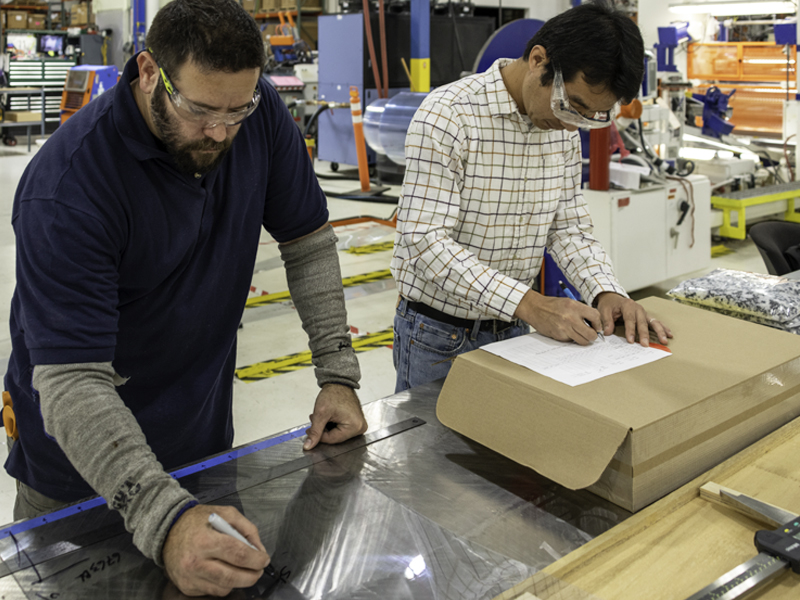
The most revealing address in this business might be the Innovation Center. At 90,000 square feet, it gives customers access to scientists, design engineers, processing knowledge, and testing. Spartech offers prototyping and reverse engineering as well as material development. A product team can bring a problem before it has settled on the material that will solve it.
the job
and pilot
material
production
There is a useful lesson here for anyone buying a manufactured component. Write down what the material must survive, how it will be processed, and what the finished product must achieve. Then test those requirements together. A promising material can still create difficulties on the production line. Spartech’s development offering puts those questions in the same room.
The commercial model follows that relationship. Spartech sells physical materials and packaging to businesses, with technical work supporting selection and development. Custom projects go through consultation and quotation. Buyers are evaluating material, manufacturing fit, and supply together. The company emphasizes U.S. sourcing and production close to customers, making logistics part of its pitch alongside chemistry.
The price of another chapter
Its corporate history deserves equally careful specifications. Operating roots reach back to 1960. PolyOne acquired the former Spartech Corporation in 2013. Four years later, Arsenal Capital Partners paid $115 million for PolyOne’s Designed Structures and Solutions business, covering sheet, rollstock, and packaging assets. That business took the Spartech LLC name. Compounding operations remained with PolyOne.
Nautic Partners and management acquired Spartech in 2019. The Jordan Company completed an acquisition in 2021, with Nautic retaining a minority investment. These transactions describe changing ownership of an industrial business with established capabilities. They also explain why historical figures need their dates and boundaries attached.
in the June 2025 refinancing
In June 2025, Spartech announced refinancing intended to reduce leverage and debt service while adding liquidity, including a $45 million new capital commitment. In January 2026, Andy Filson became president and chief executive. By March, the company was describing a stronger balance sheet, an asset-based lending facility, and additional capital from new equity holders.
“We have strengthened our foundation, sharpened our portfolio, and aligned our leadership team around disciplined execution.”Andy Filson, March 2026
The announced priorities included healthcare diagnostics, electric vehicle battery systems, aerospace transparencies, automotive acoustics, and energy storage. The operational agenda included consistency and customer responsiveness. Read together, the announcements describe a company repairing its financial room to maneuver while deciding where its materials expertise should earn its keep.
Recycling begins at the drawing board
One more specification belongs near the beginning: what happens afterward? Spartech describes closed-loop programs that buy back customer production trim and return it to substrates. Its July 2026 materials article highlights recycled-content sign sheet and truck flooring. These are concrete design choices, made before a product becomes waste.
The qualification matters. Regrind must fit performance requirements, and different products demand different properties. A recycling plan also needs a workable collection and processing route. For a customer, the useful move is to discuss recovery while choosing the material. Spartech’s business makes a persuasive case for asking more questions of an ordinary-looking sheet. By the time it becomes a window, a housing, or a package, many of the consequential decisions are already inside it.