Look closely at honeycomb and the first thing you notice is how much of it is missing. A procession of thin walls encloses a great deal of air. Put this cellular core between two skins and you have the basis of a stiff, lightweight sandwich panel. For an aircraft designer, the empty space is useful. For Hexcel, learning how to manufacture it became the beginning of a business.
- Hexcel supplies the ingredients inside aircraft: carbon fiber, resins, prepregs and honeycomb.
- Its customers buy performance, but also materials they can process reliably.
- The next challenge is factory speed: lighter structures still need to make financial sense.
That makes Hexcel an interesting company to notice from an airline seat. Its work can be buried inside the structure or tucked into an engine assembly. The passenger sees the finished machine. Somewhere upstream, engineers have made a succession of decisions about fibers, chemistry, heat and geometry. Hexcel sells into those decisions.
The useful part is the gap
The company incorporated as California Reinforced Plastics in 1948, after Roger Steele and Bud Hughes began experimenting with postwar technologies. Steele worked in Hughes’s basement. The first military research contract concerned fiberglass honeycomb for aircraft radomes; in 1949, the company deliberately bid low to supply B-36 bomber fuel-cell support panels. Getting the material into a working aircraft mattered.
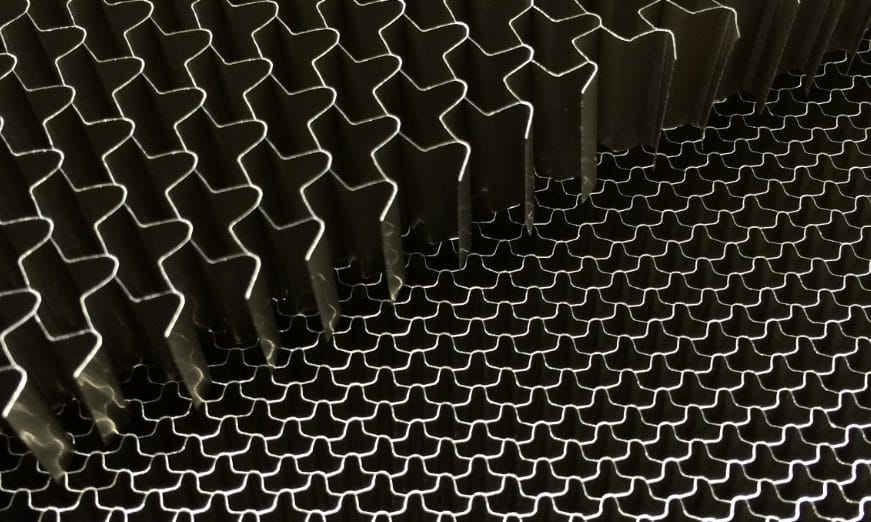
Today, HexWeb honeycomb comes in more than 700 varieties. Aluminum, fiberglass and aramid-based materials offer different properties; cell size and density change the result again. Some cores absorb energy, others help control sound. The apparent simplicity conceals a menu of engineering choices. A honeycomb buyer needs the right empty space.
The fiber is only the beginning
Carbon fiber supplies another part of the story. HexTow is Hexcel’s continuous carbon fiber; HexForce includes reinforcement fabrics. HexPly prepreg combines reinforcing fibers with a formulated resin system before the customer makes the part. Heat cures the thermoset resin into a solid structure. Fiber carries reinforcement; resin holds the system together. Both choices matter.
The chemistry follows the job. Aerospace epoxies address toughness and structural loads. Other systems address higher temperatures, aircraft-interior fire requirements or space applications. Hexcel also supplies infusion resins, adhesive films and tooling materials. The breadth lets engineers work across several connected problems rather than shop for a single miracle ingredient.

Then there is engineered core: honeycomb formed, shaped, machined or bonded to a customer’s specifications. Buying a component ready for its place in an assembly can remove manufacturing stages and reduce the customer’s need for equipment. Here the value extends beyond kilograms saved. A supplier can take work off the factory floor.
A place in the drawing
Hexcel sits between materials science and aircraft production. Airbus uses HexPly prepreg for the A350’s primary structures, including its fuselage. Boeing announced new and extended long-term agreements with Hexcel in July 2026 across commercial, defense and space programs. Engine makers are another constituency. These are business customers making decisions that outlast a shopping season.
Consider Acousti-Cap, which puts permeable caps inside honeycomb cells. Customers specify characteristics including flow resistance, core thickness and cap depth to tune acoustic performance. Hexcel identifies GE and Rolls-Royce as users. The little cell has acquired another responsibility: helping manage engine noise.
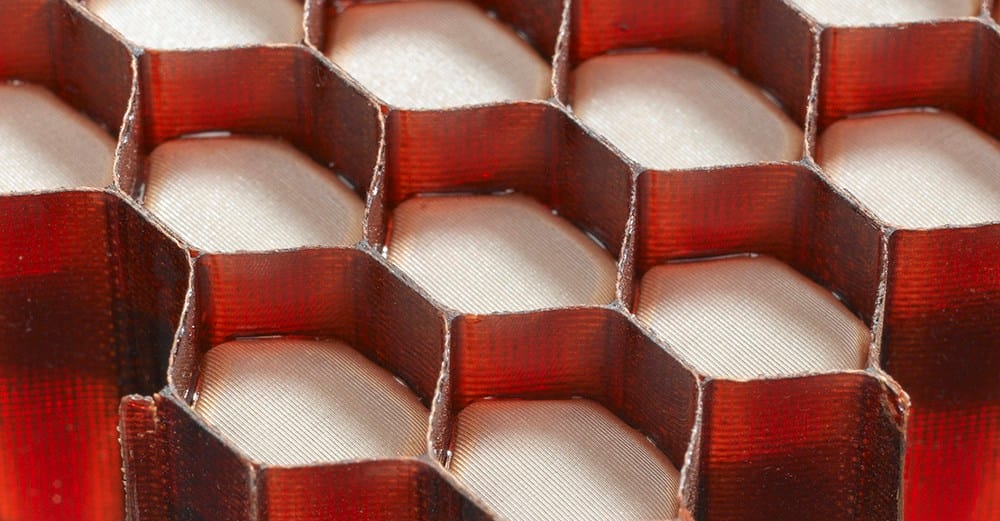
There are credible alternatives. Toray offers aerospace thermoset and thermoplastic composites; Syensqo supplies prepregs, resins and adhesives. Hexcel’s distinguishing combination is its reach from carbon fiber and resin systems to honeycomb and processed core, together with established aircraft applications. Its business model is the repeated sale of qualified materials and components. The competitive question is whether a specific system works for a specific aircraft and production process.
An excellent material still needs cash
Engineering success did not spare Hexcel a financial reckoning. After an attempted debt restructuring failed, it filed for Chapter 11 in 1993. It reduced operations, exited non-core assets and raised $50 million in equity during 1994, then emerged in February 1995. The subsequent Ciba-Geigy and Hercules composites acquisitions broadened its capabilities. A good material could find a customer while its manufacturer still needed a different balance sheet.
“Lightweighting to Propel the Future”Hexcel’s stated purpose
The modern bill is substantial, too. In the first nine months of 2026, accrual-based capital additions totaled $61.2 million. Third-quarter research and development expense was $16.2 million. These figures describe company spending, not a price tag for carbon fiber. Customers obtain quotations tied to their requirements.
+8.8% year over year. Reported sales, unadjusted for currency.
Third-quarter 2026 sales reached roughly $496 million. Yet accelerated hiring and training added costs as Hexcel prepared for expected demand. The practical limit is familiar: factories need people and capacity before the extra output arrives. Aircraft schedules, customer production rates and material demand do not always move together.
Now watch the clock
September 2026 brought U.S. manufacturing capability for HexPly M901 in Salt Lake City. Under specified conditions, the prepreg offers cure cycles as short as four to five minutes. Hexcel also introduced vented Flex-Core designed to simplify forming complex aerospace structures while managing pressure differences. Both announcements tackle the work required to turn a promising material into a manufactured part.
The factory emphasis also explains the new Hexcel Applications Center at Wichita State University’s National Institute for Aviation Research. Groundbreaking was announced in May 2026. The collaboration brings materials development closer to automated processing and structural manufacturing. For a customer, a laboratory result becomes more useful when the path to making the part is visible.
There is work after production, too. Hexcel’s Fairmat collaboration recycles carbon fiber prepreg scrap into material for other commercial uses. The relationship began in Europe in 2021 and expanded to Salt Lake City in 2024. It is a specific response to manufacturing waste, with a narrower claim than making an entire aircraft circular.
The lesson other businesses can copy is to examine the customer’s process as closely as the product. A lighter component earns its keep when performance, processing and cost line up. Where weight matters little, or qualification and manufacturing costs overwhelm the benefit, composites may be a poor choice. Hexcel’s useful trick begins with empty space. Making that space economical is the continuing job.