Dateline / Santa Barbara
A surgeon sits down. The patient is on another continent.
There is a screen. On the left, a checklist. On the right, an operating room that the surgeon is not standing in. Somewhere off-frame, a robotic arm waits for instructions that will travel across an ocean and arrive in a fraction of a second. The surgeon flexes a hand. Thousands of miles away, a patient's procedure begins. This is not a render or a pitch deck. This is what Sovato makes ordinary.
Sovato is a health-tech company. That description is technically true and almost entirely useless. What Sovato actually does is treat the operating room the way the internet treated the office: as something you no longer have to be physically inside to use well. The company builds the platform - software, connectivity, and a thick book of safety rules - that lets a skilled surgeon operate a robotic system from somewhere else entirely.
"Remote robotic surgery programs provide healthcare organizations with a practical way to extend the reach and impact of skilled surgeons, care teams, and operating rooms."- Cynthia Perazzo, Co-Founder & CEO
The Problem
The best surgery in the world is stuck in a few buildings.
Here is the uncomfortable arithmetic of modern medicine. The surgeons who do a complex procedure best tend to be the ones who do it most. The ones who do it most tend to cluster in a handful of large hospitals in a handful of wealthy cities. Everyone else - rural towns, smaller countries, entire regions - gets whoever is nearby. Geography, not skill, has quietly become the deciding factor in who lives well.
You could move the patient. People have been doing that for a century, with all the cost, delay, and disruption a long trip implies. You could move the surgeon, which is slower and scales even worse. Or you could move the only thing that has ever traveled cheaply: information. The catch is that surgery is not a webpage. A few hundred milliseconds of lag is the difference between a clean stitch and a complication.
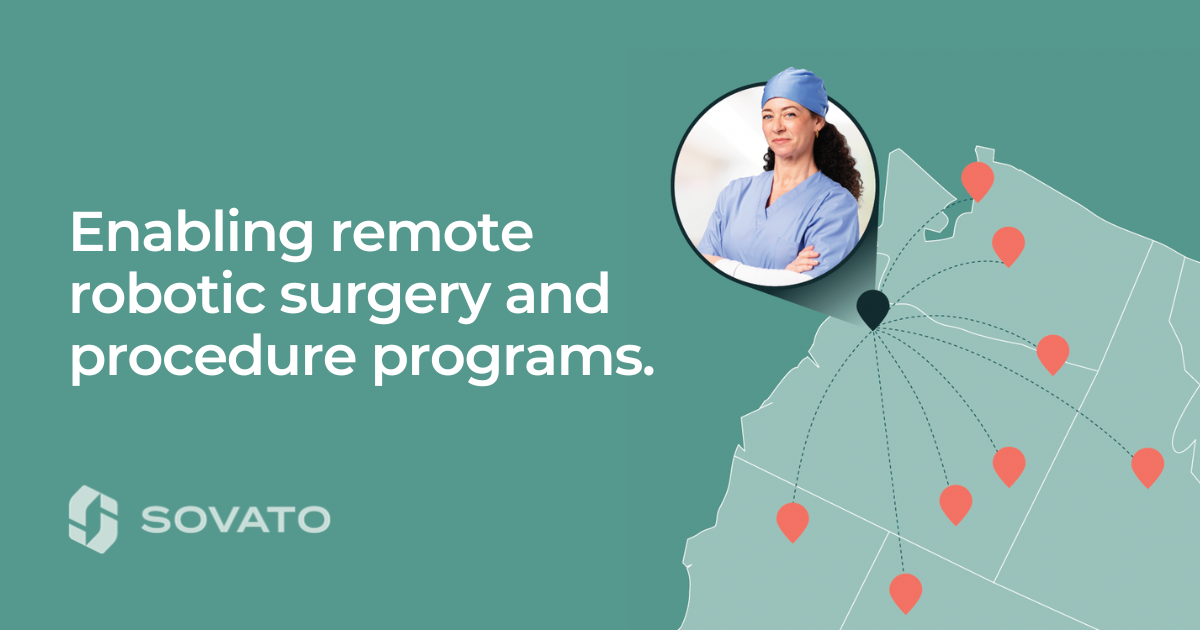
Caption: The map most companies draw has dots for hospitals. The map Sovato draws has dots for the patients who can't reach them - and a lot of empty space in between.
Distance has always been the silent third party in the operating room. Sovato's entire business is asking it to leave.
The Founders' Bet
A man who invented surgical robotics, doing it a third time.
Sovato was co-founded by Cynthia Perazzo, a healthcare strategist who became CEO, and Yulun Wang, who has the unusual distinction of having helped invent this field already - twice. Wang founded Computer Motion, an early surgical-robotics company that eventually merged into Intuitive Surgical, the giant that now dominates the operating room. He then founded InTouch Health, a telemedicine pioneer acquired by Teladoc. Sovato is, in effect, his third act, and it sits exactly where his first two careers overlap: robots and remote care.
The bet was specific. Wang's team had found that surgeons can tolerate roughly 300 or more milliseconds of delay between moving a hand and seeing the result - enough headroom, if and only if you refuse to waste any of it. Most of the budget gets eaten by mundane things, like the time it takes to compress and decompress a video feed. So Sovato built a pipeline fast enough that the processing itself nearly disappears, leaving the precious milliseconds for the part nobody can negotiate with: the speed of light.
Caption: It takes a certain confidence to look at the company you helped create and decide the sequel should be longer-distance. Wang appears to have it.
Most founders want to disrupt an industry. Wang keeps inventing the same one, each time from further away.
The Product
One platform, agnostic to whose robot it is.
The clever decision was not to build a robot. Sovato builds the layer around them. Its platform is system-agnostic, which is a dry way of saying it aims to remote-enable almost any surgical, interventional, or diagnostic robotic system rather than locking customers into one machine. In a market where every hardware maker would happily sell you their walled garden, Sovato volunteered to be the road between gardens.
The model is hub-and-spoke. Concentrate the expertise at a hub - a leading surgeon, a center of excellence - and deliver it to spoke sites that could never staff that talent full time. Around the technology, Sovato has built the unglamorous but essential scaffolding: clinical, operational, and technical guidelines worked out with hospitals and robotics makers, covering safety, accountability, and the workflow of a care team split across two rooms and possibly two countries.
~300msDelay surgeons tolerate
AnyRobotic system, in theory
Hub+SpokeOperating model
1stComprehensive platform
The Platform
Software and connectivity that remote-enables existing surgical robots over a low-latency link.
The Programs
Hub-and-spoke setups that send scarce surgical expertise to sites that lack it.
The Rulebook
Safety, accountability, and workflow guidelines built with hospitals and OEMs.
Sovato didn't try to build a better robot. It built the thing the robots forgot they needed: a way to be somewhere else.
A short history of getting further away
2022
Sovato founded in Santa Barbara by Cynthia Perazzo and Yulun Wang to make remote surgery practical, not theoretical.
2023-24
Preclinical cases demonstrate safety and feasibility across hundreds to thousands of miles, domestically and abroad.
2024
A U.S.-based remote robotic-assisted surgery demonstration runs with Virtual Incision, City of Hope, and UIC.
Jun 2025
A surgeon in Florida performs a robotic prostatectomy on a patient in Angola - the longest-distance telesurgery ever completed.
Nov 2025
Closes $41M Series B led by Beringea, with Polaris Partners, Intuitive, Teladoc Health and others.
The Proof
Florida to Angola, by way of a checklist.
In June 2025, a team led by Dr. Vip Patel operated from a center in Celebration, Florida, on a 67-year-old prostate-cancer patient who never left Luanda, Angola. The distance was close to 7,000 miles - reported as the longest telesurgery ever completed, run as part of a U.S.-based transcontinental clinical trial under an FDA investigational device exemption. The patient went home. The point was made.
That case did not appear from nowhere. It followed years of preclinical work and a collaboration with Virtual Incision, City of Hope, and the University of Illinois Chicago. The money has followed the milestones. Sovato's $41M Series B, which closed in November 2025, was led by Beringea and joined by an investor list that doubles as a strategic map: Polaris Partners, GS Ventures, Laerdal's Million Lives Fund, Puma Venture Capital, Teladoc Health - and Intuitive, the dominant surgical-robotics company Sovato hopes to remote-enable.
How far surgery has reached
Approximate distance of remote robotic cases - source: public reporting
Caption: The bar on the bottom is the one that gets the headlines. The bars above it are the years of boring, careful work that made it boring and careful instead of reckless.
An investor that also happens to be your industry's giant is either a vote of confidence or a very polite way of keeping an eye on you. Sovato will take it.- on Intuitive's involvement
The Mission
Access, defined by skill instead of zip code.
Sovato's stated mission is plain: create access to the highest-quality surgery and procedures for everyone, everywhere. It is the kind of sentence that usually means nothing, except that this company has already moved a surgeon's hands across an ocean to back it up. The business case is just as plain. Health systems get to extend a small number of excellent surgeons across many more operating rooms, which is good economics dressed as good medicine, or possibly the other way around.
A caveat the company makes itself: the platform is still under development and not yet commercially available in the U.S. This is, for once, a reassuring sentence. Surgery is not a category that rewards moving fast and breaking things. The careful pace is the product.
Caption: "Everyone, everywhere" is the most overused phrase in tech. It means slightly more when your last demo was on a different continent.
Why It Matters Tomorrow
The surgeon sits down again. This time it's a Tuesday.
Picture the screen once more. The checklist on the left. The operating room on the right, somewhere far away. Only now imagine it is not a milestone, not a press release, not the longest-distance anything. Imagine it is routine - a regional patient, a top surgeon two states over, a scheduled procedure that nobody films because nobody needs to. That is the world Sovato is building toward: one where the remarkable thing about remote surgery is that it stopped being remarkable.
Distance decided too much for too long. A company of around 46 people in Santa Barbara, $41M in the bank and a third-time founder at the table, has decided to argue otherwise. The surgeon flexes a hand. The procedure begins. The ocean, for once, does not get a vote.
Watch / Listen
See it and hear it
Spread the word
// telesurgery is having a moment. share it.