At a Sonny's BBQ, the most important employee may be the one whose job title sounds least corporate. The pitmaster arrives in a restaurant system armed with standards, recipes and equipment, then spends the day managing a process that refuses to hurry. Pork, brisket, ribs, chicken and turkey meet oak and time. The smoker runs through the night. A guest, meanwhile, can order from a phone in seconds.
That contrast explains the company better than a menu does. Sonny's is a regional chain trying to make slow craft dependable at fast-service scale. It began in 1968, when Floyd "Sonny" Tillman and his wife, Lucille, opened a neighborhood joint on Waldo Road in Gainesville, Florida. The original restaurant is still there. So is the first table on the right, known as Tillman's Table because that was where Sonny sat when he visited.
Today the system counts 90 restaurants: 88 franchised and two company operated as of the end of 2025. Nearly all sit in the Southeast, where barbecue can be both ordinary Tuesday dinner and a subject of intense regional argument. Sonny's calls its style mostly Kansas City, particularly the sweet, brown-sugar sauce, but the broader menu speaks with a Southern accent. The company sits between the idiosyncratic local smokehouse and the national casual chain - more standardized than the first, more specialized than the second.
The craft is a person, not a poster
Barbecue chains confront an awkward problem. Consistency creates the chain, but too much visible automation drains barbecue of the thing diners came to taste: attention. Sonny's answer is to standardize the craftsperson. Each restaurant has a certified Sonny's Pitmaster, a title earned through P.I.T. Academy. Candidates receive hands-on instruction, sit written and practical exams and compete head to head. The ritual gives employees a career marker, managers a quality-control system and customers someone real to associate with the smoke.
“At the heart of every restaurant is a certified Sonny's Pitmaster who's constantly perfecting their craft.”Sonny's Art of BBQ
The mechanics matter. Meat is smoked fresh in-house on wood-fueled rotisserie smokers, rather than arriving as a finished product to be reheated. Oak supplies a steady, versatile smoke across several proteins. Sauces then let diners tune the result: sweet, smoky, mustard-leaning or hotter. It is a modular system built around one expensive promise - the difficult cooking happens on site.
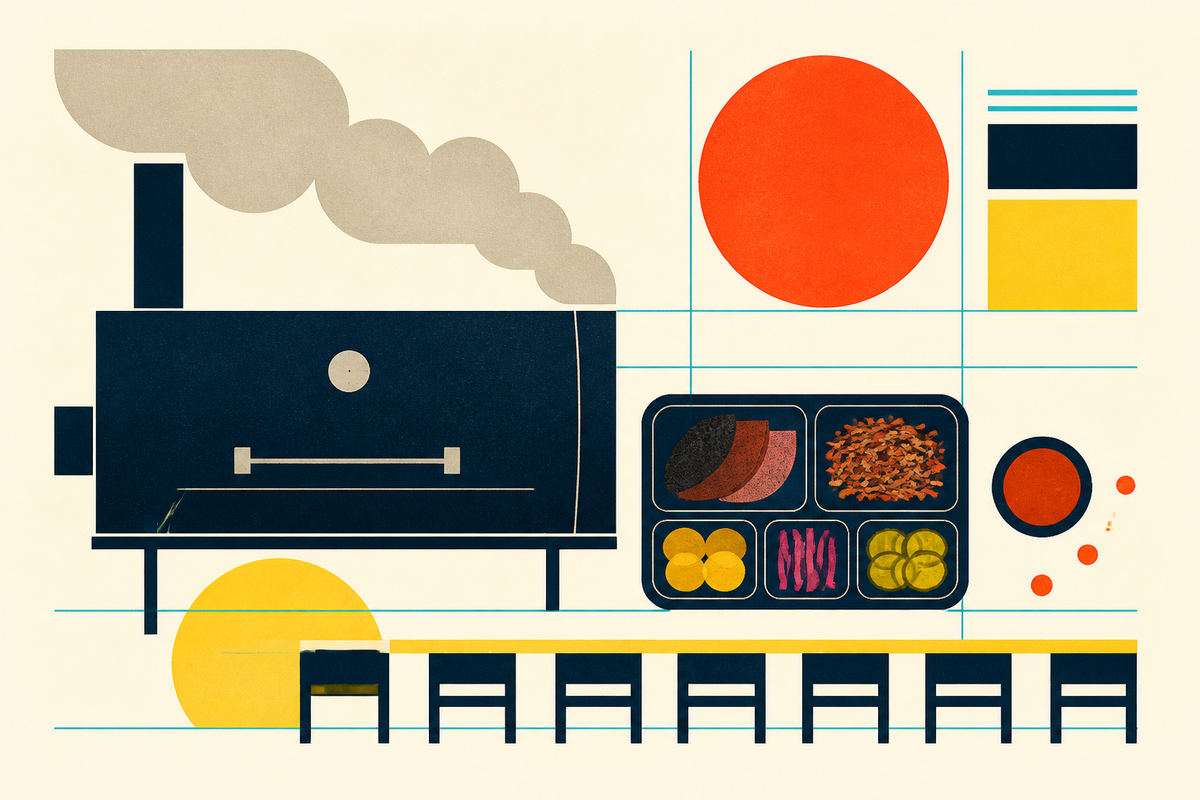
One smoker, six reasons to visit
Sonny's sells familiar plates and sandwiches, but the business is organized around occasions. A dining room catches lunch and family dinner. Takeout and drive-thru capture the commute. Delivery turns the restaurant into a weekday utility. Catering moves the same kitchen into offices, graduations, game days and backyard parties. Gift cards, bottled sauce and merchandise carry the brand outside meal time.
lunch + dinner
drive-thru
online ordering
bundles
events
merchandise
For franchisees, those channels spread demand across the day and beyond the dining room. The company reported average annual sales of $3.24 million for franchised restaurants in 2025, with 45 percent meeting or exceeding that figure. The figure is historical, not a promise, but it reveals why the pitch is larger than a plate of ribs. Sonny's offers a 20-year standard franchise agreement and supplies the brand, training, marketing, operating playbook and technology. Operators supply capital, local management and the daily discipline of running a restaurant.
The competitive set is equally broad. Mission BBQ, Jim 'N Nick's, City Barbeque, Famous Dave's and Dickey's sell recognizable chain barbecue. Independent smokehouses compete on personality and local authority. Fast-casual restaurants compete on ease; grocers compete on family meals; local caterers compete for the graduation party. Sonny's response is not one dramatic point of difference. It is the combination of in-house smoking, a wide menu, multiple ordering modes and a regional reputation built over generations.
The app learns while the smoker repeats
The newer Sonny's is built around a feedback loop. Its app and rewards program connect purchases to individual guests, replacing some of the bluntness of newspaper-style coupons with points, tiers, personalized offers and early access. Members can order online, connect a payment card or upload a receipt. Catering purchases made through Sonny's own platform can also earn rewards. For the restaurant, that produces a clearer view of frequency, preference and promotional response.
Seasonal menus provide the experimental layer. Sweet peach chicken, cherry cola sauce, brisket grilled cheese and dessert egg rolls are not random stunts so much as probes: familiar Southern flavors recombined into something worth noticing. Customer requests have brought dishes back, while proven seasonal items have graduated to the full menu. A test kitchen announced as part of the company's multi-year growth plan would make that process more deliberate.
This is where Sonny's appears most like a modern consumer company. It has a core product that should barely change and an attention layer that must change constantly. Pulled pork and sweet tea provide recognition. The limited-time menu gives lapsed customers a reason to look again. Loyalty data tells the company whether curiosity turned into a second order.
Kindness as a local operating habit
Restaurant mission statements tend to hover above the work. Sonny's has tried to put its own into the hands of local teams. Through 'Q the Kindness and Random Acts of BBQ, restaurants nominate and surprise nurses, teachers, first responders, longtime employees and other neighbors with meals and recognition. The company says it donates more than $1 million annually, has reached 41,000 people through the programs and involves a system of about 5,000 team members.
The clever part is structural. A corporate donation can be generous and invisible. A local restaurant arriving with a barbecue feast creates a small public ceremony, one that franchise employees can perform and neighbors can retell. The company even appoints a chief kindness officer to coordinate the Kindness Crew and expand participation. That title could sound ornamental; the budget, nomination system and repeated local events give it weight.
“Kindness isn't just a value at Sonny's BBQ - it's the foundation of everything we do.”Elden Scott, chief kindness officer
A regional brand decides how to grow
Sonny's was once larger. During the 2000s it reached roughly 150 restaurants, then contracted. The current footprint is a reminder that restaurant expansion is not the same as durable growth. In 2025 the company promoted George McAllan to president and Katie Love to chief marketing officer, pairing an operations and franchise specialist with a marketer who has spent more than a decade inside the brand. Their stated priorities include franchisee profitability, regional market growth, stronger guest connections and culinary innovation.
The market opportunity is easy to see and hard to execute. Barbecue travels well into family bundles and catering trays, but its kitchens require more training and time than a typical quick-service assembly line. The Southeast offers brand recognition, yet every town also has independent loyalties. Commodity costs can move sharply. A franchisee must maintain hospitality in the dining room while serving cars, couriers and mobile orders through the same building.
There is also a useful limit in the map. With almost all of its restaurants clustered across Southern states, advertising can sound regional without requiring translation, franchise support can concentrate its attention and the menu can assume a baseline familiarity with sweet tea, smoked pork and sides. Going farther would enlarge the addressable market, but it would also make Sonny's explain what the Southeast already understands.
Sonny's advantage is that it does not need to invent a reason to exist. It needs to keep translating one. The translation runs from oak smoke to a practical training academy; from a neighborhood table to a local giving program; from regulars remembered by servers to guests recognized in a loyalty database. Those systems make the company more scalable. The smoker keeps it from becoming generic.
Nearly six decades after the Tillmans opened their door, the useful lesson is not that everything old should be preserved. Sonny's has shortened its name, updated its identity, built new ordering channels and turned seasonal menus into a product pipeline. The lesson is to identify the slow part customers actually value. Build speed around it. Measure it. Train for it. Then leave it slow.