The most useful moment in Pizza Salvatoré's 62-year history arrived when its buffet became illegal overnight. In March 2020, more than half of the Quebec chain's sales depended on all-you-can-eat dining. Then dining rooms closed. The five siblings who had bought the company from their father two years earlier watched total sales fall 15 percent in the first week. They could have treated delivery as a life raft. Instead, they treated the dining room as the problem.
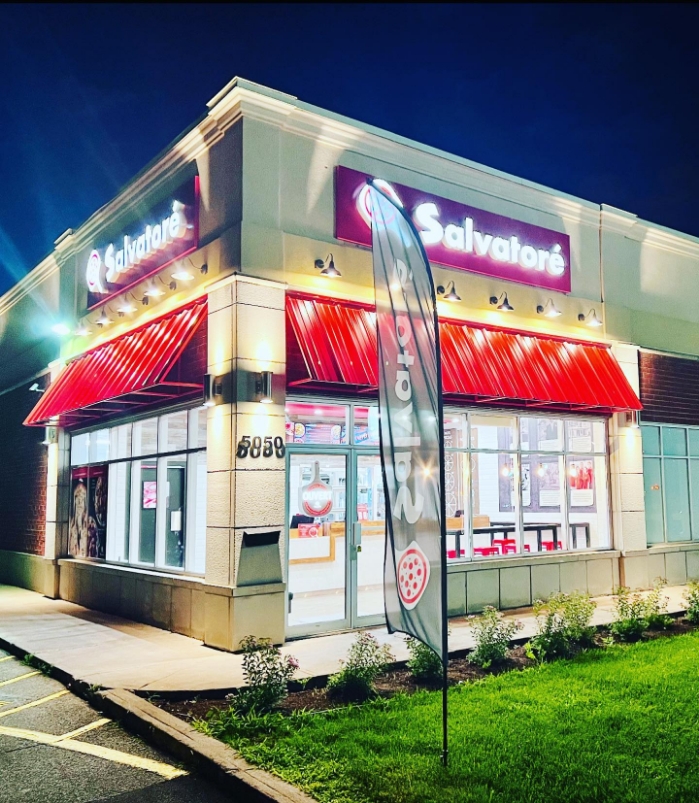
A month later, sales were up 60 percent, according to co-owner Élisabeth Abbatiello. The kitchen had already known how to deliver; the family simply enlarged that muscle, pushed sharp promotions and kept employees working. The emergency response became a format called DELCO - delivery and carryout, no dining room. Company franchise materials say it can occupy roughly half the space of the old buffet restaurant while producing substantially higher sales.
That is the hinge in this story. Pizza Salvatoré did not scale because pizza suddenly became novel. It scaled because five operators stopped paying rent for an experience their customers no longer needed, then built the whole company around the way those customers were already behaving.
The family recipe was never just a recipe
The origin story is almost suspiciously tidy. Salvatore Abbatiello, an Italian immigrant from the province of Benevento, made pizza for the Beauce family of his Quebec-born wife, Angèle Fecteau, at a New Year's gathering. They urged the couple to sell it. In 1964, the pair opened in Saint-Georges, raised seven children in an apartment above the restaurant and introduced a corner of Quebec to a food it barely knew.
The second generation created a franchise system in 1987. By 2015 there were 12 restaurants - respectable, regional and slow. Then Guillaume Jr., Élisabeth, Sébastien, Katarina and Frédéric Abbatiello bought the business in 2018 at what their father says was market price. Each sibling took a department suited to his or her abilities. They did not inherit ceremonial jobs. Élisabeth has described all five working 60 to 70 hours a week with their hands in operations.
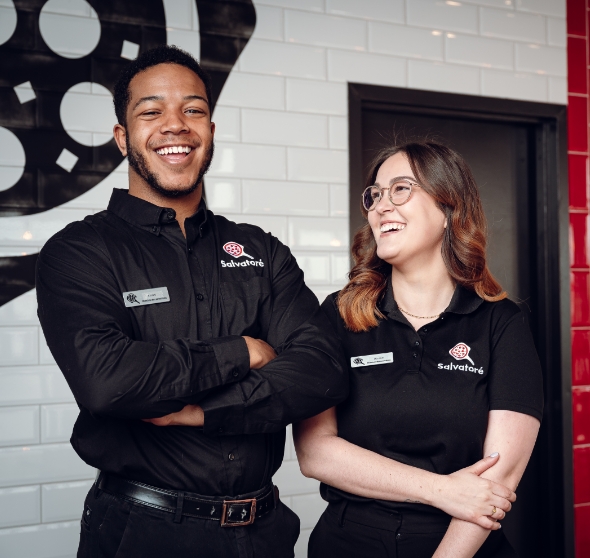
The acquisition loan was scheduled for five years. The siblings paid it back in two. They grew from 13 stores in 2018 to 64 by early 2023, while turning down approaches from larger buyers. At first they favored company-owned restaurants, a choice that required more capital but gave them control over the operating experiment. Only after opening more than 50 corporate pizzerias did they launch the current program for outside franchisees.
“Our priority isn't so much the number of restaurants, but the potential sales volume per unit.”Élisabeth Abbatiello, translated from a 2022 interview
What they actually sell
On the surface: stuffed-crust pizzas, wings, fries, dips, desserts and an exuberant list of poutines. Beneath that: convenience. Customers are households, students, families and groups who want a hot, familiar meal without surrendering an evening to it. The online checkout, mobile app, loyalty program, pickup counter and delivery route are as much the product as pepperoni.
Poutine is the regional wedge. The company has said that the Quebec staple represents about half its orders. That is a second demand engine most national pizza chains cannot imitate with the same credibility. It also explains why Pizza Salvatoré feels local even as the storefronts repeat. A customer can order a Hawaiian pizza or chicken wings anywhere; fresh cheese curds and brown gravy carry a postal code.
The small box multiplied
The business makes money through food sales at corporate stores and, increasingly, fees and royalties from franchised ones. Its franchise pitch includes help with financing, site approval, construction, training and recruitment, plus support for owners who want several units. The company reports average annual sales above C$1.3 million per pizzeria. That is a sales claim, not profit; rent, food, labor, delivery and financing still get their bite.
A useful historical cost exists. In 2022, Élisabeth said each new location required C$350,000 to C$400,000, and that more than C$10 million had been committed to 26 openings. Those numbers explain the initial corporate strategy and should not be mistaken for a current franchise quote. Construction and financing conditions move. Anyone buying a store needs the current disclosure document, not a charming number from an old newspaper.
The thing worth stealing
The copyable idea is not “post more on TikTok,” though the chain is unusually fluent there. It is sequencing. First, remove an expensive feature customers no longer value. Second, shrink the physical box. Third, route demand through software so the kitchen can see, prepare and dispatch it. Fourth, prove the process in stores you control. Only then hand the manual to franchisees.
Challenge the sacred feature. The buffet carried history, labor and square footage. None of those guaranteed future demand.
Fit the operation into a smaller delivery-and-carryout footprint with fewer moving parts and better sales density.
Make online ordering the default architecture. Pizza Salvatoré says four of every five orders now arrive digitally.
Operate the model yourself at scale before asking franchisees to finance its multiplication.
Social media sits on top of this system, not beneath it. The brand mixes promotions, family personalities, local donations and fast cultural reactions. Pizza Salvatoré says it has accumulated more than 315 million social impressions. In 2026, Élisabeth reported that the brand had passed 300,000 TikTok followers and 1.4 million followers across platforms. That audience lowers the distance between a discount and an order, especially when 80 percent of checkout already happens online.
But attaching a brand to a family creates a second edge. In 2025, remarks by individual Abbatiello siblings on public issues sparked criticism, and the company publicly distanced itself from at least one set of comments. Family visibility can make marketing feel human. It can also make a franchisee's asset wobble when a co-owner opens a camera. The operating lesson and the governance lesson arrive in the same pizza box.
A local brand has to act local
The company's community work is not separate from the growth system. New restaurants have opened with pizza donations to nearby organizations, sometimes in collaboration with distributor Sysco Canada. In 2024, the chain announced 100-pizza donations in both Moncton and London, Ontario, and gave C$10,000 to Fondation maman Dion's back-to-school program. A store enters a town as an employer, a delivery fleet and a familiar sponsor before it becomes somebody's Friday-night habit.
That approach fits the values its parent, Groupe Abbatiello, publishes: mutual aid, integrity, teamwork and self-improvement. It also gives “family business” a job to do. The phrase is otherwise decorative. Here, the family story helps a standardized counter feel less imported, while local giving supplies each new unit with a reason to be noticed beyond an opening discount. The tactic is copyable, but only if the contribution is useful. Fifty social posts about a ceremonial cheque cannot rescue slow delivery or a cold poutine.
Where the machine can jam
Pizza Salvatoré competes with Domino's, Pizza Pizza, Pizza Hut, Toujours Mikes and a town-by-town army of independents. It differentiates with poutine, a Quebec family identity, aggressive digital promotion and rapid delivery. None is a moat by itself. Cheese travels, discounts are copied, and every neighborhood has opinions about crust.
This playbook will not work everywhere
- Delivery density must be high enough that drivers and kitchens stay productive.
- Customers must already be comfortable ordering online; otherwise the compact format loses its demand funnel.
- Sales per unit must outrun food, labor, rent and promotion costs. Store count alone can disguise weak economics.
- A local menu advantage such as poutine must travel without becoming generic.
- Franchise growth requires quality control and reputational discipline from the people who personify the brand.
The announced goal is 500 restaurants by 2029, set when the 100th store opened in Ontario in 2024. Goals are cheap; openings are expensive. Even at the old C$350,000 floor, hundreds of locations imply a great deal of capital, training and cheese. The broader Groupe Abbatiello now owns several restaurant banners and says it operates more than 200 locations, which provides shared infrastructure but adds portfolio complexity.
Still, the chain's place in the market is clear. It is not an artisanal pizzeria pretending every pie was whispered to by Naples. It is a quick-service system built for eastern Canadian habits, with poutine as co-star and the screen as front door. Its best insight is deliciously unromantic: a restaurant can become more useful when it stops trying to be a room.
The buffet failed first. What survived was the kitchen, the family and the customer's appetite. Pizza Salvatoré reorganized those three things into a smaller rectangle and repeated it. For operators wondering what to copy, start there - not with the pizza, but with the subtraction.