Som Seif had a perfectly serviceable reason to stay in investment banking: he was learning, advancing, and doing work that rewarded effort. He gave himself a deadline anyway. If he was still in the same seat on his thirtieth birthday, he would resign. A birthday usually comes with cake. This one came with an escape clause.
He left before it arrived. In 2005, at 28, he started Claymore Investments in Canada. Seven years later, BlackRock bought the business. Seif then faced a question that money could make more comfortable without making it any easier: what, exactly, did he want to keep building?
Today he is the founder and CEO of Purpose Unlimited, whose businesses extend from investment funds to advisor technology and small business financing. The range can make his career look like an exercise in collecting companies. The more interesting pattern is his willingness to examine a good situation and ask whether it is still the right one.
The architect who chose another drawing board
Long before funds and financial platforms, Seif wanted to design buildings. Architecture appealed to his creative side: the attraction was making something. He eventually chose engineering at the University of Toronto, graduating in 1999. The desire to build survived the change of degree.
His family's route to Toronto was less direct. Born in England, he lived in Iran before coming to Canada as a three-year-old in 1980. His father had studied in England and later came to Toronto to pursue a doctorate at York University. Seif treats the family's move as a decisive piece of good fortune, a choice made for him that widened his possibilities.
That matters to his account of entrepreneurship. He is comfortable discussing risk, but he also gives substantial credit to the circumstances that made his own risks possible. A founder's story can become rather crowded with the founder. Seif makes room for his parents' decision before getting to his own.
After university, he joined RBC Capital Markets. He helped develop structured products in Canada and the United States, working with asset managers on structuring and raising capital. It was an education in how financial businesses worked from the inside, acquired before he set out to run one.
Seven years, 34 funds, and a difficult goodbye
Claymore began in January 2005. Seif led its business development and corporate strategy as president and CEO, helping build a Canadian business around lower-cost exchange-traded funds. An ETF packages investments into a fund whose units can be bought and sold on an exchange. The packaging sounds dry. For a business trying to change how people invest, distribution is part of the design.
Over seven years, Claymore grew organically to roughly C$8 billion in assets and a family of 34 ETFs across asset classes. Those numbers describe investors' assets, rather than Seif's personal wealth. They also describe a business that had moved well beyond its opening proposition.
When its owner decided to sell, Seif initially wanted to buy it. He participated in the process, looking for financing partners while the price rose. By December 2011, during his daughter's birthday, he recognized that attachment was pushing him beyond the price he had intended to pay. He told his wife that he was holding on too tightly and backed BlackRock's bid.
The sale closed in March 2012. He quickly drafted the plan for his next business, then resisted launching immediately. He worried that the urge to return was being driven by the wrong motivation. A three-month trip through Southeast Asia with his wife, with his BlackBerry switched off, gave the idea time to cool. The enthusiasm returned when he did. Purpose Investments followed in 2013.
A fund is a vehicle. Where is the passenger going?
Purpose's proposition placed emphasis on the result an investor needed: managing risk, generating income, or assembling a portfolio suited to a particular goal. Seif saw room for products that addressed those needs. It is a useful distinction in an industry with an inexhaustible supply of instruments and rather less certainty about the listener's favourite tune.
He has also resisted turning the ETF wrapper into a matter of faith. Purpose has offered mutual fund and ETF versions of many strategies. His reasoning is practical: investors want a suitable strategy in a format that works for them. A distribution preference should not have to become a philosophical argument.
Purpose Investments passed C$1 billion in assets in 2015. In 2017, the broader Purpose financial services platform took shape, alongside the launch of Purpose Advisor Solutions. In 2018, the business acquired small business lender Thinking Capital, now known as Driven by Purpose. The ambition had expanded from making funds to supplying more of the machinery around financial decisions.
- 2013Purpose Investments begins
- 2017Advisor technology joins the platform
- 2018Thinking Capital adds small business lending
- 2025Steadyhand joins Purpose
Bitcoin, with an ordinary brokerage ticket
On February 18, 2021, Purpose Bitcoin ETF began trading on the Toronto Stock Exchange. The exchange identified it as the world's first direct-custody bitcoin ETF. Investors could obtain exposure through fund units while the fund held bitcoin directly.
For Seif, the launch added a conspicuous new chapter to a career spent thinking about access and investment structure. The underlying asset attracted the attention; the mechanism made it available in a familiar account. Canadian-dollar and US-dollar units traded under BTCC.B and BTCC.U.
The milestone was specific. It established a way to hold exposure through an exchange-traded fund; it did not settle the arguments about bitcoin's value or future. Seif and the Purpose team marked the occasion with a virtual market close the following day. After years of financial engineering, the ceremonial button was comparatively straightforward.
The coach returns to campus
Another version of Seif appears in a university photograph, holding an Arbor Award between David Naylor and David Peterson. The recognition was for volunteering as a water polo coach. He had played for the Varsity Blues, then returned after graduation to coach the team to four consecutive OUAA championships.
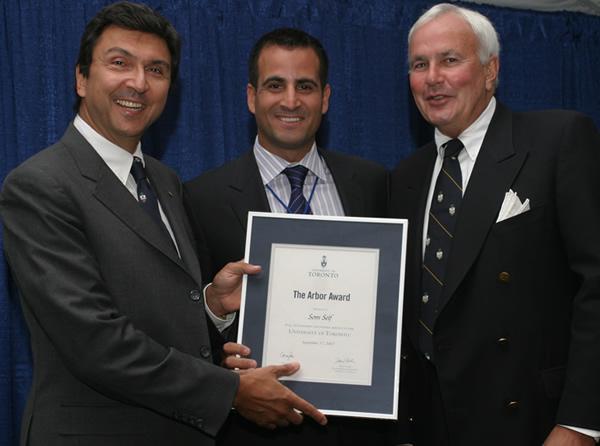
His explanation for coaching is uncomplicated: a volunteer coach had supported him, and he wanted to return the favour. By 2022, he was a co-chair of the university's Defy Gravity campaign. He had also begun volunteering as a Big Brother while still an engineering student, fitting it around coursework and training.
The campus memories have a welcome lack of grandeur. He recalls the courtyard at Sir Daniel Wilson residence, where a free phone let him call the girlfriend who became his wife, and naps during late-night studying at Robarts Library. Even an entrepreneur's university years require somewhere to sit and a reasonably economical telephone.
The institution behind the individual
The connection between those activities and his business ambitions is his interest in what helps other people act. Coaching, mentoring, and financing are different occupations. Each can put someone else's decisions within reach. His NEXT Canada board involvement adds another setting for that interest in entrepreneurship.
In 2025, Purpose acquired Vancouver-based Steadyhand. Co-founder Tom Bradley and Seif discussed the proposed partnership publicly that March. The attraction included Steadyhand's approach to advice and a structure for serving smaller accounts that can be expensive to support through traditional investment counselling.
Steadyhand's own origin story emphasizes straightforward service, personal contact, and friendly fees. Its decision to join Purpose brought that existing identity into a larger financial company. For Seif, it extended the work beyond manufacturing investments and further into the relationship between an investor and the people helping manage their money.
His stated definition of success remains deliberately domestic in scale, however large the organization becomes.
“My personal definition of success is: happy customers and happy employees.”Som Seif
A promise under examination
Purpose's public claims have also attracted regulatory scrutiny. In September 2025, the Ontario Securities Commission brought an enforcement proceeding against Purpose Investments and Seif concerning statements about environmental, social, and governance factors in its investment process.
The OSC alleges that 19 sales communications overstated how extensively those factors were considered. Purpose and Seif deny the allegations, maintaining that the firm's efforts and public statements were genuine and did not breach securities law. These are contested allegations.
The merits hearing concluded on September 25, 2026, with the Capital Markets Tribunal reserving its decision. The dispute puts a concrete question beside the company's stated principles: whether the language used to describe an investment process accurately reflected the work being done. Its outcome will matter to a business that makes its customer commitments part of its identity.
The question beneath the portfolio
In October 2026, Seif was discussing a more personal question facing financial advisors: whether a client is going to be okay. He argued that an industry built around trading and products still creates obstacles for advisors trying to help people plan their lives. Purpose's Canadian Momentum Project examined that gap between investors' ambitions and the tools available to serve them.
Earlier that year, he had challenged Canada's treatment of business failure, arguing that criticism can discourage people from taking entrepreneurial risks. He also described artificial intelligence as a reason to reconsider how Purpose itself operates. Having built an organization does not, in his view, exempt its design from another look.
That brings the story back to the young banker with a birthday deadline. Seif has accumulated businesses, products, and responsibilities since then. The question he keeps bringing to them is recognizable: does the structure still serve the life it was supposed to make possible? For a would-be architect, it is a reasonable thing to keep asking.