The first number Software.com wanted to know was oddly intimate: how many minutes had a developer actually spent in a code editor? Not how long a laptop was open. Not how many meetings filled a calendar. The minutes in which somebody was reading, writing, or shaping code. Its Code Time extension put that number in the editor, a little mirror where the programmer already worked. If the reflection was unflattering, the product could at least point to the interruptions around it.
- Software.com built Code Time and automated metrics for engineering teams; it became Antenna in April 2026.
- Its current platform connects Git and AI tool data to delivery, quality, adoption and cost measures.
- Paid plans start at $15 or $29 per Git user per month; enterprise contracts are custom.
- The useful question is whether an AI tool changes shipped work, not simply whether people use it.
That modest stopwatch has become a much larger instrument panel. The company now calls itself Antenna. It wants to show engineering leaders what happens after AI assistants enter the workflow: which teams use them, what the tools cost, whether more original work gets delivered, and where the new work piles up. A glance at an individual’s focus time has turned into an argument about an organization’s capital allocation.
A clock in the editor
Code Time remains the neatest way to understand the company’s instincts. The open-source extension tracks editor activity and offers a personal dashboard for code time, active coding, projects, and meetings. Its Flow Mode can mute distractions and protect a coding session. The definition is pragmatic rather than magical: editor focus counts as code time, and a brief trip outside the editor can still be included if the developer returns soon. Active code time is narrower, tied to actual editing.
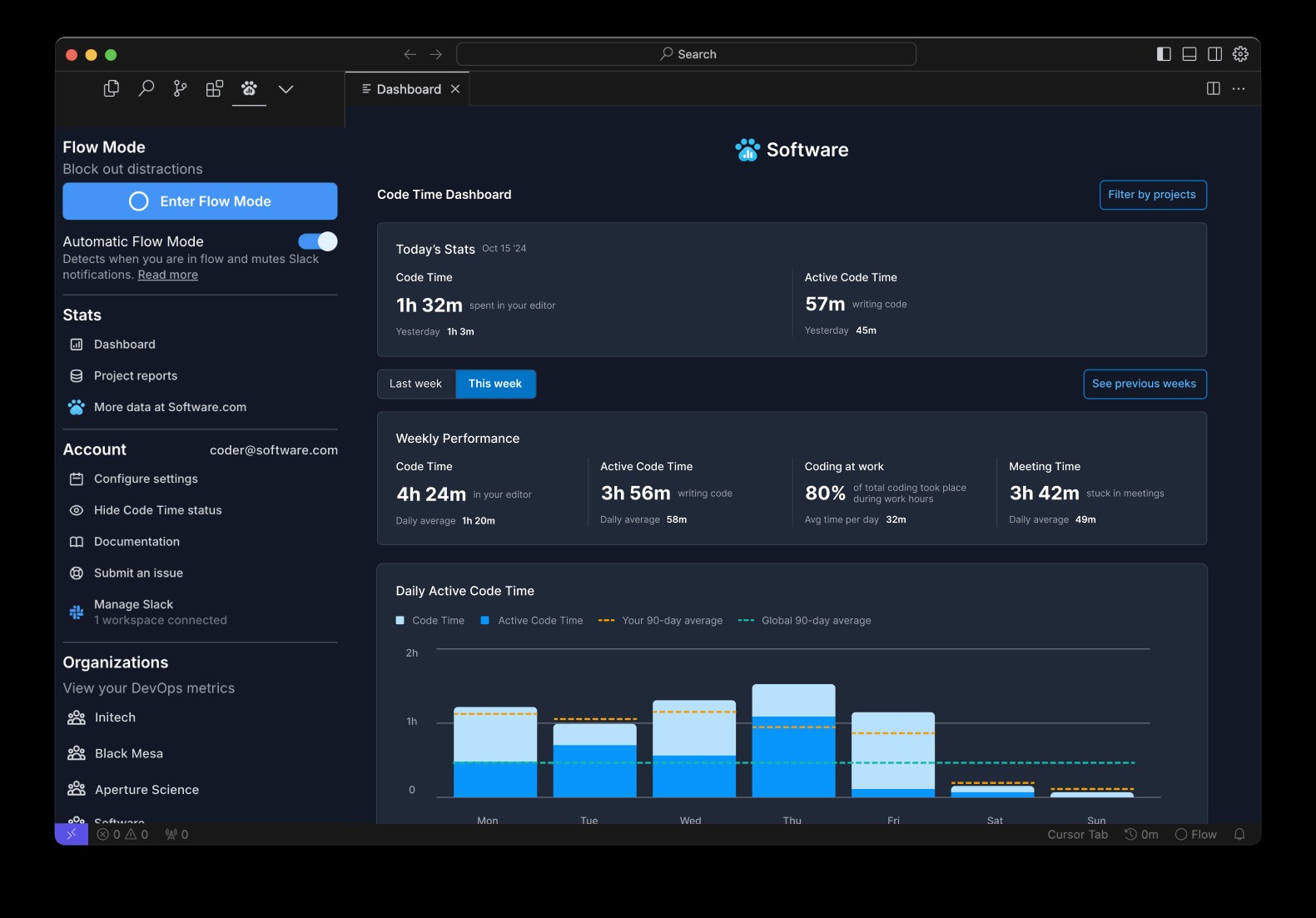
The distinction matters. Counting keystrokes alone would reward noise; counting all desk time would hide the meeting that broke the day in half. The plugin’s published data policy says it collects coding metadata, not source code. It also says identifiable individual data is not shared with managers through team views. That privacy boundary is central to the appeal. A developer may welcome a personal mirror and resist a managerial surveillance camera.
Software.com’s team product took a different route through the same problem. Rather than requiring a new ritual, it connected to development systems already in use and assembled measures for review, deployment, lead time, rework and output. The original sales pitch was plain: remove the spreadsheet between engineering activity and management decisions. In December 2021, Next47 and 8VC put $15 million behind that pitch. At the time, co-founder Brett Stevens said the platform was used by more than 250,000 developers worldwide.
Then the bill arrived
AI coding assistants changed the argument. A license can be counted. So can an accepted suggestion or a million tokens. None of those numbers, by itself, says whether a feature reached a customer faster. A team can generate more code and merely lengthen the queue for code review. It can push more pull requests through while accumulating rework. The assistant may speed up one desk and slow down the whole room.
This is the gap Antenna now sells into. Its platform draws from Git providers, project trackers and AI tools, including GitHub Copilot, Claude Code and Cursor. It can show adoption and spending alongside measures such as lead time, rework and “new deliveries,” its attempt to estimate the new component of pull requests per developer. The company compares AI users with a baseline cohort and lets customers drill into the records behind a chart. The latter is less glamorous than a productivity percentage, and more useful when a result looks too good to be true.
The move became official in April 2026, when Software.com announced the Antenna name and moved its primary domain. The change sharpened the pitch from engineering metrics to visibility and financial control for AI-driven development. Later releases added AI budgets by tool, developer and group, a model selection planner, and connections to a wider set of AI services. In June, Unisys announced that it would embed Antenna’s independent benchmarks in its application services. That is an instructive customer story: the buyer wants a way to judge AI work across many teams, not one more code editor feature.
The fastest way to write a pull request is of little use if the pull request spends the week waiting for a reviewer.The bottleneck moves with the work
What the customer actually buys
The likely buyer is an engineering executive trying to justify or redirect AI spending, with product and finance colleagues nearby. A team lead can look for a slow review queue. A finance leader can ask whether rising token spend is buying more delivery. A developer can still use Code Time to see where a week went. Those are related customers, but they do not all want the same dashboard. Antenna’s trick is to connect their questions without pretending that one number answers them all.
Its commercial model reflects that split. Code Time has a free individual offering, while the main SaaS product charges by Git user. The public pricing page lists plans starting at $15 and $29 per Git user per month, with custom pricing for large organizations. It is a deliberate denominator: the bill scales with the population doing software work, while the product argues that even a small improvement to that population is worth measuring. A team still has to decide what “improvement” means in its own context.
The company competes with engineering intelligence platforms such as LinearB, Jellyfish, DX and Pluralsight Flow, as well as the graphs bundled into Git and AI products themselves. Its difference is the financial question attached to engineering telemetry. GitHub can show Copilot activity; Antenna wants to put that activity beside delivery, rework, and cost across tools. It also offers benchmarks drawn from a wider developer community. The strongest use of those benchmarks is to prompt an investigation, not to declare a winner between unlike teams.
A measurement worth copying
There is a simple practice inside this elaborate product. Start with a baseline before a new tool arrives. Count what the tool consumes: seats, tokens, time. Then follow the work downstream through review, deployment and rework. If coding accelerates but delivery does not, the next investment may belong in reviewers, tests, or smaller changes. Antenna’s own guidance suggests identifying the biggest constraint and setting an objective against it. That is more persuasive than buying another dashboard and waiting for the line to rise.
The method has limits. It needs enough consistent workflow data to make comparisons sensible, and teams have to inspect the underlying records. A newly formed team, a long research project, or work that never appears in pull requests may not fit a tidy productivity ratio. AI impact is also hard to isolate when staffing, product scope and release policy change at the same time. The right response is to treat the numbers as clues to investigate, not verdicts on individuals.
Software.com began with a small, almost comic act of honesty: look at the clock and see how little uninterrupted coding time survived the day. Antenna has carried that habit into a more expensive room. The clock now has a token counter beside it. The old question was, “Where did the afternoon go?” The new one is, “What did the money make possible?” The company’s lasting value will depend on whether its customers are willing to follow the answer beyond the first chart.