The old joke about enterprise software is that nobody buys it; committees merely stop resisting. Opsera has built a business around the moment when resistance becomes impractical. A large company may have GitHub for code, Jenkins for builds, Jira for work, SonarQube for quality, several clouds, a security stack, Salesforce, Databricks and a few hundred other tools accumulated through acquisitions and good intentions. Each works. Together, they resemble an airport where every airline invented its own runway signals.
Opsera sells the control tower. Its platform connects those tools, lets teams assemble delivery pipelines without coding every integration, applies security and approval rules, and shows leaders what happened from the first ticket to production. The company does not insist that customers throw away their favorite tools. That is the clever bit. It sells order without demanding monogamy.
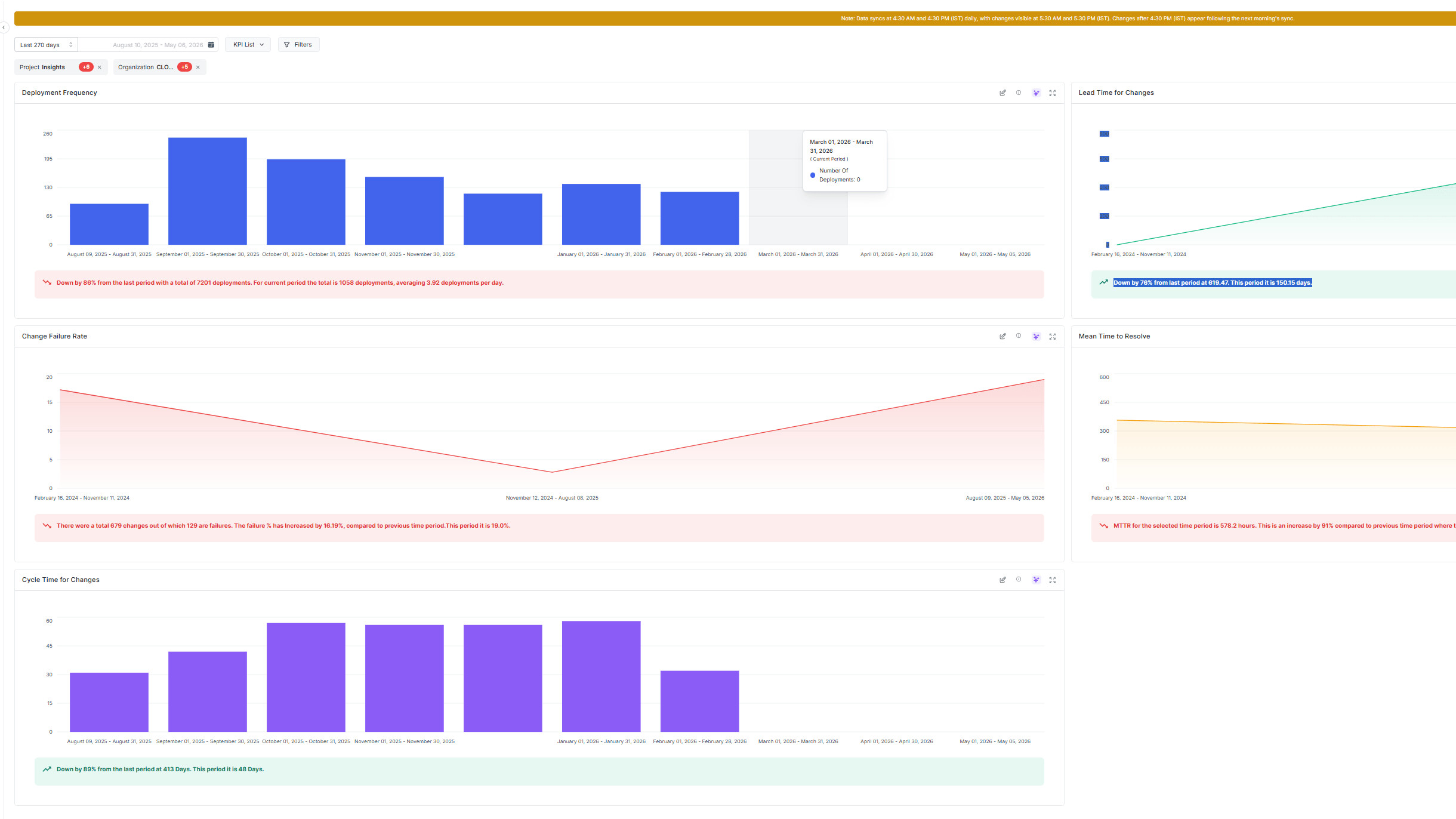
Now AI coding assistants are producing more code, more quickly, and the airport is busier. Opsera has followed the congestion upstream. Unified Insights measures whether tools such as GitHub Copilot improve delivery, Hummingbird AI interprets the telemetry, autonomous agents recommend or execute fixes, and the newer Forge product tries to carry business intent and technical context from an idea into governed, production-ready software.
The new bottleneck is not writing code. It is proving that faster code became better software.
The original woundFive hundred tools walk into a deployment
Kumar Chivukula and Chandra Ranganathan founded Opsera in January 2020. Their first phrase for the product was “continuous orchestration”: a no-code layer across the software lifecycle that gave developers tool choice, operations teams automation and executives a common set of measurements. The pitch landed because the apparent alternatives were both unpleasant. A company could accept vendor lock-in, or it could hire specialists to maintain a web of brittle scripts.
Infoblox provides the cleanest build-versus-buy story. Its DevOps environment had more than 500 tools, and its Salesforce release process still required time-consuming merges and conflict resolution. Building an internal platform for ten business applications was estimated to require at least ten people and two years. The company bought Opsera instead. A team of two automated release workflows with security and quality gates in a couple of months, while the broader tool count fell to roughly 200.
Internal build estimate
10+ peopleAt least two years for ten business applications.
Opsera route
2 peopleReported time to value: two to three months.
What failed first was not an exotic algorithm. It was the handoff. Static analysis was not properly integrated. Developers could not work easily across branches. Merges consumed a day or two of collective attention. The internal-build estimate changed the decision: flexibility sounded attractive until the staffing and maintenance bill became visible. That is the condition Opsera repeatedly exploits - complexity has already arrived, but the company no longer wants to employ a small civilization to tend it.
What customers buyA pipeline builder, a referee and a scoreboard
The core Unified DevOps Platform handles CI/CD pipelines, toolchains, release orchestration, governance and source-code migrations across cloud, hybrid and self-hosted environments. Salesforce teams can add Git-based workflows, tests, approvals, backups and rollbacks. Data teams can apply similar discipline to Databricks notebooks, jobs and machine-learning assets. Security teams can insert scans and policy gates before vulnerable work travels downstream.
One control loop, many existing tools
City of Hope used the no-code builder while developing applications for precision-medicine data. Its pipeline setup reportedly shrank from two and a half hours to 30 minutes, an 80 percent reduction, while developer productivity rose 25 percent. NortonLifeLock had a different mess: even after consultants designed a Salesforce delivery system, 40 percent of the steps remained manual and outages could last two or three days. Its first Opsera pipeline went live within hours; the customer later reported cutting deployment time by 50 to 75 percent and saving $55,000 in annual productivity.
The emergency case is more memorable. During the Log4j crisis, a Fortune 100 customer used Opsera to identify affected components, scan automatically, test fixes and deploy across development, quality assurance and production. The team ran 164 pipelines and more than 500 releases in less than 48 hours. The copyable lesson is not “buy emergency software.” It is the opposite: connect tools, define gates and rehearse the release path before a vulnerability turns the company calendar into a countdown clock.
The AI turnCounting Copilot seats was never the point
In 2023, alongside a $12 million Series A Plus round, Opsera introduced Hummingbird AI. The product summarized errors, surfaced trends, suggested pipeline templates and translated delivery data into recommendations. By 2025, the company was selling a broader argument: businesses had bought AI coding licenses but lacked a credible way to connect usage with throughput, reliability, security or savings.
Unified Insights collects DORA, SPACE and developer-experience signals across more than 150 integrations. It can run independently of Opsera's orchestration platform, including on premises, which widens the market. One insurer case study covered 2,288 licensed developers and identified $1.93 million in monthly savings within 30 days, including 700 inactive seats tied to an $850,000 monthly reduction opportunity. Cisco's cyber-security group, meanwhile, reported a threefold improvement in time to pull request and a 62 percent faster merge cycle after consolidating security tools and adding shared visibility.
Metrics can easily become workplace surveillance wearing a dashboard. Opsera's public position is “measure productivity, not people,” using cohort patterns and delivery outcomes rather than keystroke theater. Buyers should still establish who can see individual-level data, how comparisons are used and whether engineers can challenge a misleading measure. A chart becomes management policy the moment someone ties it to performance review.
Forge and the new wagerKeep the intent attached to the code
Opsera's 2026 launches move beyond observing delivery. AppSec agents detect and remediate security issues. Reasoning agents diagnose pipelines. Forge starts with an idea or legacy application, creates structured specifications and work orders, preserves architectural context, and coordinates coding agents under enterprise guardrails. A May partnership embeds that context and autonomous workflow into Cursor.
The wager is that prompt-first development loses the plot. Agents produce plausible code but do not automatically know an organization's hidden dependencies, approval requirements or business rules. Forge tries to version the intention along with the implementation. If it works, the valuable artifact is not just generated code; it is a traceable chain explaining why the code exists, which policy touched it and what reached production.
This also explains Opsera's evolution better than the usual AI makeover. The company began by preserving tool choice while imposing a delivery process. Forge preserves agent choice while imposing context and governance. Different actors, same traffic problem.
Money and marketEnterprise economics, mostly behind the curtain
Opsera sells business-to-business software through demos and negotiated contracts, with SaaS, self-hosted and hybrid options. Public pricing is sparse. Its Salesforce AppExchange listing starts at $125 per pipeline per month, while a free agents offer targets startups and small teams. Those figures should not be mistaken for the cost of a global deployment involving thousands of developers, custom integrations and support.
The public Salesforce listing starts at $125 per pipeline per month. Typical enterprise contract values are not disclosed.
The company has announced $51.3 million in funding: a $4.3 million seed round, a $15 million Series A, a $12 million Series A Plus and a $20 million Series B led by Prosperity7 Ventures in April 2025. It reported 200 percent revenue growth between the last two rounds. The supplied company estimate places annual revenue around $11.5 million and headcount near 100; neither number is disclosed in audited public accounts.
Competitors surround every edge. GitLab, Harness and GitHub Actions address pipeline and platform work. Copado and Gearset specialize in Salesforce delivery. Jellyfish, LinearB, DX and Swarmia sell engineering intelligence. Then there is the eternal competitor: an internal platform built from Jenkins, Jira, cloud services and scripts. Opsera's distinction is breadth - tool-agnostic orchestration, analytics and remediation across conventional software, SaaS applications and data workloads - but breadth also raises the burden of implementation.
The honest fitCopy the operating model, not the shopping list
Opsera fits when: many teams share a complicated toolchain; releases cross clouds or business applications; security and audit gates matter; leadership needs comparable delivery data; and maintaining integrations is already a job.
It may not fit when: a small team has one repository, one cloud, uncomplicated GitHub Actions and little compliance overhead. In that world, another control plane can create more administration than leverage.
The most useful thing a reader can copy is a sequence. First, inventory the handoffs rather than the tools. Find where work waits, where data is re-entered and where only one person understands the release script. Second, calculate the real internal-build cost, including the years of maintenance after launch. Third, automate one painful path with explicit security and rollback gates. Finally, measure the production outcome - lead time, failure rate, recovery time, cost - instead of celebrating pipeline activity.
Opsera's future depends on whether enterprises accept one more platform to reduce the complexity created by all the others. That sounds paradoxical until the runway fills with coding agents. Then a control tower looks less like optional architecture and more like the only place where anyone can still see the planes.