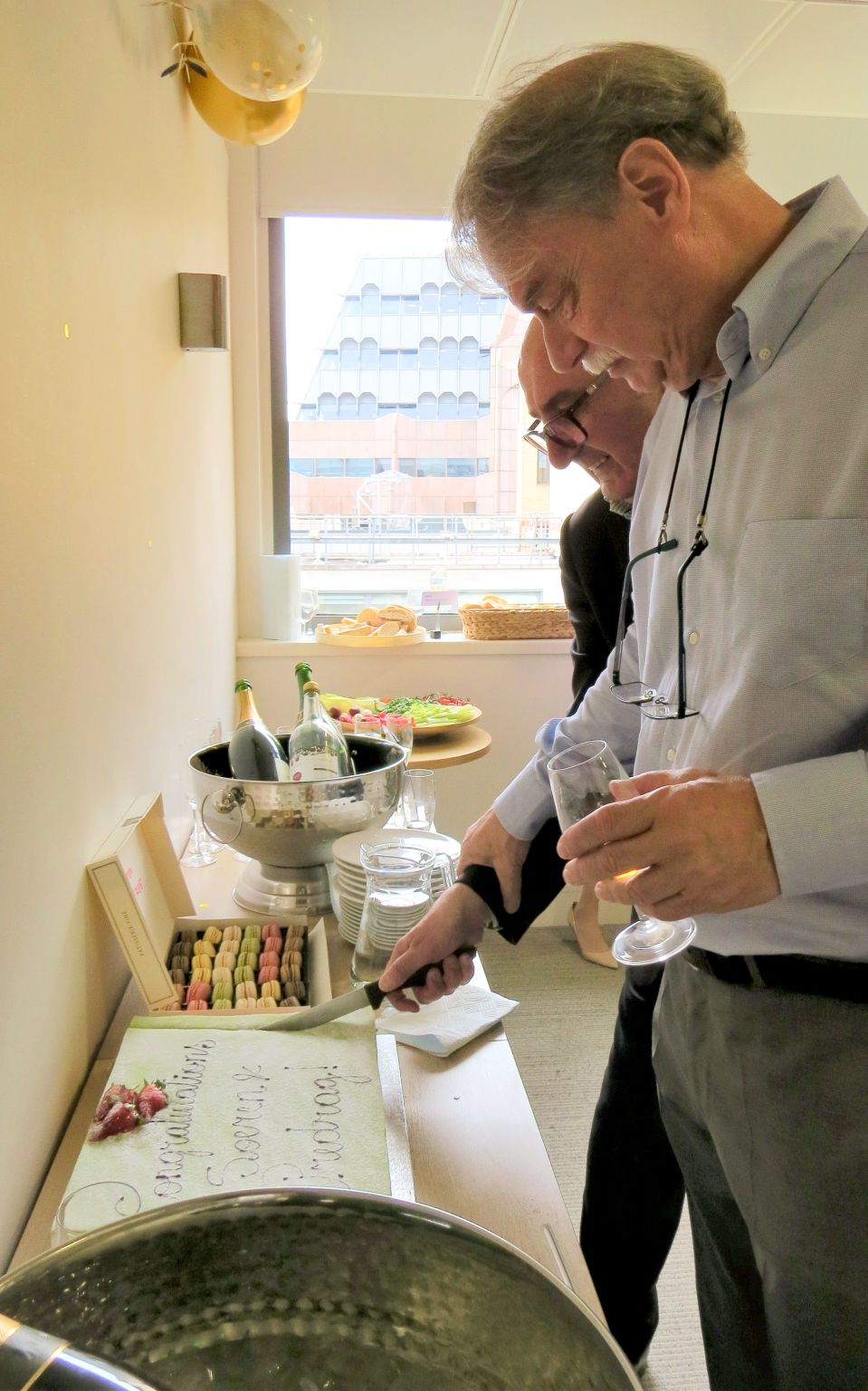
The cake says congratulations to Soeren and Predrag. Around it, there are glasses, bottles in an ice bucket and a box of macarons. Soeren Christensen has a knife in one hand and a wine glass in the other. After a career involving risk, probability and financial information, he has arrived at a problem with a pleasantly definite solution: somebody must cut the cake.
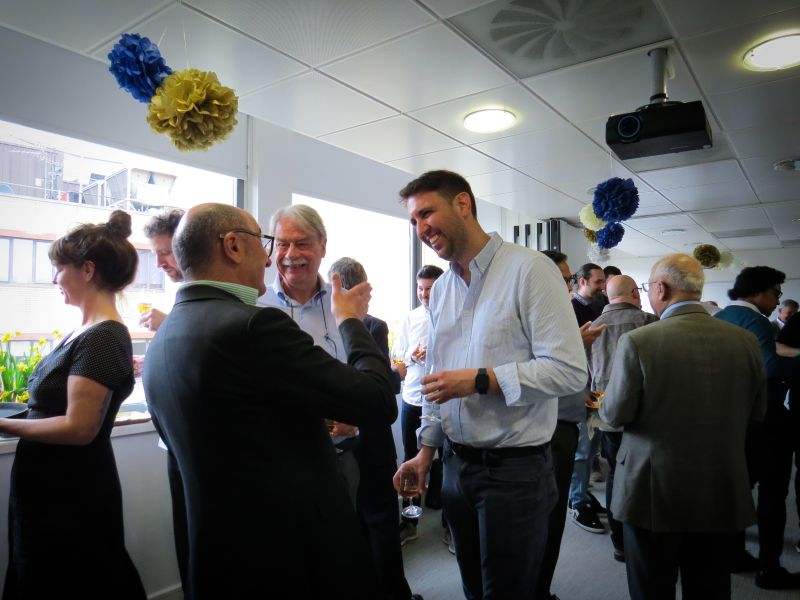
Fincore shared the photographs in April 2023, marking a new chapter for Christensen and his co-founder, Predrag Popovic. The gathering welcomed Mateja Popovic and Mike Ellis into the next phase of leadership. For a business whose products generally live behind other businesses, it was an unusually visible moment. The people who made the machinery work had stepped out from behind it.
There is a long professional partnership inside that scene. Christensen and Popovic met at Nomura International, working in risk management in the late 1980s. They went on to found Finsoft in 1995. Banking software led into betting technology and other kinds of business systems. The company history acquired several names, a sale and a fresh start. The two names on the cake stayed familiar.
The mathematics before the company
Christensen’s academic route took him through Aarhus University in Denmark and the University of North Carolina at Chapel Hill. His qualifications include an MSc in Mathematics and Physics, an MS in Statistics and a doctorate in statistics and advanced probability. It is a substantial education in the behaviour of things that refuse to behave exactly as expected.
Probability is a useful companion in investment banking. Prices change, exposures accumulate and a decision that looks sensible in isolation can become awkward when placed beside a thousand others. Risk management asks people to describe that uncertainty carefully enough to act on it. The arithmetic must eventually survive contact with an institution, its records and its working day.
Christensen held investment-banking roles focused on risk management and later e-commerce before becoming a software founder. That sequence matters. He entered the software business with experience of the environment the software was meant to serve. A customer’s complicated problem could be a familiar kind of complication, even when its particular details were new.
The meeting with Popovic gave that experience a partnership. The late-1980s connection at Nomura preceded the 1995 founding by several years. Their business began in the territory of complex financial systems. Over time, the same organization would work in markets whose outward appearances were quite different. A central bank and a bookmaker do not decorate their offices for the same audience.
- Late 1980sNomura
Risk management - 1995Finsoft
The founding - 2006Fincore entity
Directorship begins - 2023A new chapter
Leadership celebration
A sale with a second beginning
By 2007, Finsoft’s sports-betting operation had become an acquisition target. GTECH announced an agreement to buy the London business and substantially all the assets of its affiliated Serbian development operation. Its announcement named customers including Singapore Pools, Chisholm Bookmakers and Boyle Sports. The software had travelled a considerable distance from its investment-banking origins.
The attraction included real-time transaction processing and risk management. Finsoft’s MarginMaker platform supported the practical business of taking bets through different channels. Whatever the channel, an operator needed the underlying information to remain coherent. A familiar commercial problem had appeared in another setting: many moving parts, with money depending on their agreement.
The transaction also drew a line through the business. Non-sports-betting activities were to be separated into Finsoft Financial Systems, owned by Finsoft’s existing shareholders. The sale therefore created two continuing stories. The betting operation entered a larger group. The other activities continued on their own path, eventually under the Fincore name.
Christensen had been appointed a director of the present Fincore legal entity on 14 November 2006. It began as Finsoft Systems Limited, became Finsoft Financial Systems Limited in 2007 and took the Fincore Limited name in 2009. Those changes can make a short biography look untidier than the career it describes. Company names are helpful labels until several of them occupy the same paragraph.
For Christensen, the distinction is consequential. The 2007 transaction belongs in his story, alongside the business that continued beyond it. Treating the sale as the end would lose the subsequent financial-data work and his later years as Fincore CEO. The next chapter contains a particularly revealing example of what occupied his attention.
A name for every institution
At FIMA in 2008, Christensen discussed the European Central Bank’s Centralised Securities Database. He was managing director of Finsoft Financial Systems, which had worked with the ECB on the project. His proposal concerned a basic piece of financial infrastructure: the identifiers used to distinguish one institution from another.
“Each institution needs a unique identifier”
Soeren Kier Christensen · FIMA, 2008
The database could, he argued, become a recognised source of business entity identifiers. Different information providers used different codes. A translation table helped connect them. Reusing an established set of identifiers could reduce the repeated effort of sorting out which records referred to which organization. The proposal was a practical argument for making existing work useful more widely.
The project covered market and instrument information, entity records and corporate actions. Its job included receiving information, checking it and making it usable. The interest here is Christensen’s choice of problem. Beneath the impressive vocabulary of financial markets lies a plain question: are we all talking about the same thing?
Consider an ordinary address book with the same person entered under three names. Now imagine that the entries describe institutions and the records feed consequential calculations. Tidying the names becomes part of understanding the numbers. That is an explanatory analogy, but it captures why a discussion about identifiers can matter to people well beyond a database team.
The appeal of that proposal is its economy. Christensen was pointing towards identifiers already held in an existing system. Wider usefulness could come from arranging and sharing information that had already been collected. For a software entrepreneur, this is a recognisable commercial territory: helping an organization get more value from the work it must do anyway.
Code AProvider B
Code BProvider C
Code C
Different labels must resolve to the same entity before the information can be used consistently.
The room in Basel
Five years later, Christensen’s name appears in another discussion about bringing financial information together. The Financial Stability Board lists him, as Fincore CEO, among private-sector participants at its 13 November 2013 outreach workshop in Basel. The subject was approaches to aggregating over-the-counter derivatives data.
The participant list includes people from Bloomberg, CME Group, DTCC, Deutsche Börse and other financial organizations. It places Christensen in a room concerned with how information from different parts of a market could be combined. Participation alone does not assign him a particular proposal. It does show the professional setting in which his company was involved.
Aggregation has a simple attraction: a wider view. Its difficulty is that the separate pieces must be compatible enough to belong in that view. A sum becomes misleading if the components are duplicated or described inconsistently. The FIMA discussion and the Basel workshop sit five years apart, yet both turn attention towards the usefulness of information across organizational boundaries.
There is also an organizational challenge inside the technical one. A common description has to work for several participants, each accustomed to its own records and routines. The workshop setting makes that visible. Software companies, market infrastructure providers and information businesses were all represented in the discussion. A shared view requires a conversation as well as a database.
That gives Christensen’s career a more specific shape than a list of executive titles would provide. He appears at points where financial activity needs a shared description. Mathematics supplies ways to reason about uncertain events. Software has to arrange the records that allow an organization to do that reasoning in practice.
What survives the handover
Over his years leading Fincore, the business moved from professional IT services towards packaged software delivered as a service. The wider company story also included workflow systems and a return to gaming in 2012. It is a varied portfolio, connected by the need to fit software around complicated operations.
By the time of the 2023 celebration, there was an organization around the original partnership. That makes the office gathering more than a decorative ending to a corporate timeline. A company has reached a different stage when it can mark the founders’ transition while introducing the people carrying the work forward. The celebration put faces around that change.
The legal and executive histories continue on different tracks. Christensen remains listed as a director of Fincore Limited. Elsewhere, his Nextgen Clearing and Nextgen Plus directorships, both begun in March 2014, ended in April 2024. A leadership celebration, an executive role and a board appointment each mark a different part of a working life.
Fincore now describes its work in terms of modernising older technology, connecting systems and helping gaming businesses deliver their plans. Those are the company’s present activities. Christensen’s place in the story rests on the partnership, the founding and the years of building that preceded the handover.
A founder’s contribution also sits in decisions made before a business became familiar to its customers. The later organization carries those beginnings alongside the work of the people who joined it afterwards.
Return to the cake and the chronology becomes easier to hold in mind. Two colleagues met in banking. They founded a software business. Parts were sold; other parts continued. Decades later, the company gathered around them. For once, the thing in front of Christensen required neither an identifier nor a probability model. It required plates.