At a Marex training session, the students had to do more than solve a maths problem. They had to decide how much to bid on their answer. A correct calculation with a timid bid could lose to a competitor who understood the odds better. Marex described the exercise in its August 2026 account of QuantFin Discovery Week. For a company selling financial services, it was an unusually compact explanation of the job.
- Marex helps institutions execute, clear and manage trades.
- Its customers span commodity businesses, banks and investment firms.
- Acquisitions add expertise; shared infrastructure makes it useful.
The programme brought together 100 Year 12 maths students. At Marex, staff explained pricing, hedging, sales, models and structuring. Each discipline answered a different question about the same transaction. That is also a useful way to understand Marex itself: as a collection of people and systems that make a trade possible, then deal with its consequences.

The business between yes and settled
Imagine a manufacturer worried about the price of metal it will need in six months. Finding a quoted price is easy. Finding the right hedge, executing it, arranging collateral and monitoring the exposure is a longer assignment. This hypothetical customer illustrates the territory Marex occupies. Its clients include producers, consumers and traders of commodities, alongside banks, hedge funds and asset managers.
Marex divides the work into four services. Agency and execution connects buyers and sellers. Market making supplies prices and liquidity using the firm’s own balance sheet. Clearing gives clients access to exchanges and handles obligations after a trade. Hedging and investment solutions designs customised derivatives for corporate risks and structured investments for professional investors. These services address different needs, but a customer can use several.
“Clearing is the central hub of Marex”
Marex securities prospectus, 2025
Its distinction is the combination: commodity specialists connected to clearing, capital and investment-product capabilities. StoneX overlaps across several activities; TP ICAP, BGC and Tradition compete in brokerage. Banks compete in clearing and derivatives. Marex’s proposition is that a customer can access several parts of the transaction through one organisation. Its network reaches more than 60 exchanges.
Buying the next useful connection
Established in 2005, Marex accelerated its expansion after investors advised by JRJ acquired a majority stake in 2010. Spectron followed in 2011, adding over-the-counter energy brokerage. The combined business became Marex Spectron. In 2021 it shortened the name to Marex, explaining that the old label no longer reflected the breadth of its activities.
The acquisitions kept extending that breadth. ED&F Man Capital Markets added clearing and financial-securities capabilities through staggered closings beginning in 2022. Bloomberg reported a $220 million deal value, citing people familiar with the transaction. Cowen’s legacy prime brokerage and outsourced trading business followed in 2023. These purchases brought capabilities and customer relationships that Marex could connect to its existing services.
Expansion did not guarantee a smooth route to public ownership. Marex withdrew its planned London IPO in June 2021, citing challenging market conditions. In April 2024, it priced a Nasdaq offering at $19 a share. Roughly $292 million of shares were offered before any overallotment, but only about $73 million represented new shares sold by Marex. Most of the base offering belonged to selling shareholders.
The plumbing has a financing bill
Revenue reached $2.024 billion in 2025, up 27% from $1.595 billion in 2024. Reported profit before tax was $411.6 million. Those figures combine several income streams: commissions, trading income and interest income, with funding costs also affecting the result. A transaction business can earn money in several places without escaping the expense of financing itself.
Reported revenue, rounded. Full years, not trading notional.
The details resist an easy success story. Group net interest income fell in 2025 as higher funding costs outweighed the increase in interest income. Within market making, agriculture revenue fell even as metals grew. Diversification spreads exposures; it does not abolish them. More activity can also demand more liquidity, more collateral and more investment in controls.
Growth complicated the organisation itself. In July 2026, Bermuda-incorporated Marex Group Limited became the ultimate parent. Management said the previous corporate structure and regulatory framework had become complex after years of expansion. Simplification and anticipated cost efficiencies were the stated rationale. The decision exposes an acquisition strategy’s recurring bill: eventually, someone must make the accumulated pieces manageable.
One screen. More markets.
Neon is the client-facing answer to part of that problem. The platform brings together intelligence, liquidity, portfolio information and risk tools. Its specialist applications cover markets from energy to metals. Marex’s stated goal is to integrate acquired platforms into Neon so clients gain a consistent view. That goal matters: owning related services is easier than making them feel related to a customer.
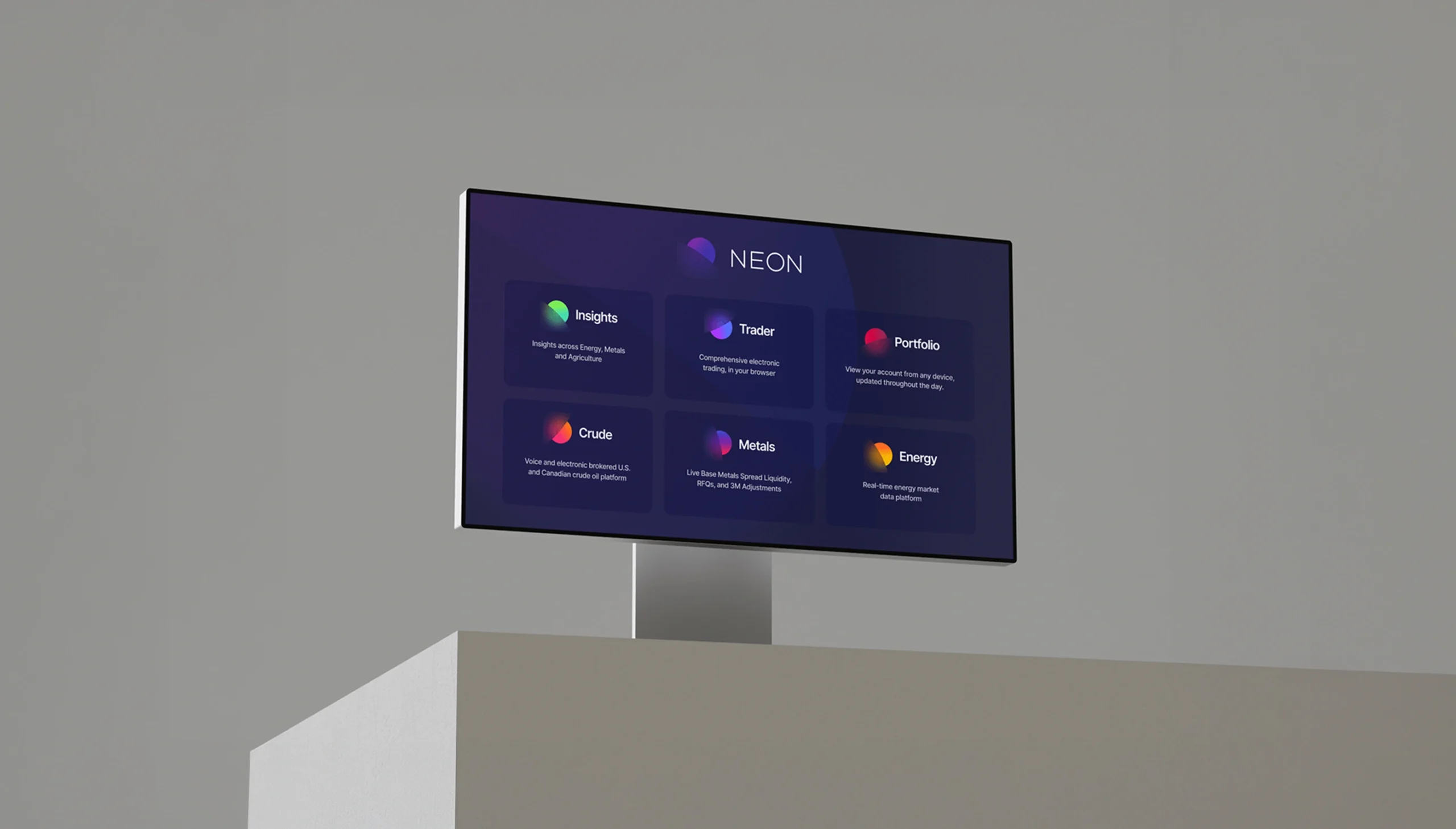
The same approach now reaches digital assets. On October 1, 2026, Marex announced rolling spot crypto exposure through a cash-settled OTC derivative and introduced Neon Crypto. Institutions can take long or short exposure without holding the underlying coins. On October 14, Bitcoin and Ethereum volatility carry indices followed, using Coinbase instruments and independent calculation and administration through MSCI’s Compass business.
For the customer, the convenience is operational. A hedge fund can need execution and clearing without building exchange relationships everywhere it trades. A corporate treasury team can need a hedge that follows its currency exposure rather than a standard contract. Marex supplies expertise and infrastructure around those requirements. The fit depends on the mandate: an off-the-shelf trading account and a negotiated institutional relationship solve different problems.
Follow the transaction
There is a useful constraint here. Combining services reduces work only when information moves reliably between them. A new desk, product or geography introduces its own obligations. The customer benefits when the provider absorbs that complexity and still makes positions, balances and risks legible.
The lesson for other businesses is practical: follow an existing customer’s transaction and look for the next costly problem. That is an editorial reading of Marex’s expansion, rather than a promise that every acquisition creates value. The approach depends on retained expertise, integrated systems and enough capital to support the work. Lose those, and additional services can become additional friction.
For a prospective client, the questions are equally concrete. Which exposure needs managing? Which exchange or counterparty is required? What collateral, liquidity and reporting will the position demand? Marex primarily serves institutional and professional clearing clients. A useful hedge still brings obligations. Like the students deciding how much to bid, the customer needs to understand the commitment behind the answer.