The first Socialite Media client did not arrive through a pitch deck, an ad campaign or a warm introduction from a venture capitalist. The story begins at a small Chicago restaurant, where Holly Sias noticed two things at once: empty seats, and owners too consumed by the restaurant to explain online why anyone should fill them. They needed social media. They did not need another task.
This distinction became the business. Sias had recently earned a master’s degree in journalism from DePaul and thought she had landed the career she wanted. The fit proved wrong. The restaurant visit showed her a different kind of reporting assignment: find the story a business is already living, turn it into material people will notice and keep publishing after the novelty is gone. She formed the idea in late 2019 and launched Socialite Media in June 2020. A first client followed within days.
The timing was terrible in the obvious way. Hospitality businesses were fighting through a pandemic. It was also clarifying. Delivery, reopening and the survival of neighborhood places were being negotiated on phones. A restaurant with no reliable digital voice was not merely unfashionable; it was harder to discover, harder to trust and easier to forget.
The agency’s neatest insight was to treat attention less like an event and more like a utility bill.
One creator. Then another next week.
Influencer campaigns often resemble opening night. Everyone arrives together, the photos pour out, the graph spikes and the room is swept before breakfast. Sias described a different operating principle: “Aiming for constant exposure.” For restaurant clients, that meant roughly one creator collaboration a week, without designing the campaign around a single finish line. A person might notice the first recommendation, recognize the second and finally make a reservation after the third.
The local part matters. A Chicago food creator with a modest audience is not a cut-price celebrity. The creator knows the neighborhood, the commute, the happy-hour ritual and what followers can plausibly do at six o’clock. Socialite Media also tried not to send the same influencer back to the same restaurant for six months to a year. Novel faces kept the recommendation stream from feeling like a house ad.
The company’s 30-day packages begin after a research week; longer contracts add monthly analytics. The loop, not one post, is the product.
Measurement becomes wonderfully literal at a restaurant. Delivery promotions can carry a creator-specific code. Reservations are messier; staff may have to ask guests how they heard about the place. The agency says creator recommendations helped some clients improve happy-hour reservations. It is a useful reminder that “digital” marketing still ends with a person walking through a physical door.
The post is only the visible piece
Today, Socialite Media is a roughly 20-person, woman-owned and women-led agency with a Chicago base and work in markets including Las Vegas and Scottsdale/Phoenix. Its public client roster moves from neighborhood hospitality to national consumer names: Gino’s East, Legal Sea Foods, Hyatt Place, Kindbody, Zing Zang, Rancher Hat Bar and Takis appear among featured work.
The service list is broad because the problem is broad. The agency manages channels and community replies. It organizes creator relationships. It photographs food, products, venues and people; shoots video and drone footage; makes graphics; runs digital ads; supports PR; builds websites; works on SEO; covers events; consults; teaches workshops. The connective tissue is simple: each capability gives a business something worth distributing, and somewhere to distribute it.

Customers buy that work through recurring retainers, custom projects and a la carte services. Public materials describe Basic, Gold and Platinum packages built around 30-day terms. The agency takes a week to study the company and its competitors, then supplies a strategy before the term begins and an analytics overview at the end. Longer, 90-day agreements include monthly reporting. Dollar prices are not published. The more revealing cost is operational: a client must provide product information and photography at the basic level, or pay for a higher-touch team to create it.
A party can be a distribution system
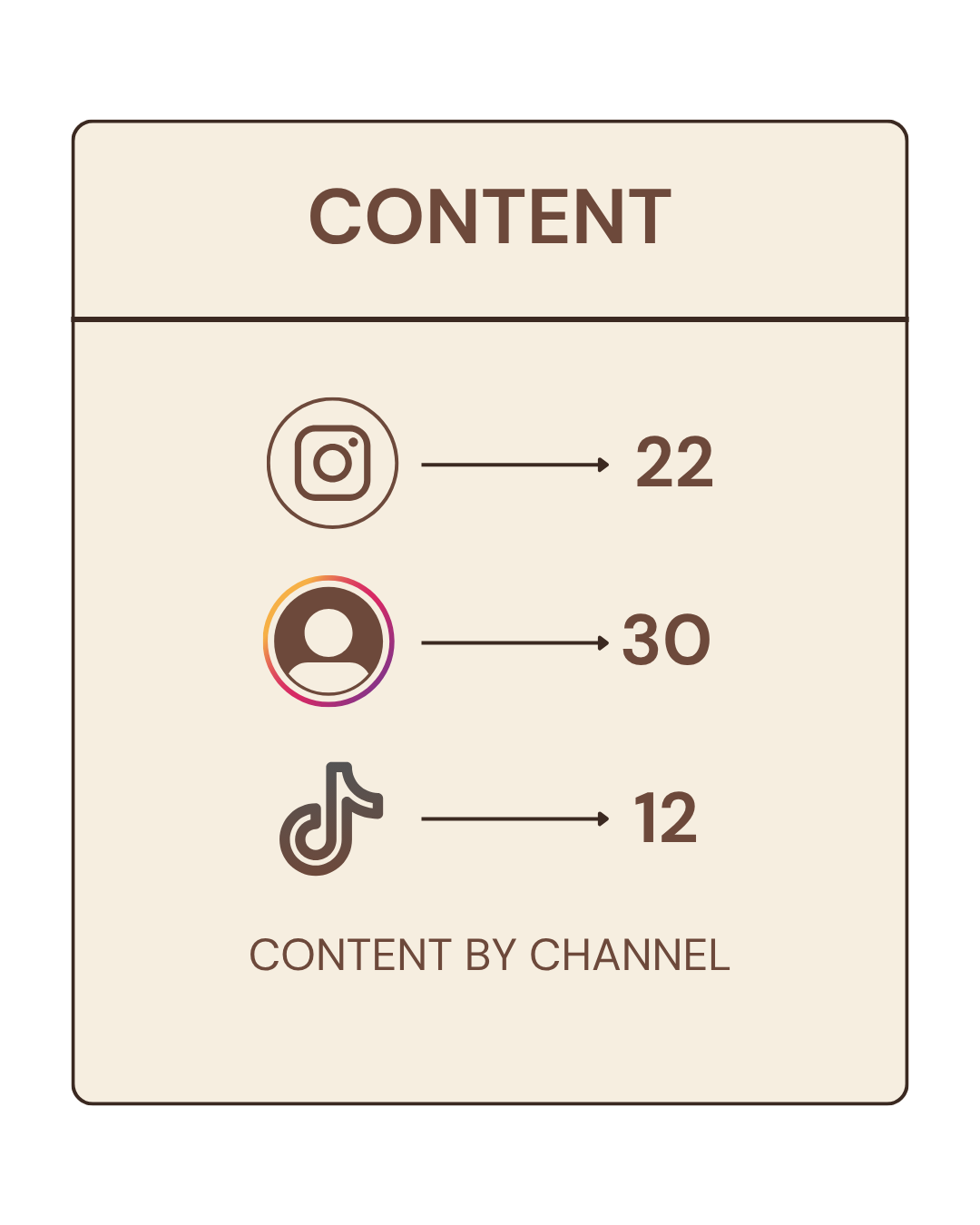
Consider a Takis activation at a Lollapalooza pre-party. Socialite Media brought in 12 creators. They produced real-time Instagram and TikTok material, generating more than 50 placements and over 128,000 impressions. The party was not separate from the campaign. It was the campaign’s factory: one well-designed physical moment, multiplied through a dozen points of view.
Rancher Hat Bar offers another clue. The agency captures custom hat-making, the store atmosphere and customer experience for the brand’s Chicago location. The product is already a performance. Socialite Media’s job is to frame it, preserve it and keep it moving after the customer leaves.
The same logic produced Boss Babes of Business. What began around influencer gatherings expanded into recurring networking events for women founders and local companies, with sponsors, demos, food and panels. The events make community support tangible, but they also reveal the agency’s competitive advantage. A national platform can identify creators by audience size. A local operator knows who should be in the room, which restaurant can host them and why the room will matter next month.
The parts worth stealing
You do not need an agency to borrow the central idea. First, stop asking a single post to do the work of a relationship. Choose a cadence you can sustain. Second, make one real-world activity produce several assets: a demonstration can become short video, still photography, creator material, a customer answer and an email. Third, separate reach from relevance. Ten thousand nearby people with an appetite can be worth more than a million spectators elsewhere. Fourth, build measurement into the invitation. Use a code, a reservation question, a landing page or a specific offer before the content goes live.
This approach is strongest when a business is visual, geographically useful and able to deliver a repeatable customer experience. It is a poorer fit when there is nothing new to show, no staff time to host or approve content, a sales cycle too long for social signals, or a weak product hoping that frequency will impersonate satisfaction.
That last condition is the quiet check on the whole model. Repetition compounds whatever is underneath it. A charming restaurant becomes familiar. A tactile retail experience becomes shareable. An indifferent experience merely becomes familiar more quickly. Socialite Media can supply the calendar, the camera, the creators and the community management. The client still has to supply a reason to return.
Sias’s first restaurant owners were not short on ambition. They were short on hours. Six years later, her agency still sells them the same scarce thing in a more elaborate package: the ability to keep showing up while they are busy doing the work that gives the posts something to say.