A pharmacy benefit manager has a strange job. It negotiates drug prices for the employer paying the bill, yet the employer may struggle to tell which transaction paid the manager. Rebates, pharmacy spreads, specialty channels and guarantees can make a handsome discount look better than the final price. SmithRx founder Jake Frenz chose a less theatrical number to put at the center of his business: the administrative fee.
- SmithRx runs pharmacy benefits for self-insured employers and their members.
- It says it passes through rebates and discounts and earns a disclosed administration fee.
- Its Drug Pathways Engine looks for clinically appropriate lower-cost medicines and sourcing routes; advocates help members make the change.
- Public customer cases report meaningful savings, though results depend on the plan and its starting costs.
The company is an independent pharmacy benefit manager, or PBM. Its clients are employers and health plans paying for prescriptions, often with brokers and third-party administrators in the room. Members see the practical side: a pharmacy network, benefit support, price-search tools and, now, a mobile app. The employer sees claims, rebates and spending decisions. SmithRx sells the proposition that both sides should be able to understand what happened to a prescription.
The bill behind the bill
In a 2018 interview, Frenz explained the commercial design with unusual economy: SmithRx did not make revenue from retail, mail or specialty pharmacy channels and did not keep any rebates. Its revenue, he said, came from the admin fee. That account remains the company's stated model, though individual program contracts can include disclosed fees for certain high-savings transitions. An employer evaluating the promise should read the actual contract and the claim data, not just the slogan.
Why does the distinction matter? Imagine two clinically suitable versions of a medicine. One has a very large sticker price and a very large rebate. The other has a modest price and almost no rebate. A buyer impressed by the rebate alone can buy the more expensive drug. SmithRx argues that the right question is what the plan and member pay after every discount, fee and assistance program. The least glamorous column in the spreadsheet may be the most useful.
Identify a clinically appropriate generic, biosimilar or existing medication.
Compare the final cost across pharmacies, rebates and sourcing routes.
Contact the member and prescriber when a lower-cost choice needs a change.
The company calls this process its Drug Pathways Engine. It analyzes where a prescription can go, while clinical staff and member advocates handle the part no routing table can do: explaining the option, contacting the people involved and preserving access to care. In June 2026, SmithRx retired the older Connect 360 name and grouped its savings and access programs under Drug Pathways. A new label is less interesting than the operational question: can the cheaper route actually get a patient the medicine?
A family illness, then an industry
Frenz's interest in the problem was personal before it was financial. SmithRx says he became a caregiver at 22 while his father had cancer, faced his own cancer diagnosis, and later helped his mother manage specialty medication during a long illness. Those episodes do not prove a business model. They do explain why the person who later worked in healthcare operations at Anthem and Collective Health might become unusually attentive to what happens between a doctor's order and a pharmacy counter.

The early bet was not instantly obvious to everyone. Venrock partner Bryan Roberts told Axios he initially passed on an investment, then reconsidered after SmithRx had won more than 1,000 customers. The company announced more than 1,100 employer clients with its $20 million Series B in March 2022. Venrock later led a $60 million Series C in January 2024. It is a neat reversal: the point that changed an investor's mind was not a slide about disrupting healthcare, but employers buying a different contract.
“The only revenue we make is through our admin fee.”Jake Frenz, 2018 SmithRx interview
The test is a real prescription
SmithRx has assembled options beyond a conventional retail network. It added Mark Cuban Cost Plus Drug Company in 2023, giving members access to eligible low-cost generics through a pharmacy with explicit cost-plus pricing. Amazon Pharmacy became a home-delivery option with upfront copay visibility. Those partnerships are useful only when the math works for a specific drug and the member can use the route. SmithRx itself says savings vary by medication; a member can compare prices in its portal and, where relevant, at the partner pharmacy.
The more revealing examples are customer transitions. At Keystone Cooperative, benefits leaders described a prior arrangement with little visibility into claims and partners' performance. One member, the company says, saw a child's asthma inhaler copay go from $300 a month to $0 after outreach and a different pathway. SmithRx reports more than 40% average savings per member per month for Keystone from the first quarter of 2024 through the third quarter of 2025, and $1.8 million in Drug Pathway savings over that period. These are company-published case figures, not an independent estimate for every employer.
UnitedAg presents a different problem. Its 55,000 members are spread across agricultural communities, where an elegant network map can conceal a long drive to a pharmacy. Before choosing SmithRx, UnitedAg evaluated six PBMs, studied claims and insisted on full rebate pass-through and a clear admin fee. The eventual transition, according to the published case, had 99% continuity of care. The work included multilingual outreach, local pharmacy support and home delivery. It suggests a practical condition for the model: the cheapest pathway is no bargain if the member cannot get there.
A national beverage distributor offers a longer view. SmithRx's 2026 case says its per-member-per-month drug cost stayed more than 35% below the prior arrangement for over three years. The same account mentions a difficult launch and a dedicated support line created in response. That detail deserves attention. A PBM replacement changes cards, pharmacies, forms and familiar routines for real people. Claims software may choose a route in an instant; restoring a missed prescription requires someone to answer the phone.
A smaller number than a discount
SmithRx published a third-quarter 2025 analysis of its manageable therapeutic areas, reporting that its Drug Pathways Engine reduced average monthly cost from $133.08 to $95.46 per member, or $37.61 saved. The biggest reported contribution came from autoimmune treatments. The figures are defined by SmithRx's own categories and population, so they are best read as evidence of its customer experience, not a prediction for a new plan. The company gives the employer enough claim-level visibility, it says, to test the result on its own population.
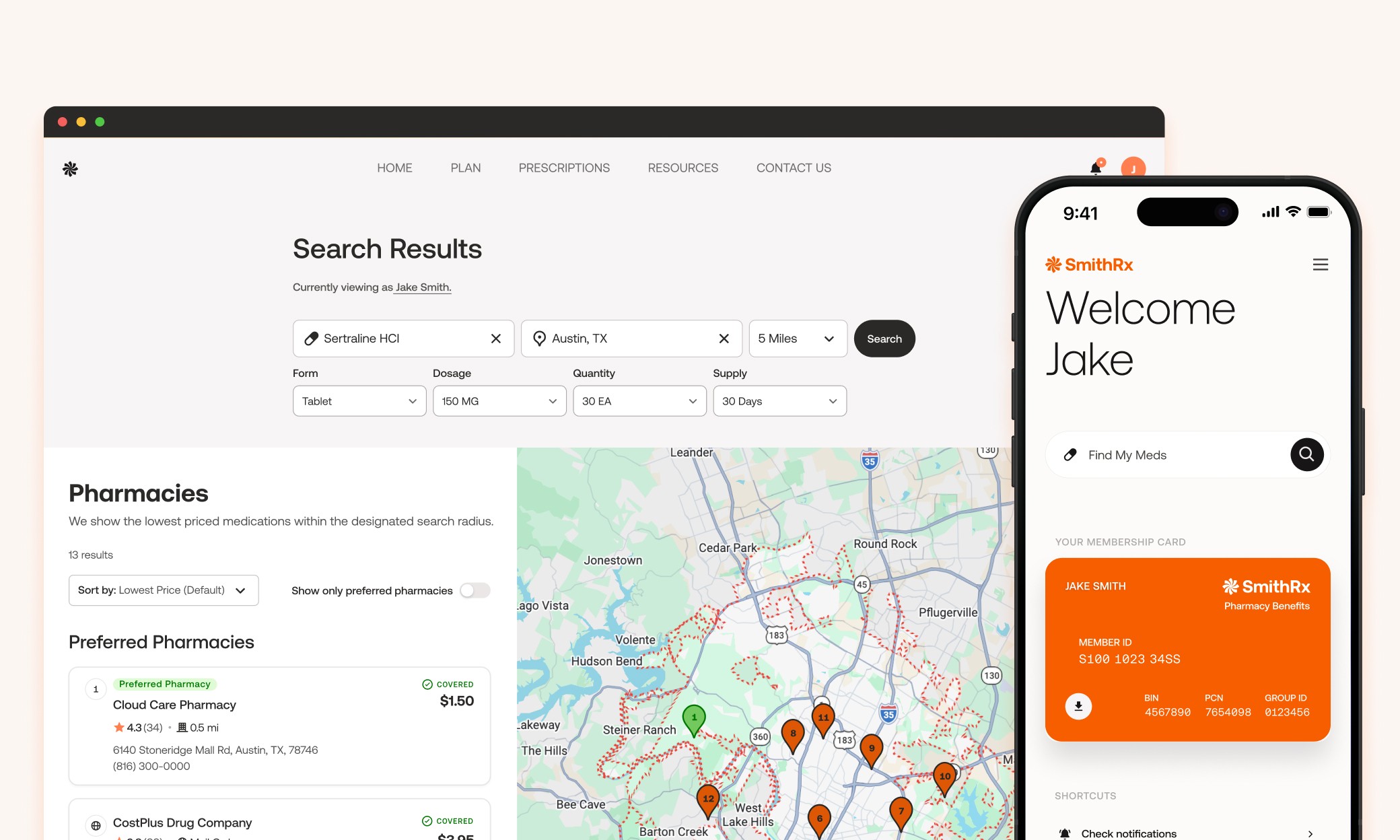
Its consumer tools have also become more ordinary in the best sense. The Member Portal and Find My Meds let eligible members check coverage and compare options. An August 2026 mobile app added a digital ID card, prescription history and plan information; Find My Meds received clearer search and price explanations. No one wants to become an expert in pharmacy reimbursement just to refill a medicine. A price that can be found before the pharmacy counter is a modest, concrete improvement.
SmithRx operates in a market shaped by enormous integrated PBMs, including CVS Caremark, Express Scripts and OptumRx, alongside newer independent competitors. Its argument is not that fees are magically small or every alternative medicine is suitable. It is that an employer should be able to locate the PBM's compensation, compare final drug costs, and see whether a proposed switch worked for members. The repeatable lesson for any benefits buyer is almost embarrassingly plain: ask for the net-cost calculation, the revenue streams, claim-level access and a transition plan for the people taking the drugs.
A pharmacy middleman cannot make medicine simple. It can make its own bill legible. SmithRx has built a company around that smaller promise, and it is a surprisingly large one.