Most founders who sell a company to a name like The Guardian take the win and disappear into advising and angel checks. Rafat Ali did the opposite. In 2008 he sold PaidContent, the site he had built to cover the business of digital media, to Guardian News & Media. Four years later he was back at the starting line with a co-founder, a small pile of angel money, and a bet that one of the largest industries on earth was covered by some of the thinnest journalism. He called the new thing Skift - a Scandinavian word meaning "shift" or "change" - and pitched it, without much modesty, as the Bloomberg of travel.
More than a decade later, that pitch reads less like a slogan and more like a description. Skift is a New York company that sells news, research, marketing services, and conferences to the people who run the travel industry: airline executives, hotel groups, online travel agencies, tourism boards, and the sprawling ecosystem of vendors that serves them. It is not a consumer travel site. You will not find it ranking the best carry-on bags. Its readers are the ones deciding where the planes fly and what the rooms cost.

What it actually doesA trade publication that grew a research desk
Skift started as a newsroom and never stopped being one - the free site at skift.com publishes daily coverage of aviation, lodging, online travel, and tourism. But the newsroom is the front door, not the business. Behind it sit the products that people pay for: Skift Pro, a premium news subscription; Skift Research, a subscription service of deep-dive reports, data sheets, and analyst calls; and a shelf of specialist newsletters read by executives in specific corners of the industry.
The company's clearest tell is its annual output. Every January it publishes Skift Megatrends, a forecast of what will shape travel over the coming year, and through the year it ships its State of Travel research. Operators plan around these documents. When Skift decides a theme matters - live tourism, AI in booking, the limits of growth - the rest of the industry tends to spend the next twelve months arguing about it.
The business modelThree legs, on purpose
Plenty of travel-media outlets have died over the last fifteen years for a simple reason: they sold one thing, advertising, into a market that swings hard with every fuel price and every pandemic. Skift built on three legs instead. Roughly speaking, revenue comes from subscriptions, from branded content and marketing through its in-house studio SkiftX, and from a global events franchise. Branded content has historically been about a third of the business; since around 2018 the company has leaned harder into subscription and reader revenue to steady the whole thing.
Approximate. Skift is privately held and does not publish a line-item breakdown; branded content has been cited at roughly 30% of revenue.
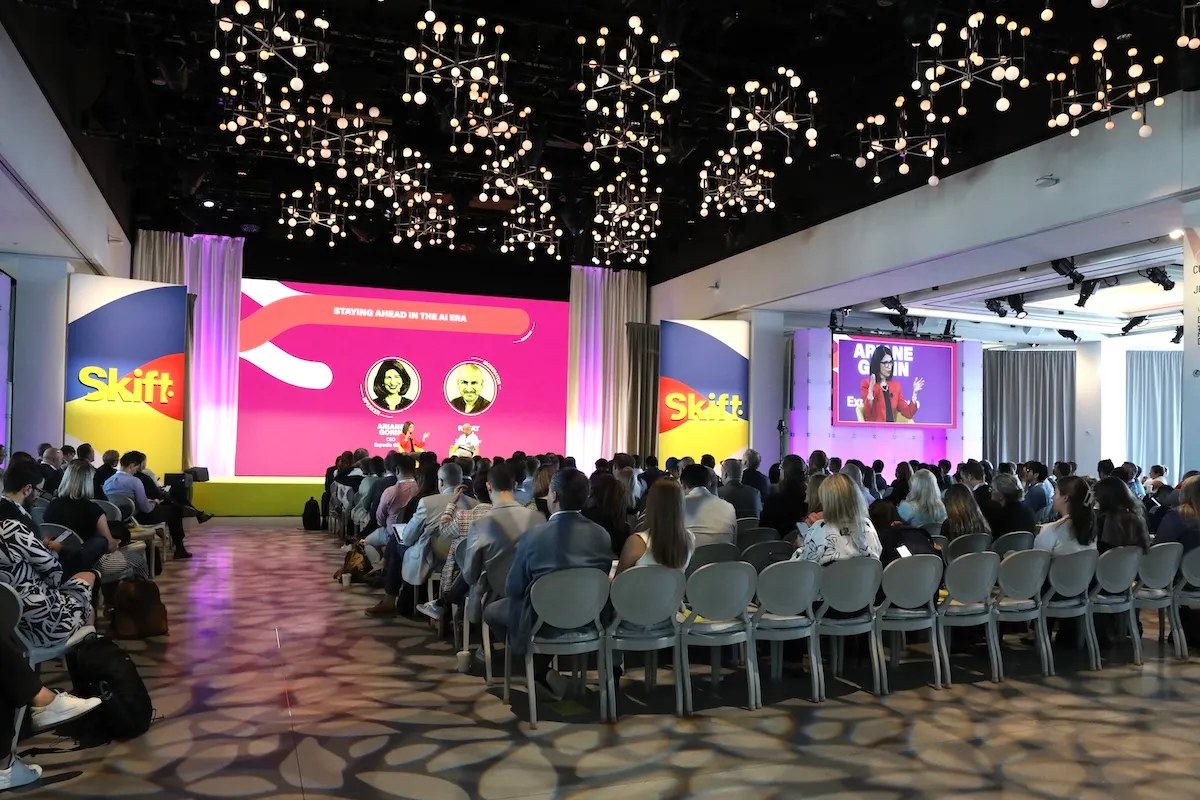
The third leg is the loudest. Since 2014 the Skift Global Forum has grown into the travel industry's marquee executive gathering, with sibling forums that have run in Europe and Asia. The forum is not just a revenue line; it is the flywheel. The research feeds the reporting, the reporting feeds the audience, and the audience shows up in a room that sponsors will pay handsomely to reach.
Who pays for itReaders with budgets, not readers with attention
The single most useful thing to understand about Skift is who it does not chase. It is not optimizing for the largest possible audience. It is optimizing for the audience that controls spending. Skift Global Forum's own figures put more than 70% of attendees at director level or above. That is the entire strategy compressed into one statistic: a smaller room, filled with people who sign contracts.
Its customers are airlines, hotel chains, cruise lines, online travel agencies, destination marketing organizations, national tourism boards, and the technology firms selling into all of them. When those companies want to know what their peers are thinking, or want to reach them, Skift is the intermediary - through a subscription, a research report, a sponsored series, or a badge to the forum.
The one wordHow Skift named a global problem
In 2016, in a short editorial, Ali used a word that had barely existed in English before: overtourism. Skift kept using it, reporting on it, and putting it in front of the industry. Within a few years it had escaped the trade press entirely - into mainstream headlines about Venice, Barcelona, and Amsterdam, and into the vocabulary of the officials writing tourism policy. It is the cleanest example of what Skift sells that isn't a product: the power to frame the conversation an entire industry has with itself.
Growth by acquisitionRolling up the trade press
While much of legacy trade media has shrunk, Skift has been buying. It acquired the aviation newsletter Airline Weekly in 2018, the events-industry publication that became Skift Meetings in 2019, and the long-running hotel newsletter Daily Lodging Report - founded back in 1995 - in 2021. In July 2025 it added Women Leading Travel & Hospitality, a members' organization, and Hospitality.fm, a podcast studio, expanding into community and audio.
The competitionWhere Skift sits
Skift's closest analogues are the travel-research house Phocuswright and its news sibling PhocusWire, the Northstar-owned trade titles led by Travel Weekly, and consumer-leaning outlets like The Points Guy that circle the same industry from a different altitude. What separates Skift is the bundle: few competitors run news, subscription research, a branded-content studio, and a flagship conference under one roof, each one feeding the others.
The next threatWhen the answer engine eats the search box
The risk Skift now reports on is the same one aimed at its own model: AI assistants that answer travel questions before anyone clicks a link. Its response has been to build rather than brace - shipping Ask Skift, an answer engine trained on its own archive of reporting and research. The logic is familiar to anyone who has watched the company work: if the industry is going to ask a machine what happens next, better that the machine be reading Skift.
What a founder can copy from all of this is not the travel angle - it is the shape. Pick an industry too large to ignore and too fragmented to be covered well. Refuse to sell only advertising. Build research people will expense, host the gathering they feel they must attend, and give the whole field a word or two for the things it cannot yet name. Skift did it in travel. The structure is portable.
Quick answersFrequently asked
What does Skift do?
Skift is a travel-industry intelligence and media company. It publishes news and research and runs events and marketing services for professionals across travel, hospitality, and tourism.
Who founded Skift and when?
It was founded in 2012 in New York by Rafat Ali and Jason Clampet. Ali had previously founded PaidContent, sold to The Guardian in 2008.
How does Skift make money?
Three streams: subscriptions (Skift Pro, Skift Research, and specialist newsletters), branded content and marketing via SkiftX, and its global events franchise led by Skift Global Forum.
Did Skift really coin "overtourism"?
Skift popularized the term in a 2016 editorial by Rafat Ali. It has since become standard vocabulary in travel journalism and tourism policy.
What is Skift Global Forum?
It's Skift's flagship annual conference in New York, drawing several hundred senior travel-industry leaders, the majority at director level or above.